|
|
 |


|
|
|
|
|
|
|
|
|
|
|
Felagund
Gondor

Mar 22, 7:21pm
Post #2 of 9
(301 views)
Shortcut
|
My first thought when reading your question was the way Tolkien describes Morgoth, in 'Myths Transformed' (HoMe X).
He [Morgoth] had become absorbed in 'kingship', and though a tyrant of ogre-size and monstrous power, this was a vast fall from even his former wickedness of hate, and his terrible nihilism.
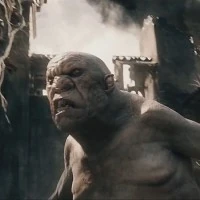
Although 'the fall' appears to have been Tolkien's main point here, we do see the use 'ogre-size' as a means of illustrating scale. If we blend this with the various descriptions of Morgoth in his duel with Fingolfin or when Lúthien and Beren encounter him in Angband, then it appears that 'ogre-size' was huge indeed! Synonymous with 'giant', perhaps?
This doesn't tell us much about a 'species' called 'ogres' though. About as much as I can find in that regard is a reference in The Book of Lost Tales Volume II, where you can track back to drafts that still locate the Valar in a procreative framework. A note to 'The Fall of Gondolin' describes the Balrog Gothmog as "a son of Melko and the ogress Fluithuin". Precisely 'what' Fluithuin is, I don't know and would have to delve deeper – if indeed Tolkien ever clarified. A corrupted Maia, perhaps? There's some other passing ogre references in the The Book of Lost Tales duo, including to 'cannibal-ogres' ('The Tale of Eärendel'), who strike me as less Ainur and more Laistrygonian, the man-eating giants who appear in Homer's Odyssey.
I know that Silvered-glass is a close student of the material from this period of writing and may have thoughts or other references to hand.
Welcome to the Mordorfone network, where we put the 'hai' back into Uruk
|
|
|
CMackintosh
Rivendell
Apr 28, 10:53am
Post #3 of 9
(169 views)
Shortcut
|
|
Ogres = corrupted Maiar's offspring?
[In reply to]
|
Can't Post
|
|
At least that's the conclusion I drew from reading all the various texts. Probably, if corrupted Maiar were used by Melkor to breed orcs and trolls, then tales of giant orcs and trolls that occasionally appear in the HoME series of texts, are probably their offspring.
|
|
|
Otaku-sempai
Immortal

Apr 28, 2:19pm
Post #4 of 9
(165 views)
Shortcut
|
Ogres = corrupted Maiar's offspring?
At least that's the conclusion I drew from reading all the various texts. Probably, if corrupted Maiar were used by Melkor to breed orcs and trolls, then tales of giant orcs and trolls that occasionally appear in the HoME series of texts, are probably their offspring.
Maybe -- that might also explain the Middle-earth origin of giants in general, similar to the Biblical Nephilim. Or maybe giants are physical incarnations of elemental beings.
“Hell hath no fury like that of the uninvolved.” - Jenny Blake Isabella
|
|
|
Maciliel
Valinor

Mon, 9:38pm
Post #5 of 9
(40 views)
Shortcut
|
|
the issue with all the non-valar, non-ainar entities
[In reply to]
|
Can't Post
|
|
the issue with all the non-valar, non-maiar entities is -- are they their own entities, with their own agencies? or are they just very fancy biological puppets?
and what is shelob? she seems to be her own entity.
are there differing levels of agency?
morgoth and sauron cannot create true life, but they can corrupt it.
do their horrible machinations take X amount of "true life" from a corrupted being, and meld it with "true life" from another being, to make a super-creature, like a dragon?
do they take X amount of "true life" from a corrupted being and disperse it amongst an army of (less-powerful) puppets, who have diluted power as individuals, but combined power en masse?
cheers --
..a
aka. fili orc-enshield
+++++++++++++++++++
the scene, as i understand it, is exceptionally well-written. fili (in sort of a callback to the scene with the eagles), calls out "thorRIIIIIIN!!!" just as he sees the pale orc veer in for the kill. he picks up the severed arm of an orc which is lying on the ground, swings it up in desperation, effectively blocking the pale orc's blow. and thus, forever after, fili is known as "fili orc-enshield."
this earns him deep respect from his hard-to-please uncle. as well as a hug. kili wipes his boots on the pale orc's glory box. -- maciliel telpemairo
|
|
|
CuriousG
Half-elven

Tue, 5:11pm
Post #6 of 9
(32 views)
Shortcut
|
|
Definitely agree Shelob has agency
[In reply to]
|
Can't Post
|
|
But how much do Orcs have? Isn't it hard to imagine, credibly, that a bunch of Orcs swear off violence, take up gardening, and move to Hobbiton where they live gently and amicably, and only steal spoons because Lobelia did, and all because they chose to? I would say they couldn't, because they don't have that much agency. They can decide *how* they will maim, kill, plunder, but they can't decide to do anything besides those things.
|
|
|
Maciliel
Valinor
4:50am
Post #7 of 9
(27 views)
Shortcut
|
|
sometimes an orc is just an orc
[In reply to]
|
Can't Post
|
|
this makes sense to me (what you're saying about orcs not being able to decide not to be orcs but having the choice of how to be orcs).
when sauron was vanquished, was he killed? he was diminished, but did some (ineffectual) spark of him remain? do orcs exist without sauron being "alive"? can they exist with a sauron who is diminished? do they all keel over without him?
and what of ogres, trolls, and dragons?
melkor created the dragons, and (iirc) he was cast out of arda altogether. dragons persisted after him. as did trolls.
trolls are not in the same power class as dragons. were they corrupted maiar? i'm assuming any corrupted maia still retained agency after the corruption (which makes sense to me, when considering dragons).
but trolls do not seem maiar-ish to me. maybe there was an uber-maia-troll adam and an uber-maia-troll eve and they spawned all the lesser trolls? so if trolls are not corrupted maiar, how did they retain their "aliveness" after the passing of sauron? if they were just puppets animated by sauron's evilness, wouldn't they keel over when he passed? marionettes whose strings were abruptly clipped?
similar thoughts re ogres, who seem to be a more advanced type of troll. bigger. meaner. (smarter?)
shelob, as always, is in a class by herself.
cheers --
.
aka. fili orc-enshield
+++++++++++++++++++
the scene, as i understand it, is exceptionally well-written. fili (in sort of a callback to the scene with the eagles), calls out "thorRIIIIIIN!!!" just as he sees the pale orc veer in for the kill. he picks up the severed arm of an orc which is lying on the ground, swings it up in desperation, effectively blocking the pale orc's blow. and thus, forever after, fili is known as "fili orc-enshield."
this earns him deep respect from his hard-to-please uncle. as well as a hug. kili wipes his boots on the pale orc's glory box. -- maciliel telpemairo
|
|
|
noWizardme
Half-elven

10:30am
Post #8 of 9
(28 views)
Shortcut
|
By co-incidence I arrived wanting to post something that turns out to be relevant, and wondering where best to put it.
I wanted to quote a Voronwë the Faithful post in this conversation https://thehalloffire.net/...p?t=379&start=20
It's a very fine conversation BTW - started in 2006 ans still seeming to be going strong. I can recommend it.
Okay. The dilemma has been pretty well stated by Prim and Sassy. On the one hand, like Prim I believe that it is absolutely imperative that the Orcs do not have redeemable souls. I believe the whole moral structure of LOTR and indeed all of Tolkien's work collapses like a house of cards if they did. On the other hand, as Sassy demonstrates, the only possible conclusion that one can reach from the full body of Tolkien's work is that the Orcs came from beings that did have souls (fëa), possibly men but also undoubtedly including Elves corrupted and twisted by Melkor (and even possibly some Maian spirits, which she doesn't mention). How then can these two seemingly contradictory points be reconciled? The answer comes from a surprising source. But before I go there I wanted to make another point. There is some precedent in Tolkien's writing for the idea expressed in Myth's Transformed that despite having speech and even cleverness the Orcs possessed no 'rational soul' or fëa. In the chapter "Of the Coming of the Elves" in the Later Quenta Silmarillion (published in Morgoth's Ring) (in what appears in the second paragraph of chapter three of the published Sil) in talking about the Balrogs the word "(ëalar)" appeared after "These were the" and before the word "spirits" with a footnote explaining that this word did not refer to an incarnate spirit, which was "fëa" and that it simply referred to "being". Thus the Balrogs themselves, as powerful as they were, and even being the first ancient spirits that allied themselves with Morgoth, were seen as merely having "being" and NOT having incarnate souls. I believe the explanation that I point to below must apply to them as well. Okay, turning back to the paradox described above. How do I explain how the Orcs could not have incarnate souls when they were derived from beings that did have incarnate souls. I find the answer in, of all places, the Athrabeth. As I have discussed before, one of the key concepts discussed in the commentary and notes that follow the Athrabeth is the idea that "the separation of fëa and hröa is 'unnatural', and proceeds not from the original design but from the 'Marring of Arda', which is due to the operations of Melkor." It is from this concept that I derive my answer to the dilemma. The Orcs originated from the hröar of originally incarnate beings (whether Elves or Men or both, and even as I believe Tolkien suggests at one point in Myths Transformed from some Maian spirits as well) that Melkor managed to separate from their fëar. Like the Balrogs these corrupted beings had "ëalar" or "being" but not "fëar" or souls. They had no wills of their own, but rather were animated by Melkor's own will, and later by Sauron's as Melkor's proxy. They were similar in that way to the beings created by Aulë before Eru took pity on him and them and gave them their own independent wills. This would even explain why, as Prim, pointed out, the Orcs "magically" died when Sauron was destroyed; with no will of their own there was nothing to animate them once Melkor's proxy was destroyed. As for Sassy's final quote, I don't see anything there that is an obstacle to this explanation. If these former Elves were mated with Men, it must have been Men who similarly had been stripped of their fëar (and beasts never had fëar in the first place). As for them going to Mandos and held in prison until the End when they died, that sounds like a reasonable precaution to prevent Melkor from re-animating them and causing even more mischief. As for Saruman breeding Men and Orcs, I don't believe it for a second, and I don't believe that anywhere does it categorically say that he did so; it is only speculation. No, those "half-Orcs" were simply Orcs that Saruman through his dark arts was able to make appear more man-like but still had no fëar of their own. That's my story, and I'm sticking to it. ;) Voronwë the Faithful post in this conversation https://thehalloffire.net/forum/viewtopic.php?t=379&start=20
So that seems to me to be a workable answer -- the best I've seen -- to the whole 'are orcs (or other evil creatures) irredeemably evil issue'. And it interested me not least because a while back (September 2024!) I wrote a long (5-part!) piece on this (starting here, should anyone be interested). But I didn't know about the sources Voronwë the Faithful cites here, or reach that conclusion.
~~~~~~
"I am not made for querulous pests." Frodo 'Spooner' Baggins.
|
|
|
Voronwë_the_Faithful
Valinor
43 mins ago
Post #9 of 9
(11 views)
Shortcut
|
As you can see from that thread, I revisited the subject earlier this year (almost 20 years later), and I have been thinking a lot about the subject. In particular, I have been thinking about how Orcs fit into the interaction of Fate and Free Will in Tolkien's legendarium. There has been a considerable amount of reconsideration of Tolkien's Orcs, particularly by Robert Tally, beginning with his 2010 paper "Let Us Now Praise Famous Orcs: Simple Humanity in Tolkien's Inhuman Creatures" and culminating in his book last year The Mismeasure of Orcs: A Critical Reassessment of Tolkien's Demonized Creatures. And there has been a lot of discussion by various different Tolkien scholars (most prominently Verlyn Flieger), about the roles of Fate and Free Will in Tolkien's legendarium. But I am not aware of any works that connects the two, discussing how the role of the Orcs illuminates how the Marring of Arda by Melkor impacts the complicated interaction of Fate and Free Will.
That might have to change.
'But very bright were the stars upon the margin of the world, when at times the clouds about the West were drawn aside.'
The Hall of Fire
|
|
|
|
|