|
|
 |


|
|
|
|
|
|
|
|
|
|
|
Altaira
Superuser

Mar 11 2008, 1:25am
Post #1 of 49
(5387 views)
Shortcut
|
|
The Mirror of Galadriel 1 - The Fortress of Caras Galadhon
|
Can't Post
|
|
Welcome to this week’s chapter discussion. I’m afraid it’s going to get off to a slow start as I’m still very ill with a coldy, coughy thing (thankfully the sore throat is gone). So, it’s likely to spill over to Saturday. FYI, I’ll be posting primarily in the evenings.
The next leg in the journey of the Fellowship: their stay in Caras Galadhon. But, they’re not there yet, so let’s get this chapter discussion started!
After the group left Cerin Amroth, they came to the outskirts of the city of Caras Galadhon. Tolkien describes it:
“There was a wide treeless space before them, running in a great circle and bending away on either hand. Beyond it was a deep fosse lost in soft shadow, but the grass upon its brink was green, as if it glowed still in memory of the sun that had gone…. They came at last to a white bridge, and crossing found the great gates of the city.”
Not being familiar with the term fosse, I looked it up:
“Fosse: a moat or defensive ditch in a fortification, usually filled with water”
-- Dicitonary.com
Now, I have a confession to make. A most wonderful confession, actually. After reading LOTR so many times I’ve lost count, I realized something new (for me) about the story from this very quote and the definition. Even having browsed “The Atlas of Middle-earth” by the late (and dear) Karen Wynn Fonstad many times, I never realized Caras Galadhon was surrounded by a moat. And, despite Tolkien describing “the great gates of the city,” my astute powers of observation never made the connection that Caras Galadhon is actually a fortress in its own right; a fortress as well thought out and designed as those of Isengard and Minas Tirith. I guess I always imagined it as more of a nice garden with lots of trees. But someone put some serious thought into defending that garden. So, let’s go off on that tangent if we may.
Below is my poor attempt at recreating the picture of Lorien from Karen’s book:

Notice the circular shape of the fortress. Also notice how the road winds half way around the fortress before coming to the gates, then winds through the inner structure before coming to the center (squigly line to the left of Celeborn's Chamber is the road, or path - the squigly line going down to the right is a stream leading to Galadriel's Mirror).
1. This is reminiscent of both Isengard and Minas Tirith. What makes this a good design for a fortress?
2. Karen describes the road as made of stone (as does Tolkien) and the walls made of earth (because they were green). Do you agree about the walls? How about the gates? Tolkien describes them a "tall and strong." Trees are plentiful, but Moria is also nearby. Do you think the gates were made of wood or metal?
3. Karen thought the fosse did not contain water because it was described as "lost in shadow." Do you agree? With water available nearby, why wouldn't it contain water?
4. According to Unfinished Tales, Galadriel and Celeborn settled in Lorien after Sauron made the One Ring, then attacked Eregion and laid waste to it in around 1697 of the Second Age. While some other notable Elf kingdoms were built in caves (Menegroth and Thranduil’s digs), they chose woods. Why do you think they chose woods? Were all the good caves taken?
5. Looking at the map of the area of Lorien, what about it was good defensively? Did it have any vulnerabilities?
6. In 1100 of the Third Age, The Wise discovered that an evil power had moved into Dol Guldur. Dol Guldur is uncomfortably close to Lorien (due east approximately 100 miles). Do you think the fortress of Caras Galadhon was built then? Or, do you think it was there when Celeborn and Galadriel arrived?
7. According to Karen, the walls of Caras Galadhon were approximately 2000 feet in diameter. That almost seems a little small to me according to how I've always imagined it. Does this jive with your own impressions? How do you think she arrived at that size?
There are no right or wrong answers here, so go with your own impressions and imaginations. 

Koru: Maori symbol representing a fern frond as it opens. The koru reaches towards the light, striving for perfection, encouraging new, positive beginnings.
"Life can't be all work and no TORn" -- jflower
"I take a moment to fervently hope that the camaradarie and just plain old fun I found at TORn will never end" -- LOTR_nutcase
TORn Calendar
(This post was edited by Altaira on Mar 11 2008, 1:38am)
|
|
|
Ataahua
Forum Admin
/ Moderator

Mar 11 2008, 4:57am
Post #2 of 49
(4287 views)
Shortcut
|
I, too, hadn't realised there was a water-filled moat ('lost in shadow' doesn't mean it was dry) around Caras Galadhon. Note to self: Check dictionary when I come across unknown words while reading.
What makes this a good design for a fortress?
Well the circular nature of the walls means that the defenders can see the longest stretch possible to either side, whereas a square wall would cut off your vision at the corners and make it (theoretically) easier for enemies to sneak up unseen.
Why do you think they chose woods? Were all the good caves taken?
I wonder if they settled there with the intention of being a thorn in Sauron's side, so that he couldn't move from Mordor without Lothlorien being able to respond quickly?
Hmmm, I wonder how the timing of Lothlorien being settled matches the Dwarves moving into Moria...
Looking at the map of the area of Lorien, what about it was good defensively? Did it have any vulnerabilities?
Dutch Mallorn disease, maybe...
Celebrimbor: "Pretty rings..."
Dwarves: "Pretty rings..."
Men: "Pretty rings..."
Sauron: "Mine's better."
"Ah, how ironic, the addictive qualities of Sauron’s master weapon led to its own destruction. Which just goes to show, kids - if you want two small and noble souls to succeed on a mission of dire importance... send an evil-minded b*****d with them too." - Gandalf's Diaries, final par, by Ufthak.
Ataahua's stories
|
|
|
FarFromHome
Doriath

Mar 11 2008, 9:22am
Post #3 of 49
(4288 views)
Shortcut
|
I had that nasty coldy coughy thing a couple of weeks ago, and it's no fun!
I'd never thought about the details of Caras Galadhon before - I'd received a strong impression of natural beauty combined with strength, but never tried to relate it to real buildings in the real world. But now you come to mention it, I think there are parallels - places I've seen that make my mental image of Caras Galadhon all the more vivid.
1. Notice the circular shape of the fortress. This is reminiscent of both Isengard and Minas Tirith. What makes this a good design for a fortress?
Circles have no obvious weak spots - no corners that are harder to defend because they are tight inside (where the defenders are) but exposed outside. It's also a very natural shape, much more so than something with angles and corners, which is fitting for the Elves. Like Isengard, it seems that Caras Galadhon looks very natural, rather than built. And also like Isengard, it rises as a complete circle from the land around it. Minas Tirith and Helm's Deep, in contrast, being man-made, are much more obviously fortresses, and instead of rising from the land, they back into a cliff.
2. Karen describes the road as made of stone (as does Tolkien) and the walls made of earth (because they were green). Do you agree about the walls? How about the gates? Tolkien describes them a "tall and strong." Trees are plentiful, but Moria is also nearby. Do you think the gates were made of wood or metal?
I'm imagining walls made of ancient, mossy stone, with grassy banks at the bottom and climbers such as ivy thriving there too. I've seen that effect in old buildings preserved in parks and so on, and it seems to fit with the attitude of the Elves of Lothlorien. Likewise, I can imagine gates made of old wood, which also seems to turn green and mossy over the centuries. I suppose in real life such stones and gates would lose their strength, but somehow I think the Elves know how to combine their own work with that of nature to the advantage of both.
3. Karen thought the fosse did not contain water because it was described as "lost in shadow." Do you agree? With water available nearby, why wouldn't it contain water?
I think of it as more like an ancient 'ha-ha', because Caras Galadhon is very garden-like. It's defensive, but not openly so. Caras Galadhon fits right into its landscape, so the fosse should look almost like a natural ditch that does not draw attention to itself (being lost in shadow implies that it is fairly unobtrusive, and also suggests the lack of water, because reflections from the water would prevent the "lost in shadow" effect, I think). However, knowing the Elves' water-management abilities, I imagine the fosse could be filled with water from the stream at need.
4. According to Unfinished Tales, Galadriel and Celeborn settled in Lorien after Sauron made the One Ring, then attacked Eregion and laid waste to it in around 1697 of the Second Age. While some other notable Elf kingdoms were built in caves (Menegroth and Thranduil’s digs), they chose woods. Why do you think they chose woods? Were all the good caves taken?
I'm no expert on M-e history, but as far as I know Thranduil's kingdom, although in caves, was also in a forest. I think the effect of natural caves in a forest and this natural-looking fortress of grassy walls and ditches wouldn't be so very different. Forests were very good places to hide in back then!
5. Looking at the map of the area of Lorien, what about it was good defensively? Did it have any vulnerabilities?
I don't recall seeing a map of the area. Did Tolkien provide one? Just in general, I get the impression that secrecy was its first defence. The fact that there's only one gate, apparently on the side away from the obvious line of approach, makes it both secret and strong. Attackers who had to go around the city to find the weak spot of the gate would surely be seen. And there's a source of water, the most important key to surviving a siege.
6. In 1100 of the Third Age, The Wise discovered that an evil power had moved into Dol Guldur. Dol Guldur is uncomfortably close to Lorien (due east approximately 100 miles). Do you think the fortress of Caras Galadhon was built then? Or, do you think it was there when Celeborn and Galadriel arrived?
Well, if it's like most fortresses in the real world, probably some kind of defensive settlement had been there since prehistory, constantly built over by succeeding generations.
7. According to Karen, the walls of Caras Galadhon were approximately 2000 feet in diameter. That almost seems a little small to me according to how I've always imagined it. Does this jive with your own impressions? How do you think she arrived at that size?
That would make it just over 6000 feet, or not much more than a mile, in circumference. Since the Fellowship arrived on the far side, they had to travel half the circumference. But it seems to take them much longer than it would take to walk half a mile:
"We must go round to the southern side, and the way is not short, for the city is great."
There was a road paved with white stone running on the outer brink of the fosse. Along this they went westward, with the city ever climbing up like a green cloud upon their left; and as the night deepened more lights sprang forth, until all the hill seemed afire with stars.
There's a "a pale evening sky" when they first reach the walls, yet the night has deepened before they arrive. That sounds like at least a half-hour walk, if not more. And that would be at least two miles.
(Love that image of the hill "afire with stars"! We've seen similar images of lights on hillsides before, for example on the approach to Bree, but this one seems very elvish - I think it's because this comparison goes beyond the warmth of firelight, and draws in the image of stars.)
...and the sails were drawn up, and the wind blew,
and slowly the ship slipped away down the long grey firth;
and the light of the glass of Galadriel that Frodo bore
glimmered and was lost.
|
|
|
Tolkien Forever
Mithlond
Mar 11 2008, 3:29pm
Post #4 of 49
(4280 views)
Shortcut
|
|
Many Answers In Unfinished tales
[In reply to]
|
Can't Post
|
|
I think that's a good drawing of that fortress.....
And, we all know Fonstad takes her liberties in many maps/drawings, so who knows if 2000 feet is in her imagination or a fact. It's like Bag End - where does she come up with her drawing? Mere speculation based on some inexact description.
1. I agree with the other respondents who say circular is better than square.
2. It makes sense that the walls are made of earth. The gates, wood. Despite Moria being nearby, there's no indication the Dwarves were close with these Elves. Remember, it says a friendship grew up between the Elves of Hollin & the Dwaeves of Moria that has never been before or since between those two Races.
3. Good point by Fonstad, but under trees, a moat filled with water can easily be 'lost in shadow' too. Nobody says it had to be filled to the brim either. Who knows.
4. Unfinished Tales gives many different stories of what & when Galadriel & Celeborn did what & came to Lorien - nothing is really set in stone. One story says they came there when Amroth fled, right?
It is for certain they never ruled there until Amroth fled in T.A. 1981. By then, we can assume Cerin Amroth was already built. As far as digging in stone, the Elves simply use the greatest natural feature as defense. Here, it is not stone, but huge trees.
5. Lorien's best defense's are that it lies between two rivers & in the woods. Despite being near Dol Guldur, it is across the nearly impassable Anduin. It's biggest detraction is that it is open to attack from Goblin infested Moria.
6. Since the city's name is Cerin Amroth, & Amroth was King in the beginning of the Third Age, I suspect that the fortress was already there.
7. Who knows.
|
|
|
Dreamdeer
Doriath

Mar 11 2008, 5:00pm
Post #5 of 49
(4283 views)
Shortcut
|
“There was a wide treeless space before them, running in a great circle and bending away on either hand. Beyond it was a deep fosse lost in soft shadow, but the grass upon its brink was green, as if it glowed still in memory of the sun that had gone…. They came at last to a white bridge, and crossing found the great gates of the city.” Notice the circular shape of the fortress. Also notice how the road winds half way around the fortress before coming to the gates, then winds through the inner structure before coming to the center (squigly line to the left of Celeborn's Chamber is the road, or path - the squigly line going down to the right is a stream leading to Galadriel's Mirror). 1. This is reminiscent of both Isengard and Minas Tirith. What makes this a good design for a fortress? Circles offer no inroads or place to hide. Thus they were common in early fortifications. However, later builders realized that if you take the opposite tack, and build many dimples into a structure, the enemy finds himself surrounded on three sides by bowmen raining arrows down on him. So, rather than strategic, I would call this an organic shape, irresistable to elves, perhaps reflecting a blind spot. Other options might simply not have occurred to them. 2. Karen describes the road as made of stone (as does Tolkien) and the walls made of earth (because they were green). Do you agree about the walls? How about the gates? Tolkien describes them a "tall and strong." Trees are plentiful, but Moria is also nearby. Do you think the gates were made of wood or metal? Since we're dealing with elves, here, the green walls might have been thorny hedges, made all the more impenetrable by the magic of Nenya. 3. Karen thought the fosse did not contain water because it was described as "lost in shadow." Do you agree? With water available nearby, why wouldn't it contain water? That is, indeed, an odd conclusion. I would have concluded that the fosse was very deep, and the water far below. Nenya is a water-ring, and omitting water where it would customarily flow does not make sense here. 4. According to Unfinished Tales, Galadriel and Celeborn settled in Lorien after Sauron made the One Ring, then attacked Eregion and laid waste to it in around 1697 of the Second Age. While some other notable Elf kingdoms were built in caves (Menegroth and Thranduil’s digs), they chose woods. Why do you think they chose woods? Were all the good caves taken? Elves prefer trees to caves when circumstances allow. Besides, with so many rivers and streams running through Lorien, I see it as a lowlands, without much in the way of outcroppings to build into, sort of in the same sense that houses outnumbered holes in Buckland due to the unsuitability of riverside land for subterranean dwellings. 5. Looking at the map of the area of Lorien, what about it was good defensively? Did it have any vulnerabilities? The rivers act as natural moats, while the trees offer concealment and a high place from which to shoot down on a foe (soldiers generally prefer to fight from high ground than from low ground.) Lorien does however have an exposed flank towards the Dimrill Dale, leaving it particularly vulnerable to attack from Moria. This did not matter when they had allies in Khazad-Dum, but when the orcs took over it made quite a difference. Hence the heavy border guarding. 6. In 1100 of the Third Age, The Wise discovered that an evil power had moved into Dol Guldur. Dol Guldur is uncomfortably close to Lorien (due east approximately 100 miles). Do you think the fortress of Caras Galadhon was built then? Or, do you think it was there when Celeborn and Galadriel arrived? Caras Galadhon might well have started out simply as a community or a tree-house palace, fortified later when the necessity arose. 7. According to Karen, the walls of Caras Galadhon were approximately 2000 feet in diameter. That almost seems a little small to me according to how I've always imagined it. Does this jive with your own impressions? How do you think she arrived at that size? My mind goes into spasms when it tries to fathom numbers.
My website http://www.dreamdeer.grailmedia.com offers fanfic, and message-boards regarding intentional community or faerie exploration.
(This post was edited by Dreamdeer on Mar 11 2008, 5:04pm)
|
|
|
Beren IV
Mithlond

Mar 11 2008, 6:51pm
Post #6 of 49
(4265 views)
Shortcut
|
|
Of course it is a fortress - what else would it be?
[In reply to]
|
Can't Post
|
|
Not to belittle anyone, but as the Galadhrim do have enemies, they will need fortifications. Of course their city is a fortress - just one so pleasant and so hidden that you might not recognize it for one!

1. This is reminiscent of both Isengard and Minas Tirith. What makes this a good design for a fortress?
I agree: a circle provides largest internal area for the smallest perimeter. This means that it can be well-guarded.
2. Karen describes the road as made of stone (as does Tolkien) and the walls made of earth (because they were green). Do you agree about the walls? How about the gates? Tolkien describes them a "tall and strong." Trees are plentiful, but Moria is also nearby. Do you think the gates were made of wood or metal?
The way I see it, everything is made out of wood, including the walls: they are thick thorny hedges that are sturdy enough to climb up from the inside but will not allow you to climb up from the outside. You would need a siege-tower, or to batter them down, to get in unbidden.
3. Karen thought the fosse did not contain water because it was described as "lost in shadow." Do you agree? With water available nearby, why wouldn't it contain water?
I think that it does contain water, just you can't see it because it is dusk.
4. According to Unfinished Tales, Galadriel and Celeborn settled in Lorien after Sauron made the One Ring, then attacked Eregion and laid waste to it in around 1697 of the Second Age. While some other notable Elf kingdoms were built in caves (Menegroth and Thranduil’s digs), they chose woods. Why do you think they chose woods? Were all the good caves taken?
Not necessarily, but trees make a good fortress as well, and Thranduil and Thingol had them in abundance too. A flet on a giant Mallorn is a pretty good defense; I doubt Mallorns are easy to set fire to, and they're too big to easily cut down.
5. Looking at the map of the area of Lorien, what about it was good defensively? Did it have any vulnerabilities?
Yes, magic - and then fire. The walls are pretty near impregnable against anything except being burned, and since Galadriel can surely it rain when she wants, getting them to burn is essentially impossible. You would have to take out Galadriel first. That's what the One Ring is for.
6. In 1100 of the Third Age, The Wise discovered that an evil power had moved into Dol Guldur. Dol Guldur is uncomfortably close to Lorien (due east approximately 100 miles). Do you think the fortress of Caras Galadhon was built then? Or, do you think it was there when Celeborn and Galadriel arrived?
Quite possibly it was "built" then, although I would say rather that it grew, than was built.
I'm sure that the Galadhrim had defenses before then, but maybe not as elaborate.
7. According to Karen, the walls of Caras Galadhon were approximately 2000 feet in diameter. That almost seems a little small to me according to how I've always imagined it. Does this jive with your own impressions? How do you think she arrived at that size?
That is an area of about 1/8 of a square mile, which means that if there are a lot of people in the city, then they must be packed really dense. That said, they do have those mallorns, and they are very tall and probably have people living on multiple levels. In short, it's a modern city with skyscrapers and everything - except that the skyscrapers are made out of living wood and leaves instead of steel, glass, and concrete!
Once a paleontologist, now a botanist, will be a paleobotanist
|
|
|
Aunt Dora Baggins
Elvenhome

Mar 11 2008, 7:03pm
Post #7 of 49
(4289 views)
Shortcut
|
that it was only after many readings and a couple of decades that I actually paid attention to the detail of the moat and the gate. I think I was influenced too early by this:
Lothlorien
It was interesting to read the description more slowly a few years ago and have my mental image change suddenly after so long.
~~~~~~~~~~~~~~~~~~~~~~~~~~~~~~~~~~~~~~~~~~~~~~
"For DORA BAGGINS in memory of a LONG correspondence, with love from Bilbo; on a large wastebasket. Dora was Drogo's sister, and the eldest surviving female relative of Bilbo and Frodo; she was ninety-nine, and had written reams of good advice for more than half a century."
~~~~~~~~~~~~~~~~~~~~~~~~~~~~~~~~~~~~~~~~~~~~~~
"A Chance Meeting at Rivendell" and other stories
leleni at hotmail dot com
~~~~~~~~~~~~~~~~~~~~~~~~~~~~~~~~~~~~~~~~~~~~~~
|
|
|
a.s.
Doriath

Mar 11 2008, 9:02pm
Post #8 of 49
(4261 views)
Shortcut
|
|
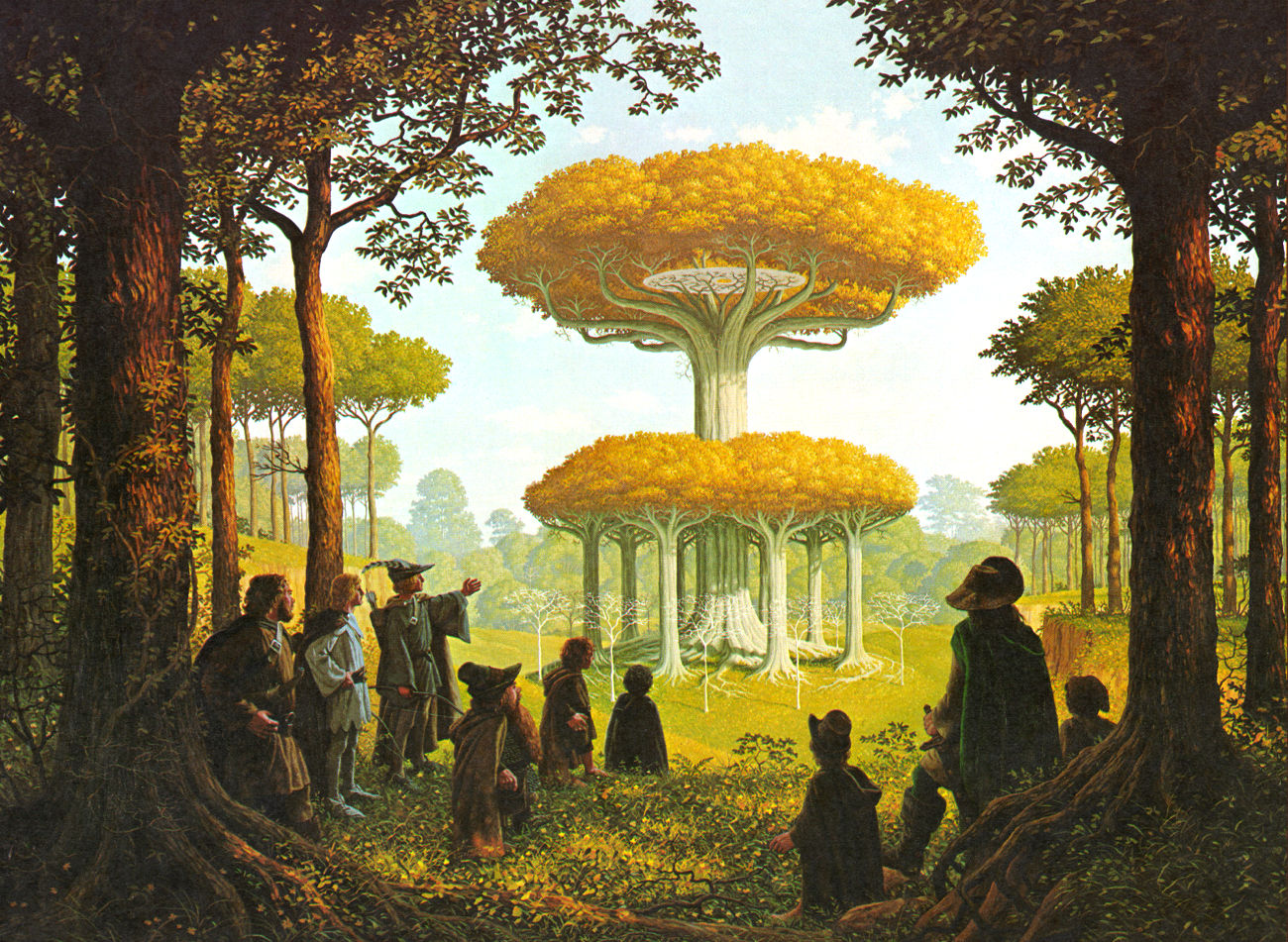
ack!! The Mushroom Cloud of Lorien!!
[In reply to]
|
Can't Post
|
|
I still have shivers about that picture!!

a.s.
"an seileachan"
"Good night, little girls, thank the Lord you are well!
Now go to sleep" said Miss Clavel.
And she turned out the light and shut the door,
And that's all there is. There isn't any more.
|
|
|
ArathornJax
Nargothrond

Mar 11 2008, 9:15pm
Post #9 of 49
(4263 views)
Shortcut
|
1. This is reminiscent of both Isengard and Minas Tirith. What makes this a good design for a fortress?
Here I see a natural place for a motte and bailey castle. A circle is not the best for defense because with angles you can bring more archers to bear on the enemy. That is why the Motte and Bailey gave way later to more elaborate designs in fortifications. I would guess thought that this shape was selected because this then is what was natural to some degree and the elves chose to simply build up on it. It could also be why there were no stone structures on it, as artificial mounds do not support stone structures (thus part of the mound could have been raised artificially by the elves). It could also depend on when it was built as the elves of Lorien that departed the great journey may not have had as great a knowledge in fortifications. Then again, the Noldor build Gondolin in a circle, Amon Sul was a circle, Edoras, Helm's Deep (a circle fortification with a wall extending out), the Morannon was defended in two circles, Tol Siron were all built in a circle shape.
I guess this picture formed my image of a Motte and Bailey
http://www.tolkien.cz/galerie/flotr/444.jpg
2. Karen describes the road as made of stone (as does Tolkien) and the walls made of earth (because they were green). Do you agree about the walls? How about the gates? Tolkien describes them a "tall and strong." Trees are plentiful, but Moria is also nearby. Do you think the gates were made of wood or metal?
I would opt for wood based on my description of a large raised mound, similar to a motte and bailey castle. The wood would not be suffer from decay as Galadriel would have preserved (and this explains why when unkept, the fortification began to disappear by FA 120 after Galadriel had departed). Since the wood had not been subject to decay, vegetation would have overgrown it, making it look natural to some degree.
On the gates, I could go with mithral gates since the city was probably built before the Balrog was released by Durin's folks, or I could go with reinforced wood that is very thick.
3. Karen thought the fosse did not contain water because it was described as "lost in shadow." Do you agree? With water available nearby, why wouldn't it contain water?
Not a big issue either way for me. If the angle from the base was steep, it is the angle that is defensive, while water may only delay the enemy while the fill it up to bring up siege equipment to make it over or through the walls.
4. According to Unfinished Tales, Galadriel and Celeborn settled in Lorien after Sauron made the One Ring, then attacked Eregion and laid waste to it in around 1697 of the Second Age. While some other notable Elf kingdoms were built in caves (Menegroth and Thranduil’s digs), they chose woods. Why do you think they chose woods? Were all the good caves taken?
Not sure if there were caves in Lothlorien? The location of Caras Galadhon was strategic in the sense that it allowed some communication to the outside world while watching Dol Guldur. The big issue just may be that the Silvan Elves had settled there (Amroth and his father Amdir) and there simply were not any caves geographically speaking.
5. Looking at the map of the area of Lorien, what about it was good defensively? Did it have any vulnerabilities?
Plenty to be worried about. They could face an attack from Moria and from Dol Guldur at the same time. Also, they had a large area of woods to defend. Natural defenses were the Angle were the Celebrant and Anduin met and this allowed some barrier for forces to cross. Finally, as has been mentioned, it would take Sauron himself coming to face Galadriel before Lorien would have fallen, but fall it will if the quest fails.
6. In 1100 of the Third Age, The Wise discovered that an evil power had moved into Dol Guldur. Dol Guldur is uncomfortably close to Lorien (due east approximately 100 miles). Do you think the fortress of Caras Galadhon was built then? Or, do you think it was there when Celeborn and Galadriel arrived?
I believe the fortress was built prior to the arrival of Celeborn and Galadriel. It may have been reinforced during their time, but I believe the elves of Lorien had already made a defensive site here.
7. According to Karen, the walls of Caras Galadhon were approximately 2000 feet in diameter. That almost seems a little small to me according to how I've always imagined it. Does this jive with your own impressions? How do you think she arrived at that size? My son has my Atlas so I can't look at her figures but I agree that this seems somewhat small. Then again as Beren IV has shared, the city did have a vertical dimension. I guess if I had the time and I knew the average diameter of the mallorn's I could compute how many could fit in that area and then based on height, how many flats could be there.
I also like Ted Nasmith's painting.
http://slavs.org.ua/...t_caras_galadhon.jpg
" . . . (we are ) too engrossed in thinking of everything as a preparation or training or making one fit -- for what? At any minute it is what we are and are doing, not what we plan to be and do that counts."
J.R.R. Tolkien in his 6 October 1940 letter to his son Michael Tolkien.
(This post was edited by ArathornJax on Mar 11 2008, 9:23pm)
|
|
|
Ataahua
Forum Admin
/ Moderator
Mar 11 2008, 11:13pm
Post #10 of 49
(4235 views)
Shortcut
|
Robin Hood pointing the way.
Celebrimbor: "Pretty rings..."
Dwarves: "Pretty rings..."
Men: "Pretty rings..."
Sauron: "Mine's better."
"Ah, how ironic, the addictive qualities of Sauron’s master weapon led to its own destruction. Which just goes to show, kids - if you want two small and noble souls to succeed on a mission of dire importance... send an evil-minded b*****d with them too." - Gandalf's Diaries, final par, by Ufthak.
Ataahua's stories
|
|
|
Darkstone
Elvenhome

Mar 11 2008, 11:16pm
Post #11 of 49
(4261 views)
Shortcut
|
1. This is reminiscent of both Isengard and Minas Tirith. What makes this a good design for a fortress?
The wall is curved. Plus there’s all those 300+ foot firing platforms covering all sides.
2. Karen describes the road as made of stone (as does Tolkien) and the walls made of earth (because they were green). Do you agree about the walls?
I pictured the walls as like the hedgerows of northern France: an earthen wall of about 10 feet high topped with a thick impenetrable row of bushes and trees. Thus the wall would be thickly interwoven with roots. The only way for an orc to get through is to use a specially modified Sherman tank. And I think making one of those beauties is beyond the capability of even Saruman’s clockwork orange mind.
How about the gates?
It said the walls overlapped, so I pictured the walls as making the first bit of a spiral, like a curly Q french fry, with the gate set perpendicular to the walls rather than set directly into the walls.
Tolkien describes them a "tall and strong." Trees are plentiful, but Moria is also nearby. Do you think the gates were made of wood or metal?
I suspected they were “tall and strong” trees, especially since they were “hung with many lamps”. I’d supposed the Elves could ask the trees to sort of bend out of the way or something.
3. Karen thought the fosse did not contain water because it was described as "lost in shadow." Do you agree?
Dunno if that’s proof enough.
With water available nearby, why wouldn't it contain water?
With a wet moat you have mosquitoes and other disease vectors. Plus a wet moat needs a lot more maintenance than a dry moat. You have to drain a wet moat to keep it dredged and to cut down vegetation. With a dry moat you can just get straight to shoveling and cutting.
On the other hand, if the wall is a hedge, then all those plant roots are very thirsty, so you have to have some sort of water flow to keep them happy.
With ample water nearby I’d say Galadriel keeps the level of the water in the moat optimally adjusted to suit immediate needs. Surely if Elrond can make the Loudwater rise and fall, and Treebeard can divert the Isen, then Galadriel can do whatever she wants with a mere moat.
4. According to Unfinished Tales, Galadriel and Celeborn settled in Lorien after Sauron made the One Ring, then attacked Eregion and laid waste to it in around 1697 of the Second Age. While some other notable Elf kingdoms were built in caves (Menegroth and Thranduil’s digs), they chose woods. Why do you think they chose woods?
The other Elves wouldn’t let them in their caves.
Were all the good caves taken?
Well, they just stopped and settled where they were. Mainly because they didn’t want to cross the mountains. Why? I don’t know. Maybe they were afraid of Caradhras.
5. Looking at the map of the area of Lorien, what about it was good defensively?
Dense woods like the Ardennes. And the Mallorn trees on top of the hedgerow walls would make excellent parapets for archers.
Did it have any vulnerabilities?
The bad thing it was split in the middle by a river. And it was surrounded on all sides by Dwarves, Beornings, Orcs, Wargs, Goblins, Giant Spiders, Rohirrim, Ents, and mean mountains like Redhorn. And if you want to cross the mountains you either go through Rivendell and Mirkwood, or Lorien and Hollin. Either way, the Elves are in the way.
6. In 1100 of the Third Age, The Wise discovered that an evil power had moved into Dol Guldur. Dol Guldur is uncomfortably close to Lorien (due east approximately 100 miles). Do you think the fortress of Caras Galadhon was built then?
Nope.
Or, do you think it was there when Celeborn and Galadriel arrived?
Absolutely! It’s a hill!! Start digging at the top of any hill on earth and odds are you’ll hit the ruins of some sort of fortification if not a city. And if there’s a river close by it becomes a certainty.
7. According to Karen, the walls of Caras Galadhon were approximately 2000 feet in diameter.
And the trees they lived in were at a minimum over 300 feet tall.
That almost seems a little small to me according to how I've always imagined it.
Picture over 3 million square feet covered with apartment buildings that are at least 25 stories tall.
Does this jive with your own impressions?
This is the Royal Palace. There’s probably peasant Elves living just outside the walls, and other small villages here and there throughout Lothlorien.
How do you think she arrived at that size?
Ouija board. But I’d never trust a spirit of one.
There are no right or wrong answers here, so go with your own impressions and imaginations.
At this stage of my life being “not wrong” feels just as good as being "right".
******************************************
The audacious proposal stirred his heart. And the stirring became a song, and it mingled with the songs of Gil-galad and Celebrian, and with those of Feanor and Fingon. The song-weaving created a larger song, and then another, until suddenly it was as if a long forgotten memory woke and for one breathtaking moment the Music of the Ainur revealed itself in all glory. He opened his lips to sing and share this song. Then he realized that the others would not understand. Not even Mithrandir given his current state of mind. So he smiled and simply said "A diversion.”
(This post was edited by Darkstone on Mar 11 2008, 11:18pm)
|
|
|
Menelwyn
Nargothrond

Mar 11 2008, 11:33pm
Post #12 of 49
(4229 views)
Shortcut
|
My Middle-earth geography is probably not what it should be. And my abilities at defensive military strategies less so. But here goes anyway.
1. This is reminiscent of both Isengard and Minas Tirith. What makes this a good design for a fortress?
Well, in addition to what others have said, if you've got a big tower in the middle of your fortress it's convenient to be able to see around 360 degrees. And you can easily defend in all directions if needed. I think flets in mallorns would certainly qualify as towers.
3. Karen thought the fosse did not contain water because it was described as "lost in shadow." Do you agree? With water available nearby, why wouldn't it contain water?
I never paid enough attention to the fosse. But it would make sense to me for it to contain water. A lot of the other great Elven fortresses feature(d) water as part of their defense. Menegroth had a river, Nargothrond had a river, Rivendell has a river. Considering that Galadriel has the Ring of Water, it would really make sense for her to incorporate that. Considering what Elrond is able to do with water, Galadriel must surely be able to muster water into some pretty amazing defenses.
5. Looking at the map of the area of Lorien, what about it was good defensively? Did it have any vulnerabilities?
It does have its good points. The Anduin is a fairly decent defense, not easily forded. Look at how long Gondor was able to hold Mordor at the line of the Anduin. I would think that being much further from Mordor, and considering whatever "magical" defenses Galadriel could accomplish, the Galadhrim should have been able to hold that border against all but the most determined invasion. I would be more concerned about the north/north-east region, which seems completely unprotected. Fortunately there aren't any major enemies in that region, and Sauron never tried to attack from Dol Guldur by crossing Anduin to the north then circling around to Lorien's north border. On the south we have the River Celebrant, never crossed by an enemy (including the orcs out of the Misty Mountains who fought at the Field of Celebrant, who admittedly were not interested in attacking Lorien). In the northwest there is the section of Lorien that borders the Misty Mountains, and which is pretty much the only path someone can take either out of the Pass of Caradhras or out of Moria. Dangerous if the orcs ever tried to invade by that route, but one must imagine those regions as heavily guarded, as indeed seems suggested when the Fellowship first reaches Lothlorien and encounters Haldir's troop.
6. In 1100 of the Third Age, The Wise discovered that an evil power had moved into Dol Guldur. Dol Guldur is uncomfortably close to Lorien (due east approximately 100 miles). Do you think the fortress of Caras Galadhon was built then? Or, do you think it was there when Celeborn and Galadriel arrived?
I would guess the fortress was built earlier. No good reason for me to think this, except that the Elves aren't idiots, and having a fortress somewhere in your country is a good idea. And yeah, Dol Guldur is uncomfortably close, but again, any invasion force would have to get across Anduin, not an easy task.
7. According to Karen, the walls of Caras Galadhon were approximately 2000 feet in diameter. That almost seems a little small to me according to how I've always imagined it. Does this jive with your own impressions? How do you think she arrived at that size?
Yeah, it feels small to me. But compared with other places in Fonstad's own atlas, it's not all that small. Smaller, yes. But not tiny. For instance, she suggests that the "the breadth of [Minas Tirith] would have averaged 3100 feet." That may be an average but it can't get all that much bigger. The hill at Edoras seems of similar size. The Ring of Isengard is probably over 4500 feet in diameter, which seems to be very large. At its widest point, the valley of Rivendell is around 1500 feet. Even granting that these differences in diameter correspond to significantly larger differences in area, Caras Galadhon doesn't sound too terribly small. And considering that it's a fair bet that the population of Caras Galadhon is smaller than (say) that of Minas Tirith, maybe this isn't ridiculous. And I wouldn't be surprised if many of the Elves don't live inside Caras Galadhon proper, but rather in the surrounding areas.
|
|
|
Bladorthin
Lindon

Mar 11 2008, 11:41pm
Post #13 of 49
(4243 views)
Shortcut
|
|
Have never really though about it
[In reply to]
|
Can't Post
|
|
But here's my impression Welcome to this week’s chapter discussion. I’m afraid it’s going to get off to a slow start as I’m still very ill with a coldy, coughy thing (thankfully the sore throat is gone). So, it’s likely to spill over to Saturday. FYI, I’ll be posting primarily in the evenings. The next leg in the journey of the Fellowship: their stay in Caras Galadhon. But, they’re not there yet, so let’s get this chapter discussion started! After the group left Cerin Amroth, they came to the outskirts of the city of Caras Galadhon. Tolkien describes it:
“There was a wide treeless space before them, running in a great circle and bending away on either hand. Beyond it was a deep fosse lost in soft shadow, but the grass upon its brink was green, as if it glowed still in memory of the sun that had gone…. They came at last to a white bridge, and crossing found the great gates of the city.” Not being familiar with the term fosse, I looked it up:
“Fosse: a moat or defensive ditch in a fortification, usually filled with water”
-- Dicitonary.com Now, I have a confession to make. A most wonderful confession, actually. After reading LOTR so many times I’ve lost count, I realized something new (for me) about the story from this very quote and the definition. Even having browsed “The Atlas of Middle-earth” by the late (and dear) Karen Wynn Fonstad many times, I never realized Caras Galadhon was surrounded by a moat. And, despite Tolkien describing “the great gates of the city,” my astute powers of observation never made the connection that Caras Galadhon is actually a fortress in its own right; a fortress as well thought out and designed as those of Isengard and Minas Tirith. I guess I always imagined it as more of a nice garden with lots of trees. But someone put some serious thought into defending that garden. So, let’s go off on that tangent if we may. Below is my poor attempt at recreating the picture of Lorien from Karen’s book: Notice the circular shape of the fortress. Also notice how the road winds half way around the fortress before coming to the gates, then winds through the inner structure before coming to the center (squigly line to the left of Celeborn's Chamber is the road, or path - the squigly line going down to the right is a stream leading to Galadriel's Mirror). 1. This is reminiscent of both Isengard and Minas Tirith. What makes this a good design for a fortress? I must say, there is much to reccommend the use of such a design. No weaknessess to cover, no blind areas, easily constructed, etc. However, there are no great strengths to its design either. True, a haphazard, angular wall construction would be more difficult to defend in some areas, but , if constructed properly, could provide a far more effective defense. Certain benefits to this design are mentioned by others. Really, the circle is neither a great strength, nor a gret weakness. It is possible the elves were targeting precisely this. I am of the mind that a design that, under some circumstances, would be excellent, under others would be a hinerance. More clealy, with great strength comes great weakness, to act as a counterbalance. 2. Karen describes the road as made of stone (as does Tolkien) and the walls made of earth (because they were green). Do you agree about the walls? How about the gates? Tolkien describes them a "tall and strong." Trees are plentiful, but Moria is also nearby. Do you think the gates were made of wood or metal? Metal. Having had good relations with the dwarves (as I think was stated, somewhere), it is possible that the gates were even constructed of Mithril. Whoever has advanced the theory of wooden gates being the entrance into Caras Galadhon implies a naivette in the elves that they certainly did not possess. It is absurd to suppose that the elves, for the sake of artistry, would abandon reasonable convention in an ever darkening World. And in the case of Galadriel, I think we are mistaking the kind of power she would wield. It would manifest itself in far subtler (yet more profound) ways than that of strengthening gates, and making walls impregnable. The idea that the power of the Rings and their bearers together would influnce tangibly (in a hokey modern fantasy kind of way) the around them is a purely modern idea of "Magic", and one Tolkin absolutely did not intend to convey. 3. Karen thought the fosse did not contain water because it was described as "lost in shadow." Do you agree? With water available nearby, why wouldn't it contain water? Why is this important? Lets not try to "can" the imaginative process! 4. According to Unfinished Tales, Galadriel and Celeborn settled in Lorien after Sauron made the One Ring, then attacked Eregion and laid waste to it in around 1697 of the Second Age. While some other notable Elf kingdoms were built in caves (Menegroth and Thranduil’s digs), they chose woods. Why do you think they chose woods? Were all the good caves taken? This would imply illogical naivette in the elves (something I am opposed to several paragraphs up) but perhaps they felt it necessary to defend one of the last remnents of the forests of the first age. Actually, I do not recall ever hearing of the origin of the Mallorn trees. Moving on. Maybe the location was central. The theory has been advanced that the elves intended to keep an eye on th goings-on in this region of the World. After the fall of Khazad-Dum, and the arrival of the Necromancer, this became still more imperative. And, initiall, they would have had contact with the Moria Dwarves. Maybe they had formed some kind of alliance, mutually profitable. The list of ideas is endless. And endless is a bit long for a slow (one finger, actually) typist. Thus, I conclude. Tolkien wanted it the way he had it,and we're all here because of it. What more is there to discuss? 5. Looking at the map of the area of Lorien, what about it was good defensively? Did it have any vulnerabilities? Trees, cover, density of foliage, all provide good strategic advantages. Plus the combat abilities of the elves. On the other side, Moria and Dol Guldor.
6. In 1100 of the Third Age, The Wise discovered that an evil power had moved into Dol Guldur. Dol Guldur is uncomfortably close to Lorien (due east approximately 100 miles). Do you think the fortress of Caras Galadhon was built then? Or, do you think it was there when Celeborn and Galadriel arrived? Considering Galadriel and Celeborn moved in directly after the forging of the Ring, they built a fortress in Lorien on the spot, if there wasn't one already. 7. According to Karen, the walls of Caras Galadhon were approximately 2000 feet in diameter. That almost seems a little small to me according to how I've always imagined it. Does this jive with your own impressions? How do you think she arrived at that size? Caras Galadhon is larger than 2,000 ft in diameter. No more need be said on the subject. I haven't the slightest idea how this inividual coms up with this stuff. Food for thought, this???? There are no right or wrong answers here, so go with your own impressions and imaginations.
Still round the corner there may wait
A new road or a secret gate;
And though I oft have passed them by,
A day will come at last when I
Shall take the hidden paths that run
West of the Moon, East of the Sun.
-Frodo Baggins, ROTK, The Grey Havens
|
|
|
N.E. Brigand
Gondolin

Mar 12 2008, 2:45am
Post #14 of 49
(4257 views)
Shortcut
|
|
Two miles would make for a very brisk half-hour walk.
[In reply to]
|
Can't Post
|
|
Walking at four miles per hour feels like racing along, in my experience. Two-and-a-half miles each hour is a comfortable walking pace (and hobbits have short legs, too). So call that the circumference, meaning the city is eight tenths of a mile across.
<><><><><><><><><><><><><><><><>
We're discussing The Lord of the Rings in the Reading Room, Oct. 15, 2007 - Mar. 22, 2009!
Join us Mar. 10-16 for "The Mirror of Galadriel".
|
|
|
N.E. Brigand
Gondolin
Mar 12 2008, 2:50am
Post #15 of 49
(4244 views)
Shortcut
|
I find that Fonstad explains most of her decisions in her essays and notes, so that even where I disagree with her conclusions, I must allow that they are not arbitrary.
Since the city's name is Cerin Amroth, and Amroth was King in the beginning of the Third Age, I suspect that the fortress was already there.
Cerin Amroth is where they spent the afternoon; this city is Calas Galadhon.
<><><><><><><><><><><><><><><><>
We're discussing The Lord of the Rings in the Reading Room, Oct. 15, 2007 - Mar. 22, 2009!
Join us Mar. 10-16 for "The Mirror of Galadriel".
|
|
|
N.E. Brigand
Gondolin
Mar 12 2008, 2:53am
Post #16 of 49
(4233 views)
Shortcut
|
<><><><><><><><><><><><><><><><>
We're discussing The Lord of the Rings in the Reading Room, Oct. 15, 2007 - Mar. 22, 2009!
Join us Mar. 10-16 for "The Mirror of Galadriel".
|
|
|
N.E. Brigand
Gondolin
Mar 12 2008, 3:00am
Post #17 of 49
(4271 views)
Shortcut
|
And not the city presently under discussion. The description that (sort of) fits that picture is this one, from the previous chapter:
To the left stood a great mound, covered with a sward of grass as green as Spring-time in the Elder Days. Upon it, as a double crown, grew two circles of trees: the outer had bark of snowy white, and were leafless but beautiful in their shapely nakedness; the inner were mallorn-trees of great height, still arrayed in pale gold. High amid the branches of a towering tree that stood in the centre of all there gleamed a white flet.
I think the Hildebrandts overdo the contrast between the outer and inner ring of trees. Among other things.
<><><><><><><><><><><><><><><><>
We're discussing The Lord of the Rings in the Reading Room, Oct. 15, 2007 - Mar. 22, 2009!
Join us Mar. 10-16 for "The Mirror of Galadriel".
|
|
|
N.E. Brigand
Gondolin
Mar 12 2008, 3:17am
Post #18 of 49
(4227 views)
Shortcut
|
Whoever has advanced the theory of wooden gates being the entrance into Caras Galadhon implies a naivette in the elves that they certainly did not possess.
You may be right, but why didn't Tolkien tell us what the walls and gates were made of, or whether there was water in the moat?
Actually, I do not recall ever hearing of the origin of the Mallorn trees.
In LotR, Tolkien doesn't say. In Unfinished Tales, Tolkien says that they came from Aman, by way of Númenor and Lindon.
Tolkien wanted it the way he had it,and we're all here because of it. What more is there to discuss?
How about: what is it about Tolkien's writings that brings us here to this discussion?
<><><><><><><><><><><><><><><><>
We're discussing The Lord of the Rings in the Reading Room, Oct. 15, 2007 - Mar. 22, 2009!
Join us Mar. 10-16 for "The Mirror of Galadriel".
|
|
|
N.E. Brigand
Gondolin
Mar 12 2008, 3:30am
Post #19 of 49
(4269 views)
Shortcut
|
|
Why does the Fellowship walk a half circle counter-clockwise?
[In reply to]
|
Can't Post
|
|
Why did Tolkien not simply have the gates be on the north side, so the Company could enter on in arriving at the city walls?
Take care of yourself, Altaira!
<><><><><><><><><><><><><><><><>
We're discussing The Lord of the Rings in the Reading Room, Oct. 15, 2007 - Mar. 22, 2009!
Join us Mar. 10-16 for "The Mirror of Galadriel".
|
|
|
Darkstone
Elvenhome
Mar 12 2008, 3:38am
Post #20 of 49
(4248 views)
Shortcut
|
It doesn't make sense,
In which case the Fellowship is walking "widdershins" in more than a couple of ways.
http://en.wikipedia.org/wiki/Widdershins
******************************************
The audacious proposal stirred his heart. And the stirring became a song, and it mingled with the songs of Gil-galad and Celebrian, and with those of Feanor and Fingon. The song-weaving created a larger song, and then another, until suddenly it was as if a long forgotten memory woke and for one breathtaking moment the Music of the Ainur revealed itself in all glory. He opened his lips to sing and share this song. Then he realized that the others would not understand. Not even Mithrandir given his current state of mind. So he smiled and simply said "A diversion.”
|
|
|
drogo
Menegroth

Mar 12 2008, 10:49am
Post #21 of 49
(4216 views)
Shortcut
|
It's a hobbit version of a mallorn tree--a mushllorn.
|
|
|
Aunt Dora Baggins
Elvenhome
Mar 12 2008, 3:06pm
Post #22 of 49
(4210 views)
Shortcut
|
|
I realized that a few years ago,
[In reply to]
|
Can't Post
|
|
but it went right over my head for decades, and colored my perception of the city.
~~~~~~~~~~~~~~~~~~~~~~~~~~~~~~~~~~~~~~~~~~~~~~
"For DORA BAGGINS in memory of a LONG correspondence, with love from Bilbo; on a large wastebasket. Dora was Drogo's sister, and the eldest surviving female relative of Bilbo and Frodo; she was ninety-nine, and had written reams of good advice for more than half a century."
~~~~~~~~~~~~~~~~~~~~~~~~~~~~~~~~~~~~~~~~~~~~~~
"A Chance Meeting at Rivendell" and other stories
leleni at hotmail dot com
~~~~~~~~~~~~~~~~~~~~~~~~~~~~~~~~~~~~~~~~~~~~~~
|
|
|
FarFromHome
Doriath
Mar 12 2008, 7:05pm
Post #23 of 49
(4226 views)
Shortcut
|
Especially the reference to the fairy tale about Childe Rowland:
Is this the way to enter Faerie?
...and the sails were drawn up, and the wind blew,
and slowly the ship slipped away down the long grey firth;
and the light of the glass of Galadriel that Frodo bore
glimmered and was lost.
|
|
|
FarFromHome
Doriath
Mar 12 2008, 7:19pm
Post #24 of 49
(4214 views)
Shortcut
|
The Fellowship should be pretty fit by now and used to making a good pace. And I don't find 4 mph excessive - it's what I find comfortable for a good, serious walk myself. Still, there are so many variables anyway that I guess your estimate is just as good as mine. We also don't know, after all, how much time we should assume for the sky to darken and the lights to shine out. Half an hour was just a guess. And even with your lower estimate of the walking speed, the diameter comes out at 8/10 mile, which is more than twice as wide as that given by Karen Fonstad.
Has anyone estimated the average walking pace of the Fellowship based on the distance covered over the whole journey? I guess we don't know how many hours per day the Fellowship tended to travel, but even knowing the average distance covered per day would be helpful in getting an idea of their walking speed.
...and the sails were drawn up, and the wind blew,
and slowly the ship slipped away down the long grey firth;
and the light of the glass of Galadriel that Frodo bore
glimmered and was lost.
|
|
|
Darkstone
Elvenhome
Mar 12 2008, 8:01pm
Post #25 of 49
(4209 views)
Shortcut
|
The US military uses a base march rate of 2.5 mph. A sustained forced march rate would be about 4 mph but I don't see the Fellowship double timing to Lothlorien.
These figures are with level ground and while bearing standard combat equipment (about 45 pounds). Inasmuch as the Fellowship is walking on a stone road and some of them are armored and some are bearing pots and pans about 2 mph would seem a reasonable figure.
Experienced and hardened marchers can average 30 to 50 miles a day but that simply means they have the endurance to march for 16 or more hours a day. They're doubtless still doing only around 2.5 mph.
The maximum sustained march speed for crack troops is 5 mph, but don't expect them to keep it up all day.
******************************************
The audacious proposal stirred his heart. And the stirring became a song, and it mingled with the songs of Gil-galad and Celebrian, and with those of Feanor and Fingon. The song-weaving created a larger song, and then another, until suddenly it was as if a long forgotten memory woke and for one breathtaking moment the Music of the Ainur revealed itself in all glory. He opened his lips to sing and share this song. Then he realized that the others would not understand. Not even Mithrandir given his current state of mind. So he smiled and simply said "A diversion.”
|
|
|
|
|









 1
1