
|
|
 |


|
|
|
|
|
|
|
|
|
|
|
Beren IV
Mithlond

Mar 1 2008, 6:04am
Post #1 of 61
(4259 views)
Shortcut
|
|
The Bridge of Khazad-dûm V: When Maiar Clash
|
Can't Post
|
|
So, what's a quarrel between friends?
The Fellowship exit the doorway and head for the gates of Moria, but before they can, they have to cross the Bridge for which the chapter is named, which is a narrow span of rock spanning a gaping chasm that must go way, way, down into the earth.
1. Why did Tolkien choose this bridge to name the chapter by?
2. We can presume that the Dwarves made the bridge, but how did the chasm come into being? Sure the Dwarves did not dig who knows how many miles down into the water where "nameless things gnaw at the mountains' roots?"
The Orcs spot them, and fire arrows at them. One of them hits Frodo but bounces off. Another goes through Gandalf's hat.
3. Why is it that the Fellowship is so lucky that the only one of them who gets hit by an arrow is the one who is wearing armor that will stop it? Is it luck?
4. Is Tolkien trying to prove a point here, or is he just trying to make it sound scary and/or believable?
Then, the climax comes. The drum-beats get louder and closer. Two trolls set stone slabs over the bridge. Something comes up behind the Orcs, a dark humanoid figure within a cloud of darkness. Legolas wails "A Balrog is come!" and Gimli identifies it as "Durin's Bane". Gandalf tells the rest to flee over the bridge, while he holds it off; this is not an enemy that any of them can fight. Boromir sounds his horn, and even the Balrog halts briefly, then advances again. The Balrog leaps across the fissure, flames rush up to meet it. It then charges after the company, but Gandalf stands firm in the center of the bridge.
5. As Maiar, Gandalf and the Balrog once knew each-other. Why do they not recognize each-other? Why is it Legolas who points out what it is?
6. So this is Durin's Bane, the being responsible for the destruction of Moria over a thousand years earlier. How much do the Wise know about Durin's Bane? How much of what they did not know is credible? How much does Sauron know?
7. The drums do seem to follow the Balrog, getting louder and stronger as the Balrog gets close, and less so while the Balrog is behind. Is the drummer mobile? How does the drummer know what the Balrog is doing at any given moment? Are the drum-beats actually some manifestation of the Balrog's power, that simply sound like drums?
8. What powers does Boromir's horn have? It sounds like it actually can repel enemies, even very powerful enemies, if only briefly. What magic is in his horn?
And now, the showdown! The actual showdown between Gandalf and the Balrog is presented in beautiful language reproduced almost perfectly by the movie, allusions to ancient holy powers quoted by Gandalf and the juxtaposition of the powers of Heaven and Hell represented in Glamdring against the Balrog's sword of lava, and Gandalf's staff against its flaming whip. Moreover, amid the beautiful text are the seeds of what may be the most argued point anywhere in Tolkien other than the nature of Tom Bombadil: does this Balrog have wings, like a classical bat-winged flying demon? Because the text is so beautiful, and so climactic, I will reproduce it here, and emphasize in boldface lines that are of particular noteworthiness.
The Balrog reached the bridge. Gandalf stood in the middle of the span, leaning on the staff in his left hand, but in his other hand Glamdring gleamed, cold and white. His enemy halted again, facing him, and the shadow about it reached out like two vast wings. It raised the whip, and the thongs whined and cracked. Fire came from its nostrils. But Gandalf stood firm.
'You cannot pass,' he said. The orcs stood still, and a dead silence fell. 'I am a servant of the Secret Fire, wielder of the flame of Anor. You cannot pass. The dark fire will not avail you, flame of Udûn. Go back to the Shadow! You cannot pass.'
The Balrog made no answer. The fire in it seemed to die, but the darkness grew. It stepped forward slowly onto the bridge, and suddenly it drew itself up to a great heingt, and its wings were spread from wall to wall; but still Gandalf could be seen, glimmering in the gloom; he seemed small, and altogether alone: grey and bent, like a wizened tree before the onset of a storm.
From out of the shadow a red sword leaped flaming.
Glamdring glittered white in answer.
There was a ringing clash and a stab of white fire. The Balrog fell back and its sword flew up in molten fragments. The wizard swayed on the bridge, stepped back a pace, and then again stood still.
'You cannot pass!' he said.
With a bound the Balrog leaped full upon the bridge. Its whip whirled and hissed.
'He cannot stand alone!' cried Aragorn suddenly and ran back along the bridge. 'Elendil!' he shouted. 'I am with you, Gandalf!'
'Gondor!' cried Boromir and leaped after him.
At that moment Gandalf lifted his staff, and crying aloud he smote the bridge before him. The staff broke asunder and fell from his hand. A blinding sheet of white flame sprang up. The bridge cracked. Right at the Balrog's feet it broke, and the stone upon which it stood crashed into the gulf, while the rest remained, poised, quivering like a tongue of rock thrust out into emptiness.
With a terrible cry the Balrog fell forward, and its shadow plunged down and vanished. But even as it fell it swung its whip, and the thongs lashed and curled about the wizard's knees, dragging him to the brink. He staggered and fell, grasped vainly at the stone, and slid into the abyss. 'Fly, you fools!' he cried, and was gone.
Lots of questions!
9. We can gather like this that Balrogs, or at least this Balrog, do in fact have appendages made out of darkness that resemble wings. But what is their function(s)? Are they wings, and if so what purpose do they serve this apparently flightless demon? (and is it flightless? More on that in subsequent questions)
10. Gandalf claims to be a servant of the "Secret Fire". What is that? If it is the Flame Imperishable, then is not the Balrog also a servant of that power, since it carries the flame?
11. Gandalf also claims to wield the "Flame of Anor" (i.e. the Sun). Why does Gandalf claim this? Isn't Aríen the Sun? How is it that Gandalf came to wield Aríen's power? Might Olórin (Gandalf's Maia name) and Aríen be married, or some such? If so, what does Aríen know of her friend/husband's plight?
12. Udûn is derived from Utumno, the ancient fortress of Melkor before He had spent His spirit into the world. How does the Balrog derive its power from that ancient fortress? What contact does it still have with Melkor (both Morogth, the body of Melkor that was banished, and the spirit of Melkor that dwells within the earth)?
13. Gandalf's monologue against the Balrog reminds me of an incantation, and indeed, he seems to put the Balrog's fire out by it, although it counters by expanding its darkness aura (its "wings", if we want to call them that). What spells is Gandalf using here? What spells is the Balrog countering with?
14. Gandalf is still visible even after the Balrog extends its full darkness, 'glimmering'. Is Gandalf showing his Maia power, and is Tolkien deliberately implying Gandalf's angelic nature in contrast to his demonic enemy?
15. The swordfight is brief, but there is a swordfight, along with more magic, the stab of white fire, and the Balrog's Hell-forged sword is broken. What is the symbolism here? What is the significance that Glamdring is continually mentioned by name? Does it imply that Elves are semi-angelic beings themselves, Glamdring being an Elvish sword?
16. Here Glamdring is, fighting a Balrog, again. Oh, how it must yearn for revenge over the Fall of Gondolin! Is this why it is featuring so prominent here? Is it fighting against an old nemesis?
17. Gandalf then breaks the bridge, but he does so by breaking his staff - his symbol of power as a wizard. Is the breaking of Gandalf's staff because shattering an ancient Dwarven bridge is just too much for him, or is it the symbolism of breaking the bridge under a Balrog's feet, i.e. the Angel makes its sacrifice to slay the Demon?
18. Imagine, for the sake of argument, that this Balrog does in fact possess wings and that it can, in fact, fly. Yet Gandalf clearly is using incantations and declarations of his own Angelic power, and the Balrog is banished, being sent into the abyss, i.e. back to Hell. Would it matter if the Balrog's wings were ordinarily functional, or would it still have to stand and face Gandalf, and then fall into the abyss, smitten by Gandalf's invocation of Heaven's wrath?
19. Gandalf now falls off as well. Does his banishment of the Balrog necessitate that Gandalf fall with him? Does the splintering of his staff foreshadow his fall?
20. Aragorn and Boromir leap after Gandalf and are ready to support him. What does this say about the character of the two men? Does it foreshadow Boromir's heroic defense of Merry and Pippin, even after his trying to steal the Ring from Frodo?
Once a paleontologist, now a botanist, will be a paleobotanist
|
|
|
SilentLion
Ossiriand
Mar 1 2008, 5:34pm
Post #2 of 61
(3733 views)
Shortcut
|
|
Some answers to the first few questions
[In reply to]
|
Can't Post
|
|
1. Why did Tolkien choose this bridge to name the chapter by?
Well the Bridge is the scene of the most the climactic event of the last several Chapters. As others have pointed out Khazad Dum has an ominous sounding name (my Tolkien pronunciation isn't that good, but I've always read 'Dum' as 'doom' in my mind). Naming the Chapter 'The Fall of Gandalf' would sort of give away the surprise. I suppose 'Fire and Shadow' might have been a reasonable chapter title.
However, the Bridge also represents passage and transition. The passage out of Moria, and the big transition of the company having to learn to cope without Gandalf to lead them. For Gandalf, as we find later, it's also not an end but a transition.
2. We can presume that the Dwarves made the bridge, but how did the chasm come into being? Sure the Dwarves did not dig who knows how many miles down into the water where "nameless things gnaw at the mountains' roots?"
The way I picture it, when Durin discovered the caves that became Moria, there were portions of the giant crevice that opened up, but still substantial amounts of rock at the entrance level. As they begin to excavate, they began to realize the true extent of the crevice. The water that created the crevice through slow erosion in the vast ages preceding Durin may have been part of the very deep, very pure aquifer that resulted in the Mirrormere and the Silverlode. Since this section was too unstable to support living space, they eventually got the idea that by removing all but a very narrow bridge of rock, they could make a very defensible entrance to to the city they were building.
An alternative explanation might be that this was the site of the very first mithril-vein. Through thousands of years, they excavated down to the very bottom until this vein ran out and then they had to look elsewhere for others. It doesn't seem very probable, but Durin's stair does reach to the the very bottom of this crevice, so they must have had some reason for doing construction down to that level.
3. Why is it that the Fellowship is so lucky that the only one of them who gets hit by an arrow is the one who is wearing armor that will stop it? Is it luck?
4. Is Tolkien trying to prove a point here, or is he just trying to make it sound scary and/or believable?
Well such things are called 'luck' in Middle Earth. The Orc archers trained in the same markmanship techniques that allow movie villains to spray a room with machine gun fire and miss all the characters important to the movie's storyline.
5. As Maiar, Gandalf and the Balrog once knew each-other. Why do they not recognize each-other? Why is it Legolas who points out what it is?
Well they knew each other as Ainu, but that was many thousands of years earlier. They have both taken on physical incarnations that the other may not have seen before. In the Balrog's case, that incarnation may have corresponded with a significant loss of individuality (maybe it's only from an Mortal-centric perspective that all Balrogs look alike, but my UUT is that Ainu that became Balrogs were the same ones who led the trumpets braying in unison and trying to drown out all others in the Great Music - they gave up much of their individuality to serve Morgoth). Because of their physical incarnation, I also don't think Gandalf and the Balrog have completely clear memories of everything that they did in their Ainu existance.
I'm not quite sure why Legolas should be the first to recognize the creature as a Balrog. As a grey-elf, his forefathers were not heavily involved in fighting Balrogs, but he must have heard tales and descriptions. I would think that Aragorn who has spent much time with Elrond and Galadriel, would have had at least as much knowledge of first age lore. However, Aragorn screaming "Ai! Ai!" doesn't sound too brave or kingly, so Tolkien gave the line to Legolas.
6. So this is Durin's Bane, the being responsible for the destruction of Moria over a thousand years earlier. How much do the Wise know about Durin's Bane? How much of what they did not know is credible? How much does Sauron know?
It seems to me strange that the dwarves don't have any detailed description of Durin's Bane. If they did, surely in some conversation with a Noldor elf through the years, the elf would have said "yup, looks like you've got a Balrog on your hands." The only thing I can think is that in the early encounters, the Balrog was very stealthy, sneaking up on it's prey and leaving no survivors who saw it directly, before returning to hiding places in the depths of Moria. Eventually, the fear and helplessness caused dwarves to flee, and the more deserted Moria became, the easier it was to pick of Dwarves alone or in small groups, leaving no survivors.
It's clear that Gandalf was surprised to find the Balrog, and that presumably means Galadriel, Elrond and Glorfindel didn't know either. Surprisingly, Celeborn who usually needs Galadriel by his side to correct him, may have had the best guess as to the Balrog's identity, as will be revealed later. Because of his thinly disguised dislike of Dwarves, the other wise may have given his opinion less credence in this matter than they should have.
Since Uruks from Mordor are present in Moria, I assume Sauron knows that Durin's Bane is a Balrog. My view is that the Balrog is another Maia, and Sauron is not yet strong enough to directly command the Balrog as he would one of the Nazgul. The Balrog wants to spread his fury and terror, Sauron wants to rule the world. The Balrog serves Sauron's purpose to the extent that those aims align with one another. I wonder if Sauron had ever pondered a two-front attack on Lothlorien, with the Nazgul attacking across the river from Dol Guldur, and the Balrog leading Orcs from Moria.
It's interesting to ponder what might happen if the Balrog had gotten his hands/wings on the One Ring. For the reason that Sauron did not yet fully control the Balrog, I think the Fellowship's Moria route had some peril for Sauron.
|
|
|
Tolkien Forever
Mithlond
Mar 1 2008, 10:01pm
Post #3 of 61
(3731 views)
Shortcut
|
Wow, that's alot of questions Here goes I guess.....
1. Why did Tolkien choose this bridge to name the chapter by?
As the previou poster mentioned, it is the most dramatic moment of the chapter & book II up to this point.
2. We can presume that the Dwarves made the bridge, but how did the chasm come into being? Sure the Dwarves did not dig who knows how many miles down into the water where "nameless things gnaw at the mountains' roots?"
I would guess that since the chasm has never been measured, it has always been there.
3. Why is it that the Fellowship is so lucky that the only one of them who gets hit by an arrow is the one who is wearing armor that will stop it? Is it luck?
Like any adventure movie where bullets fly all around the hero but he doesn't get hit, so do our heroes escape injury.
As I was reading 'The Children of Hurin' yesterday, I was struck by the comment that Turin was 'wounded many times' by Orcs in the Marches of Doriath between 17 & 20 years old. I believe it said by spear, arrow & blade. Now Aragorn looks at Merry's wound after leaving Moria & is relieved that it isn't poisoned, 'as orc wounds often are'. Yet all those wounds Turin gets & not one isn't poisoned?
We just have to suspend belief like you do at an 'Arnold', Jackie Chan or Stallone flick if you want to enjoy it.
4. Is Tolkien trying to prove a point here, or is he just trying to make it sound scary and/or believable?
Tryng to make for exciting storytelling, that's all.
5. As Maiar, Gandalf and the Balrog once knew each-other. Why do they not recognize each-other? Why is it Legolas who points out what it is?
As Ainur they once knew each other. Inside the confines of Arda, I doubt it, & certainly not once Olorin was in the confines of Gandalf's flesh.
Legolas points out it's a Balrog because as an Elf, he alone probably has the most knowledgable lore or has even seen a Balrog (if he's that old).
6. So this is Durin's Bane, the being responsible for the destruction of Moria over a thousand years earlier. How much do the Wise know about Durin's Bane? How much of what they did not know is credible? How much does Sauron know?
Well, the Wise must only know that Durin's Bane is a creature that was dug up by the Dwarves & caused mass havoc & death in Khazad-Dum. I doubt many Dwarves came across DB & got a good look without dying back in TA 1980-81. Since all Balrogs were presumed dead in the Breaking of Thangorodrim & none have been seen in almost 6000 years, logic would say that Durin's Bane is a 'nameless thing' dug up from the depths of Moria.
As for Sauron, I doubt he knows much more. There's not much safe passage back & forth across Anduin & would his Orcs recognize a Balrog? That would depend on if Orcs are eternal (Tolkien is not clear on the origin of Orcs despite what The Silmarillion says).
Could the Balrog communicate with the orcs? Would he even want to? Remember, they were afraid of him....
So, I doubt Sauron knew even as much as the Wise did.
7. The drums do seem to follow the Balrog, getting louder and stronger as the Balrog gets close, and less so while the Balrog is behind. Is the drummer mobile? How does the drummer know what the Balrog is doing at any given moment? Are the drum-beats actually some manifestation of the Balrog's power, that simply sound like drums?
They do? 25 readings & I never noticed that.....
Well, I guess the drummer must be mobile.
I don't see anywhere that indicates that the drummer follows the Balrog at all - there's two mentions of drumming & they seem to be in line with the Orcs & Trolls arrival.
Where it says 'the echoes died away', it's referring to Boromir's horn blast.
8. What powers does Boromir's horn have? It sounds like it actually can repel enemies, even very powerful enemies, if only briefly. What magic is in his horn?
No, I would disagree. This horn is HUGE, from the wild kine of the far East, by the Sea of Rhun, so it gives a huge blast & that appears to scare his foes.
9. We can gather like this that Balrogs, or at least this Balrog, do in fact have appendages made out of darkness that resemble wings. But what is their function(s)? Are they wings, and if so what purpose do they serve this apparently flightless demon? (and is it flightless? More on that in subsequent questions)
Well, I believe Balrogs have wings because the text also says 'it's wings were spread from wall to wall' Not 'like', but 'were'.
I also believe that they have some sembulance of solid body or how would they be slain when falling or how did Ecthelion slay his? Also, they could have arms besides wimgs to hold things like the pictures we have all seen of 'angels', which is what Tolkien says these beings were at one time - 'angelic beings'.
And, why are Balrogs flightless? Just because it fell & couldn't fly does not make it flightless. Big flying birds can't just flap their wings & fly after falling & this is a very tight area, only 50 feet across. If it's wings went wall to wall, forget it.
Note: I changed my mind & agree that Balrogs don't have wings; see #13.....
10. Gandalf claims to be a servant of the "Secret Fire". What is that? If it is the Flame Imperishable, then is not the Balrog also a servant of that power, since it carries the flame?
No, I would say the Balrogs were made to be servants of the Falme Imperishable, but no longer are once having fallen into evil.
11. Gandalf also claims to wield the "Flame of Anor" (i.e. the Sun). Why does Gandalf claim this? Isn't Aríen the Sun? How is it that Gandalf came to wield Aríen's power? Might Olórin (Gandalf's Maia name) and Aríen be married, or some such? If so, what does Aríen know of her friend/husband's plight?
Interesting point about Maia marriage. Never thought of that. Did other Maiar serve Arien? If so, who filled the void when Olorin left to become Gandalf?
I doubt Arien would know what Gandalf is doing in Moria.
Does Manwe even know?
12. Udûn is derived from Utumno, the ancient fortress of Melkor before He had spent His spirit into the world. How does the Balrog derive its power from that ancient fortress? What contact does it still have with Melkor (both Morogth, the body of Melkor that was banished, and the spirit of Melkor that dwells within the earth)?
'Flame of Udun' simply means 'Balrog of Morgoth' as legolas says.....
13. Gandalf's monologue against the Balrog reminds me of an incantation, and indeed, he seems to put the Balrog's fire out by it, although it counters by expanding its darkness aura (its "wings", if we want to call them that). What spells is Gandalf using here? What spells is the Balrog countering with?
I am not so sure it is a spell or incantion, or any magic. I think it's just a statement of fact & causes DB to stop & think.
I believe you make a great point about the darkness increasing & the 'wings' spreading from wall to wall. I may have to reconsider my stance on wings. 
14. Gandalf is still visible even after the Balrog extends its full darkness, 'glimmering'. Is Gandalf showing his Maia power, and is Tolkien deliberately implying Gandalf's angelic nature in contrast to his demonic enemy?
Well, Gandalf & the other Istari are 'forbidden to show themselves in forms of majesty', so no. But yes, he's still got quite a bit of power in his 'weak & humble' form.
15. The swordfight is brief, but there is a swordfight, along with more magic, the stab of white fire, and the Balrog's Hell-forged sword is broken. What is the symbolism here? What is the significance that Glamdring is continually mentioned by name? Does it imply that Elves are semi-angelic beings themselves, Glamdring being an Elvish sword?
Well, I think the combination of the 'Secret Fire', 'Flame of Arnor' & an Elven sword forged in the Elder Days does in the Balrog's sword.
There are instances of Elves fighting with Elven swords versus Balrogs & not having such luck - Fingon for instance, although he's up against Gothmog's black axe.
As far as Elves, only High Elves who have seen the Light of the Two Trees are 'semi-aAngelic beings'. As Gandalf tells Frodo, "those who have dwely in the Blessed Realm..live in both the Seen & Unseen at the same time".
16. Here Glamdring is, fighting a Balrog, again. Oh, how it must yearn for revenge over the Fall of Gondolin! Is this why it is featuring so prominent here? Is it fighting against an old nemesis?
Could be, as Gurthang certainly remembers the slaying of Beleg, but that sword was forged from a metal not found on earth too.
17. Gandalf then breaks the bridge, but he does so by breaking his staff - his symbol of power as a wizard. Is the breaking of Gandalf's staff because shattering an ancient Dwarven bridge is just too much for him, or is it the symbolism of breaking the bridge under a Balrog's feet, i.e. the Angel makes its sacrifice to slay the Demon?
I always figured that Gandalf put every ounce of his power into that blast of magic & that burst the staff. He cries aloud & if you've ever lifted weights, you sometimes cry aloud when you need every ounce of strength.
18. Imagine, for the sake of argument, that this Balrog does in fact possess wings and that it can, in fact, fly. Yet Gandalf clearly is using incantations and declarations of his own Angelic power, and the Balrog is banished, being sent into the abyss, i.e. back to Hell. Would it matter if the Balrog's wings were ordinarily functional, or would it still have to stand and face Gandalf, and then fall into the abyss, smitten by Gandalf's invocation of Heaven's wrath?
How is this abyss 'back to hell' when it's full of water at the bottom?
19. Gandalf now falls off as well. Does his banishment of the Balrog necessitate that Gandalf fall with him? Does the splintering of his staff foreshadow his fall?
No.
The whip gets wrapped around his legs & that's why he falls.
Tolkien states it's to sacrivice himself for the rest of the Fellowship, that's why he falls.
20. Aragorn and Boromir leap after Gandalf and are ready to support him. What does this say about the character of the two men? Does it foreshadow Boromir's heroic defense of Merry and Pippin, even after his trying to steal the Ring from Frodo?
I think it shows they are brave but caught up in emotion & not thinking clearly because "this is a foe beyond any of you".
|
|
|
Darkstone
Elvenhome

Mar 1 2008, 10:40pm
Post #4 of 61
(3787 views)
Shortcut
|
[1. Why did Tolkien choose this bridge to name the chapter by?
I always took it as an homage to Pierre Boulle’s novel The Bridge Over the River Kwai. One then wonders about the similarities between Colonel Nicholson and Gandalf. Of course in the 1957 film, Nicholson was played by Alex Guiness, who later played Gandalf in Star Wars.
2. We can presume that the Dwarves made the bridge,…
I’d always envisioned the Dwarves as stone shapers rather than stone cutters. Like how Elves would shape trees rather than prune and cut them.
…but how did the chasm come into being?
Moria seems like a very large natural fault cavern. So I suppose like most faults it just opened up. But SilentLion’s idea that it was a deliberately constructed humongous moat is intriguing.
Sure the Dwarves did not dig who knows how many miles down into the water where "nameless things gnaw at the mountains' roots?"
Well, how else would we know about those "nameless things gnaw at the mountains' roots?" if they didn’t?
The Orcs spot them, and fire arrows at them. One of them hits Frodo but bounces off.
He’s also faster than a speeding freight train and able to leap over large hobbit holes in a single bound.
Another goes through Gandalf's hat.
Okay, so maybe Tolkien wasn’t so dead set against Gandalf looking utterly silly.
3. Why is it that the Fellowship is so lucky that the only one of them who gets hit by an arrow is the one who is wearing armor that will stop it?
Or, ominously, that the only one they hit is the Ringbearer. Do they know? “Ignore everybody else, concentrate fire on the one with the ring.”
Is it luck?
“There was more than one power at work, Frodo. ....And that may be an encouraging thought.” Or not.
4. Is Tolkien trying to prove a point here, ..
“Arrow.” “Point.” Good one!!
…or is he just trying to make it sound scary and/or believable?
Er, no. Definitely not scary:
“The Bridge of Khazad-Dûm” with Scooter as Frodo and Steve Martin as Gandalf.
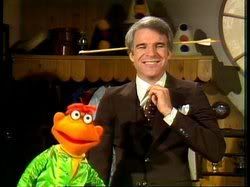
5. As Maiar, Gandalf and the Balrog once knew each-other.
Actually they were just good friends.
Why do they not recognize each-other?
Well, it’s like you’re at a party and there’s an old flame there and you both kind of ignore each other out of embarrassment and/or outright hatred until you‘re both forced to acknowledge each other and then all heck breaks loose.
Why is it Legolas who points out what it is?
He’s the only one who listened enraptured to Glorfindel’s tale of “How I Killed A Balrog” every single night for the two whole months they were at Rivendell. Even Glorfindel was getting a bit bored with it by the time they left.
6. So this is Durin's Bane, the being responsible for the destruction of Moria over a thousand years earlier.
Yeah, right. The Dwarves strip mine all of Moria, destroy their ground water, and pollute their environment with poisonous mine tailings, but it’s the Balrog who gets all the blame.
How much do The Wise know about Durin's Bane?
Quite a bit more than The Stupid.
How much of what they did not know is credible?
Well, actually they spent most of their time arguing about whether Durin’s Bane had wings.
How much does Sauron know?
“And when did he know it?” But we’ll never know because of that sixteen minute gap in the tapes.
7. The drums do seem to follow the Balrog, getting louder and stronger as the Balrog gets close, and less so while the Balrog is behind. Is the drummer mobile?
Yep:

(My alma mater. Hook 'em, horns!!)
How does the drummer know what the Balrog is doing at any given moment?
BPS: Balrog Positioning System.
Are the drum-beats actually some manifestation of the Balrog's power, that simply sound like drums?
You mean an homage to Poe’s “The Tell Tale Heart“?
8. What powers does Boromir's horn have?
It’s, er, loud.
It sounds like it actually can repel enemies, even very powerful enemies, if only briefly.
Bad music usually does that. You can clear a room with a recording of “The King of Polka”.
What magic is in his horn?
“The magic goes 'round and ‘round
Whoa-ho-ho-ho-ho-ho
And it comes out here.”
-From the film “The Music Goes ‘Round“ (1936).
9. We can gather like this that Balrogs, or at least this Balrog, do in fact have appendages made out of darkness that resemble wings.
Appendages like, say, arms, or shoulder pads. (Does Joan Crawford have wings? No way!) Similarly, (Get it? “Simile-larly?) Gandalf is “like” a tree, and the remnant of the bridge is “like” a tongue. Of course, Gandalf is not really a tree, nor is the bridge really a tongue. If Tolkien had written “he seemed small, and altogether alone: grey and bent, a wizened tree before the onset of a storm” most of us would realize that this was a metaphor, that Gandalf wasn’t really a tree. Similarly, if Tolkien had written “..and the stone upon which it stood crashed into the gulf, while the rest remained, poised, quivering, a tongue of rock thrust out into emptiness” not too many readers would picture the portion of the bridge remaining as a real slimy, wet tongue, drooling spit into the dark abyss.
What Tolkien is doing an “extended metaphor”. He starts out with the one “like two vast wings”, and later repeats the conceit. Pretty obvious IMHO.
But what is their function(s)?
To stretch wide, from wall to wall, so as to trap and envelop victims, and thus suck their life force out until they‘re merely dead dried husks. Just like an ex-significant other.
Are they wings,…
Well, the best compromise is Reverend’s theory that the Balrog did not have wings before it stepped on the bridge, but then it somehow suddenly acquired them.
.. and if so what purpose do they serve this apparently flightless demon?
To guide it as it plummets like a rock. Picture the space shuttle.
(and is it flightless?
Note that the dodo bird and the Balrog are both now extinct. What is the common feature about these two species?
… More on that in subsequent questions)
And more in subsequent responses, and future posts, and so on beyond the ending of the world.
10. Gandalf claims to be a servant of the "Secret Fire". What is that?
It’s a secret.
If it is the Flame Imperishable, then is not the Balrog also a servant of that power, since it carries the flame?
Well, Melkor always wanted the Flame Imperishable, but he never got it, so how could one of his creatures have it? So the Balrog’s flame has to be a mockery of the Flame Imperishable.
(Then again, from the Ainulindalë:
'And I will send forth into the Void the Flame Imperishable, and it shall be at the heart of the World, and the World shall Be; and those of you that will may go down into it.'
So maybe it was the Flame Imperishable and the Balrog had indeed gone really really down deep.)
11. Gandalf also claims to wield the "Flame of Anor" (i.e. the Sun). Why does Gandalf claim this?
Because it’s true?
Isn't Aríen the Sun?
No, she’s the Maia who guides Anor in its course across the sky. Like Apollo with the sun.
How is it that Gandalf came to wield Aríen's power?
Or maybe they both wield a power acquired from a common third party.
Might Olórin (Gandalf's Maia name) and Aríen be married, or some such?
Actually, they're just good friends.
If so, what does Aríen know of her friend/husband's plight?
Actually it was Nienna. She helped make the Two Trees, and later she’s the one who cried over their ruin and so created the Sun and Moon. Olórin was her student and spent a lot of time over at her house. (No, they’re just good friends.) She was also big on the power of pity, and wore a grey cloak. Obviously Olórin copied just about his entire schtick from Nienna, so it‘s no surprise that he somehow convinced her to let him wield the Flame of Anor.
12. Udûn is derived from Utumno, the ancient fortress of Melkor before He had spent His spirit into the world. How does the Balrog derive its power from that ancient fortress?
That’s where Melkor had his Balrog factory.
What contact does it still have with Melkor (both Morogth, the body of Melkor that was banished, and the spirit of Melkor that dwells within the earth)?
“Always together, eternally apart.” (You can almost hear the sad disco beat of The Alan Parsons Project.)
13. Gandalf's monologue against the Balrog reminds me of an incantation, and indeed, he seems to put the Balrog's fire out by it, although it counters by expanding its darkness aura (its "wings", if we want to call them that). What spells is Gandalf using here?
“Stallingo Forus Timeium” and “Lookus Behindo Youium“.
What spells is the Balrog countering with?
“Avada Kedavra” and “Boot to the Head“.
14. Gandalf is still visible even after the Balrog extends its full darkness, 'glimmering'.
Since this is Faerie shouldn’t this be “glamouring”?
Is Gandalf showing his Maia power,…
Everything and the kitchen sink.
… and is Tolkien deliberately implying Gandalf's angelic nature in contrast to his demonic enemy?
One of Tolkien’s main themes: There’s always a light in the darkness.
“In the velvet darkness
Of the blackest night, burning bright
There's a guiding star
No matter what, or who you are.”
-Richard O'Brien
15. The swordfight is brief, but there is a swordfight, along with more magic, the stab of white fire, and the Balrog's Hell-forged sword is broken.
Meanwhile the orcs are trying to get through the blast doors.
What is the symbolism here?
Red sword, white sword. Evil guy student, good guy mentor. Black cloak, grey robes. Darth Balrog versus Obi-Wan Gandalfi. "That's no mine, it's a tomb." "I got a bad feeling about this."
What is the significance that Glamdring is continually mentioned by name?
It’s got a good agent? Tolkien does seem to, er, “hammer” the name over and over in the text. Maybe it’s like Pinky: “Narf! I just like saying ‘pants‘!”
Does it imply that Elves are semi-angelic beings themselves, Glamdring being an Elvish sword?
Or maybe it means that suicidally stubborn kin-slaying manic-depressives can occasionally do something right.
16. Here Glamdring is, fighting a Balrog, again. Oh, how it must yearn for revenge over the Fall of Gondolin! Is this why it is featuring so prominent here? Is it fighting against an old nemesis?
'It was not the fault of the Balrogs that the friendship waned,' said Bob.
'I have not heard that it was the fault of the Foe-Hammers,' said Glamdring.
'I have heard both,' said Gandalf; 'and I will not give judgement now. But I beg you two, Bob and Glamdring, at least to be friends, and to... AHHHHHHHHHHH!!!!!’
If only Balrogs and Foe-Hammers could have learned to put their past animosities aside things might have turned out much differently. A lesson applicable even today.
17. Gandalf then breaks the bridge, but he does so by breaking his staff - his symbol of power as a wizard. Is the breaking of Gandalf's staff because shattering an ancient Dwarven bridge is just too much for him, or is it the symbolism of breaking the bridge under a Balrog's feet, i.e. the Angel makes its sacrifice to slay the Demon?
I always figured the symbolism was of Jesus’ staff at his Crucifixion in Matthew 27:29-30.
18. Imagine, for the sake of argument, that this Balrog does in fact possess wings and that it can, in fact, fly. Yet Gandalf clearly is using incantations and declarations of his own Angelic power, and the Balrog is banished, being sent into the abyss, i.e. back to Hell. Would it matter if the Balrog's wings were ordinarily functional, or would it still have to stand and face Gandalf, and then fall into the abyss, smitten by Gandalf's invocation of Heaven's wrath?
Well, Satan and all his angels had wings but they weren’t able to fly back up to Heaven. That’s the entire point of being “Cast down”.
19. Gandalf now falls off as well. Does his banishment of the Balrog necessitate that Gandalf fall with him?
Jesus fell seven times on the way to Calvary, symbolizing his conquest of the Seven Deadly Sins.
Does the splintering of his staff foreshadow his fall?
I’d say the splintering of his staff symbolizes that Gandalf is no longer the shepherd for the Fellowship, and further its loss (like a bishop losing his staff) symbolizes the loss of his jurisdiction on this earth.
20. Aragorn and Boromir leap after Gandalf and are ready to support him. What does this say about the character of the two men?
Intelligence is not their strong suit.
Does it foreshadow Boromir's heroic defense of Merry and Pippin, even after his trying to steal the Ring from Frodo?
Boromir does seem to act first and think later. So I’m still wondering how many times he tooted his horn in Moria.
******************************************
The audacious proposal stirred his heart. And the stirring became a song, and it mingled with the songs of Gil-galad and Celebrian, and with those of Feanor and Fingon. The song-weaving created a larger song, and then another, until suddenly it was as if a long forgotten memory woke and for one breathtaking moment the Music of the Ainur revealed itself in all glory. He opened his lips to sing and share this song. Then he realized that the others would not understand. Not even Mithrandir given his current state of mind. So he smiled and simply said "A diversion.”
|
|
|
SilentLion
Ossiriand
Mar 1 2008, 11:36pm
Post #5 of 61
(3746 views)
Shortcut
|
|
"Flying" versus "Falling with style"
[In reply to]
|
Can't Post
|
|
In the movie Toy Story there was a running debate about whether Buzz Lightyear could actually fly with his stumpy little wings. In practice, he couldn't blast off to infinity & beyond, but he did have a good knack for pulling off graceful landings.
I tend to view the Balrog's wings in a similar light. The Balrog has a physical form that is some ethereal mix of shifting "fire and shadow". I don't think these 'wings' are designed to allow a Balrog to soar with eagles, but they may be enough to allow the Balrog to coast so as to "run with winged speed" over the plains in the 1st age, or to fall at a survivable speed from the Bridge with Gandalf.
To me, the fact that Gandalf and the Balrog both survive the fall from the bridge is the best proof that the Balrog has wings that allow some sort of coasting or parachute effect. Maia or not, Gandalf had a physical form that could be slain and I don't see any reason he why he should be able to survive a fall thousands of feet. Balrogs could also be killed by tremendous falls, as was the case with Glorfindel in the first age, and with Gandalf casting this Balrog down from Durin's tower. In both those cases however, the fall came after epic struggles in which it might be presumed that the Balrog's wings were rendered useless or the Balrog was exhausted to the point where he could no longer use his wings effectively. However, at the bridge, the Balrog was relatively fresh. He could not fly upwards, but he evidently did fall slowly enough to survive the fall from a great height.
|
|
|
Tolkien Forever
Mithlond
Mar 2 2008, 12:10am
Post #6 of 61
(3693 views)
Shortcut
|
That's a very good point about the Balrog & Gandalf falling all that way & not dying.
I may have to re-reconsider that Balrogs DO have wings after all. 
Well, how else would we know about those "nameless things gnaw at the mountains' roots?" if they didn’t?
Because Gandalf says so when he reports back after being down there in his battle with Durin's Bane - he tell Aragorn, Gimli & Legolas in 'The White Rider'.
(This post was edited by Tolkien Forever on Mar 2 2008, 12:13am)
|
|
|
a.s.
Doriath

Mar 2 2008, 1:09am
Post #8 of 61
(3693 views)
Shortcut
|
A few random thoughts on this part of the text, rather than trying to answer the questions per se:
The last time we discussed this chapter, a reference was made to the probable influence of Macaulay's classic poem: "Horatius" (also called "Horatio at the Bridge") which Tolkien read as a schoolboy. In it, Horatio alone holds a bridge over the Tiber against the enemy, and eventually the bridge falls down and Horatio with it:
But meanwhile axe and lever
444 Have manfully been plied;
445 And now the bridge hangs tottering
446 Above the boiling tide.
447 "Come back, come back, Horatius!"
448 Loud cried the Fathers all.
449 "Back, Lartius! back, Herminius!
450 Back, ere the ruin fall!"
54
451 Back darted Spurius Lartius;
452 Herminius darted back:
453 And, as they passed, beneath their feet
454 They felt the timbers crack.
455 But when they turned their faces,
456 And on the farther shore
457 Saw brave Horatius stand alone,
458 They would have crossed once more.
55
459 But with a crash like thunder
460 Fell every loosened beam,
461 And, like a dam, the mighty wreck
462 Lay right athwart the stream:
463 And a long shout of triumph
464 Rose from the walls of Rome,
465 As to the highest turret-tops
466 Was splashed the yellow foam.
56
467 And, like a horse unbroken
468 When first he feels the rein,
469 The furious river struggled hard,
470 And tossed his tawny mane;
471 And burst the curb and bounded,
472 Rejoicing to be free;
473 And whirling down, in fierce career,
474 Battlement, and plank, and pier,
475 Rushed headlong to the sea.
How very reminiscent of Boromir and Aragorn turning back to try to help Gandalf, but helplessly watching him go down. And in the poem, at least, Horatio also makes it back out of the watery depths.
Somewhere I remember reading that one of Tolkien's articles for a school newspaper (don't remember if this was at Oxford or before) was a report on a ?rugby? match written in the style of the Macaulay poem. Wish I could link to that. Maybe someone knows what I'm referring to?
Regarding the being "of shadow and flame", Shippey in Author of the Century has this interesting bit of philology (I wish someone more knowledgable than I could talk about Norse Fire Giants here, too):
In the same way, the entrance into Moria is rather like the entrance into the goblin-tunnels in The Hobbit, with much the same outcome--adventures in the dark leading to a passage to the other side of the mountains. A new element in Moria, though, is the Balrog, introduced in exactly the same way as so many of Tolkien's inventions, as if we ought to have known about it already: 'A Balrog', muttered Gandalf. 'Now I understand.' But we do not.
Just like Woses, Balrogs owe a part of their existence, at least, to an editorial problem. There is an Old English poem called Exodus, like several Old English poems a paraphrase of a part of the Bible. Tolkien's edition of it did not appear during his lifetime, but it came out posthumously, appropriately enough 'reconstructed' from his lecture notes. Since it is both a paraphrase and a fragment, the poem has never managed to gain a central position in literary courses, but Tolkien was interested in it: for one thing, he thought on linguistic grounds that it was older than Beowulf, and he thought that like the Beowulf-poet, the Exodus-poet had known a good deal about the native pre-Christian mythology, which could with care be retrieved from his copyists' ignorant errors.
In particular, the poet at several points mentions the Sigelwara land, the 'land of the Sigelware'. In modern dictionaries and editions, these 'Sigelware' are invariably translated as'Ethiopians'. Tolkien thought, as often, that that was a mistake. He thought that the name was another compound, exactly like *wudu-wdsa and *hol-bytla, and that it should have been written *sigel-hearwa. Furthermore, he suggested (in two long articles written early on in his career, and now ignored by scholarship) that a *sigel-hearwa was a kind of fire-giant. The first element in the compound meant both 'sun' and 'jewel'; the second was related to Latin carbo, 'soot'.
When an Anglo-Saxon of the preliterate Dark Age said sigelhearwa, before any Englishman had ever heard of Ethiopia or of the Book of Exodus, Tolkien believed that what he meant was 'rather the sons of Muspell [the Old Norse fire-giant who will bring on Ragnarok] than of Ham, the ancestors of the Silhearwan with red-hot eyes that emitted sparks, with faces black as soot'.
The fusion of 'sun' and 'jewel' perhaps had something to do with Tolkien's concept of the silmaril. The idea of a fire-spirit re-emerges in the brief glimpse of the ore-chieftain who stabs Frodo, with his 'swart' face, red tongue and 'eyes like coals', but it also gave Tolkien Durin's Bane, the Balrog.
One last note: I forgot to mention this when we talked about the "doom doom" sounds below, but in Hammond & Scull's Companion, they quote Tolkein in Nomenclature:
"word doom, original sense 'judgement' (formal and legal, or personal), has in English, partly owing to its sound, and largely owing to its special use in Doomsday, become a word loaded with senses of death; finality; fate (impending or foretold)....The use in the text as a word...associated with boom is of course primarily descriptive of sound, but is meant (and by most English readers would be felt) to recall the noun doom, with its sense of disaster."
Not going to comment on the wings controversy!
a.s.
"an seileachan"
"Just look along the road, and tell me if you can see either of them."
"I see nobody on the road," said Alice.
"I only wish I had such eyes," the King remarked in a fretful tone. "To be able to see Nobody! And at that distance too! Why, it's as much as I can do to see real people, by this light!"
(This post was edited by a.s. on Mar 2 2008, 1:11am)
|
|
|
Tolkien Forever
Mithlond
Mar 2 2008, 2:18am
Post #9 of 61
(3696 views)
Shortcut
|
|
I Don't think they Knew Each Other, Beren IV Did
[In reply to]
|
Can't Post
|
|
I was trying to be diplomatically unargueable, that's all.
I said as much in my post: They certainly never knew each other once they came into Arda. Tolikien states that the Balrogs were among those who were first drawn to Melkor 'and' (happy?) 'became most like him in their corruption'.
Whether the lesser Ainur knew each other & transferred that knowledge to their being as Maiar, that's a totally different story. We know the Valar did, so we can assume that the Maiar did. But Gandalf, nobody but Elrond, Cirdan, Galdriel, Faramir & those they told knew he was Olorin.
|
|
|
dernwyn
Forum Admin
/ Moderator

Mar 2 2008, 3:41am
Post #10 of 61
(3702 views)
Shortcut
|
|
The drumbeats are metaphorical.
[In reply to]
|
Can't Post
|
|
Well, not really! But they seem to be seismic anomalies associated with the presence of the Balrog: the closer he is, the more the pounding vibration.
It suddenly occurred to me, on reading your transcript of that passage, that the "shadow" and the "wings" are actually two different things. The first instance talks of the "shadow about it" spreading outward "like two vast wings". This sentence has nothing to do with physical wings, but with the darkness associated with the creature of flame. Then once it steps onto the bridge, like a turkey raising its defences by fuffing itself to larger dimensions, it draws itself up to full height (how high is a non-slouching Balrog?) and extends its wings. The creature has both shadow and wings (although they're probably vestigial; not much use for them, in an underground situation).
Of course Gandalf is the "wielder of the flame of Anor": he's wearing Narya, the Ring of Fire!
Now, if you'll excuse me, I've got to go take care of this laughter I've been stifling, ever since reading Darkstone's bit about Alec Guinness playing Gandalf in Star Wars. And trying to shake out of my head the press party scene from "A Hard Day's Night" ("just good friends"). 
~~~~~~~~~~~~~~~~~~~~~~~~~~~~~~
"I desired dragons with a profound desire"
"It struck me last night that you might write a fearfully good romantic drama, with as much of the 'supernatural' as you cared to introduce. Have you ever thought of it?"
-Geoffrey B. Smith, letter to JRR Tolkien, 1915
|
|
|
squire
Gondolin

Mar 2 2008, 4:14am
Post #11 of 61
(3690 views)
Shortcut
|
|
Gandalf and the Balrog once knew each other?
[In reply to]
|
Can't Post
|
|
My mistake for asking TF this question, Beren IV.
How do we know this? Is this in the Appendices or the Silmarillion somewhere? I thought I knew the Valaquenta pretty well, but I don't remember this coming up before.
Is there any reason we should assume that all the denizens of Eru's creation "knew" each other in the beginning, or if they did (and what does it mean to assign to demiurgic spirits any aspect of human personality and sociality) why does that mean their incarnations in Arda necessarily have the same "memories" and selfhoods?
More to the point, Tolkien seems to dead set on portraying Gandalf as never having encountered any Balrog before. Doesn't Gandalf initially exhibit confusion as to who his enemy is? Isn't he surprised and dismayed to discover he has been fending off a Balrog? Doesn't he explicitly identify himself and his power to the Balrog? Doesn't he make a distinction between the Flame of Udun and the Flame of Anor - kind of the Good Side and Dark Side, I guess! - which would hardly be necessary if he and the Balrog had some kind of mutual understanding.
As I see it, the above narrative elements directly contradict any idea that "As Maiar, Gandalf and the Balrog once knew each-other." The best answer to all the subsequent questions that depend on this premise can only be, no, they didn't once know each other, but thanks for asking.
Or have I missed some crucial writing by Tolkien that makes this all clearer? so that Tolkien's failure to have Gandalf recognize the Balrog and then tearfully but lovingly duke it out with him like Cain and Abel is, plainly, just an egregious oversight by JRRT while writing this scene, due to some "failure to keep his notes in order"?

squire online:
RR Discussions: The Valaquenta, A Shortcut to Mushrooms, and Of Herbs and Stewed Rabbit
Lights! Action! Discuss on the Movie board!: 'A Journey in the Dark'. and 'Designing The Two Towers'.
Footeramas: The 3rd TORn Reading Room LotR Discussion; and "Tolkien would have LOVED it!"
squiretalk introduces the J.R.R. Tolkien Encyclopedia: A Reader's Diary
|
|
|
Beren IV
Mithlond
Mar 2 2008, 4:51am
Post #12 of 61
(3681 views)
Shortcut
|
Certainly Gandalf, or, more accurately, Olórin, and Durin's Bane (whatever its real name is) have seen each-other in the Timless Halls, although Olórin was singing Manwë's theme and Durin's Bane was singing Melkor's. My simple question is, if they saw each-other, why don't they recognize each-other? I know there are possible reasons, but point of these questions is to provoke thought and make us think about it from different prospectives and see others. That's part of the fun! 
Once a paleontologist, now a botanist, will be a paleobotanist
|
|
|
Beren IV
Mithlond
Mar 2 2008, 5:00am
Post #13 of 61
(3700 views)
Shortcut
|
It is interesting that you here liken Gandalf to Obi-Wan Kanobi (and also Boromir to Han Solo).
A Nineteenth Century German psychologist named Karl Jung identified a series of archetypal characters that are common to almost all myths, and postulated that the archetypes represent basic aspects of the human psyche. They are archetypes in stories because they work, because they do fill roles in our mental framework of how the world works.
Gandalf is a classic example of the Mentor archetype: the wise advisor, usually an old man, who advises the hero (in this case Frodo) and sets him on his journey, and then disappears after giving Frodo the most crucial advice, forcing Frodo to take on his own role. You are correct to liken him to Obi-Wan Kanobi: George Lucas intentionally used Jungian archetypes to create his epic, and similarly, Obi-Wan advises the hero (Luke), sets him on his journey, but then falls, forcing Luke to become independent and face the villain on his own.
I had not heretofore recognized the relationship between Boromir and Han Solo, but you are right to link them I now see: I do not know the name for this, but they are examples of the skeptic archetype: characters who are indeed heroic, but flawed in that they do not appreciate the wisdom of the mentor. This is a tragic fatal flaw for Boromir, but Han later learns the wisdom when he sees the power revealed before his eyes in the end.
I know your post was something of a joke - but you've pointed out something serious and made a real contribution to my understanding of LotR! Thank you!
I love the Reading Room! 
Once a paleontologist, now a botanist, will be a paleobotanist
|
|
|
Beren IV
Mithlond
Mar 2 2008, 5:01am
Post #14 of 61
(3671 views)
Shortcut
|
|
See my response to Darkstone's post. ;-)
[In reply to]
|
Can't Post
|
|
Once a paleontologist, now a botanist, will be a paleobotanist
|
|
|
squire
Gondolin
Mar 2 2008, 5:08am
Post #15 of 61
(3671 views)
Shortcut
|
It threw me that you asserted your premise as uncontested fact. I have no problem with hypothetical extensions of Tolkien's world as thought-experiments, as long as the limits of what he actually wrote are kept in mind.
As I've said before, I find it odd that so many fans treat "Maiar" as a distinct class of being with common properties and even "powers". I think it's pretty clear that Tolkien invented the term in the late 1940s to steam-clean his cluttered spiritual garage, after LotR had introduced a host of new entities into the Silmarillion universe. Maiar are anything spiritual that are not Ainur, from incoherent entities enlivening trees and brooks, to Sauron the Great. Which is hardly the basis for chummy reunions every odd Age or so, much less the kind of gameboy power relations I occasionally come across: "Well the Fellowship had a Maia with them, so they were well equipped to repel attacks from other Maiar", etc.
squire online:
RR Discussions: The Valaquenta, A Shortcut to Mushrooms, and Of Herbs and Stewed Rabbit
Lights! Action! Discuss on the Movie board!: 'A Journey in the Dark'. and 'Designing The Two Towers'.
Footeramas: The 3rd TORn Reading Room LotR Discussion; and "Tolkien would have LOVED it!"
squiretalk introduces the J.R.R. Tolkien Encyclopedia: A Reader's Diary
(This post was edited by squire on Mar 2 2008, 5:11am)
|
|
|
Beren IV
Mithlond
Mar 2 2008, 7:04am
Post #16 of 61
(3670 views)
Shortcut
|
Maiar are anything spiritual that are not Ainur
Once a paleontologist, now a botanist, will be a paleobotanist
|
|
|
Elizabeth
Gondolin

Mar 2 2008, 8:27am
Post #17 of 61
(3751 views)
Shortcut
|
For the benefit of all the newcomers here, Reverend was an incredibly wise, learned, witty, and beloved regular here from the dawn of TORn until his sudden and untimely death in 2003. He once led the discussion of this chapter, and his post on Balrog wings is one of my all-time favorites, which I re-posted in 2006:
The Last Word on Balrog Wings

New grandson of Elizabeth, b. 2/25/2008
Elizabeth is the TORnsib formerly known as 'erather'
|
|
|
a.s.
Doriath
Mar 2 2008, 1:11pm
Post #18 of 61
(3676 views)
Shortcut
|
|
just breaking in with a "Awww, how cute!"
[In reply to]
|
Can't Post
|
|
Not too happy to be in the world at that moment??  What a cutie pie, congratulations. What a cutie pie, congratulations.
a.s.
"an seileachan"
"Just look along the road, and tell me if you can see either of them."
"I see nobody on the road," said Alice.
"I only wish I had such eyes," the King remarked in a fretful tone. "To be able to see Nobody! And at that distance too! Why, it's as much as I can do to see real people, by this light!"
|
|
|
SilentLion
Ossiriand
Mar 2 2008, 5:36pm
Post #20 of 61
(3711 views)
Shortcut
|
13. Gandalf's monologue against the Balrog reminds me of an incantation, and indeed, he seems to put the Balrog's fire out by it, although it counters by expanding its darkness aura (its "wings", if we want to call them that). What spells is Gandalf using here? What spells is the Balrog countering with?
17. Gandalf then breaks the bridge, but he does so by breaking his staff - his symbol of power as a wizard. Is the breaking of Gandalf's staff because shattering an ancient Dwarven bridge is just too much for him, or is it the symbolism of breaking the bridge
19. Gandalf now falls off as well. Does his banishment of the Balrog necessitate that Gandalf fall with him? Does the splintering of his staff foreshadow his fall?
Gandalf's behavior over the last few chapters in Eregion and Moria is distinctly different from his behavior in the rest of Tolkien's writings. This is the one stretch where he behaves like a stereotypical 'Wizard' straight out of Dungeons & Dragons, reciting incantations in obscure tongues, doing signature magic that says 'Gandalf is here', lighting trees afire to drive off werewolves, using spells to open or close doors, and offering explanations using wizard techno-babble like "Word of Command". In his big magic finale he (seemingly) dispatches the Balrog by breaking the stone bridge, shattering his own staff in the process.
In the Hobbit and the early portion of the LOTR, Gandalf's magic is not particularly spectacular: a bit of ventroliquism with the Trolls, a pyrotechnic flash in the Great Goblin's throne room, some skill with fireworks and smoke rings. In the later parts of LOTR, Gandalf's wizardry is much more subtle. His principle role is not casting spells or zotzing foes with magical blasts, but offering council and encouragement, making connections of people and events that no one else sees, and offering hope & light in the face of darkness everywhere he goes. In fact, the only outright magic worked by Gandalf the White is breaking Sauruman's staff to cast him out of the order. Of course, the 'power' of Gandalf the White is at work combatting the wills of Sauruman and Sauron, a fact ocassionally illustrated by his displays of incadescent White Rider wattage. After the battle of Helms' Deep, one of the Rohirrim tells him "Mighty are you in wizardry Mithrandir," to which he replies "That may be, but if so, I have not shown it. I offered nothing more than good council." To tell the truth, I like my magic that way, subtle and unseen.
I think it's reasonable to ask what has happened in the last few chapters, to make Gandalf behave in this way. One possible answer is that Tokien the writer, after setting aside the story in the Chamber of Mazarbul, just decided that he wanted to push the story in a different direction. He finished off his Gandalf the Grey Conjurer at the bridge and embued his new Gandalf the White Rider with subtler but more marvelous powers. But within the context of the story, I think we have witnessed Gandalf reaching the limits of his ability to cope with situation he confronts. Rather than relying on wisdom, in Eregion he increasingly relies on brute force magic to help the Company push their way forward through dangers. Even though the Fellowship is dependent on secrecy, he finds himself forced to use signature magic that identifies his presence. By the Chamber of Mazarbul he's relying on Words of Command, and at the bridge he spends his last bit of power.
In one sense, Gandalf's sacrifice at the bridge is heroic and saves the Fellowship. However, it hardly seems in keeping with the original charge of the Istari not to confront the enemy with open displays of power. In some sense, Gandalf has begun to stray from the means authorized in his original mission, trusting power rather than wisdom push the Fellowship towards its goal. In this sense, Celeborn's later comment that "Gandalf's wisdom failed" in Moria is closer to the truth than he is given credit for. Not only did Tolkien the writer have to find a way to separate the Fellowship from Gandalf to help the other characters develop. But also the Powers had to get Las Vegas Gandalf the Neon away from the Frodo, lest he try to march them into Mordor using a desperate array of bottle rockets, cherry bombs and roman candles. I wouldn't be surprised if Eru set Olorin down for a bit of a chat before sending him back as Gandalf the White.
Gandalf remains one of the central heros of the tale, but I think the old Gandalf reached the limits of his abilities at the Bridge of Khazad-Dum
|
|
|
Ataahua
Forum Admin
/ Moderator

Mar 2 2008, 6:15pm
Post #22 of 61
(3658 views)
Shortcut
|
|
Thanks for posting that Elizabeth.
[In reply to]
|
Can't Post
|
|
He had a humorous eloquence, which is a joy to be reminded of.
Celebrimbor: "Pretty rings..."
Dwarves: "Pretty rings..."
Men: "Pretty rings..."
Sauron: "Mine's better."
"Ah, how ironic, the addictive qualities of Sauron’s master weapon led to its own destruction. Which just goes to show, kids - if you want two small and noble souls to succeed on a mission of dire importance... send an evil-minded b*****d with them too." - Gandalf's Diaries, final par, by Ufthak.
Ataahua's stories
|
|
|
Dreamdeer
Doriath

Mar 2 2008, 8:24pm
Post #23 of 61
(3648 views)
Shortcut
|
|
Venturing to answer before reading other answers, just this once...
[In reply to]
|
Can't Post
|
|
1. Why did Tolkien choose this bridge to name the chapter by?
Because the chapter comes to a climax on that bridge.
2. We can presume that the Dwarves made the bridge, but how did the chasm come into being? Sure the Dwarves did not dig who knows how many miles down into the water where "nameless things gnaw at the mountains' roots?" Chasms just exist in mountains. Volcanic forces and all that.
The Orcs spot them, and fire arrows at them. One of them hits Frodo but bounces off. Another goes through Gandalf's hat.
3. Why is it that the Fellowship is so lucky that the only one of them who gets hit by an arrow is the one who is wearing armor that will stop it? Is it luck?
Gimli also wore armor. As Sam later observed, the expedition had an enormous amount of luck come its way throughout, to the point of probably being Valar intervention. They had a blessing on their mission. Even so, such intervention could only go so far. It came darn close to failing any number of times. And how might we have had a different story if that arrow in Gandalf's hat had gone a little lower? True, he might have gotten sent back anyway, but he would have found himself lying in Moria instead of on a mountaintop, weak as a newborn and with no eagle to fetch him. How might his friends in Valinor have improvised to rescue him out of there? And the Fellowship would have had a Balrog to deal with all by themselves.
4. Is Tolkien trying to prove a point here, or is he just trying to make it sound scary and/or believable? I vote for scary and believable.
5. As Maiar, Gandalf and the Balrog once knew each-other. Why do they not recognize each-other? Why is it Legolas who points out what it is?
Just because Legolas is the first to say it doesn't mean he was the first to realize it. I always assumed that Gandalf knew the minute he laid eyes on the Balrog.
6. So this is Durin's Bane, the being responsible for the destruction of Moria over a thousand years earlier. How much do the Wise know about Durin's Bane? How much of what they did not know is credible? How much does Sauron know?
I wouldn't expect that anybody who got close enough to Durin's Bane to identify it survived to tell anyone else. The Wise would know next to nothing about him. Sauron would know more, being on the same team. The Balrog would have no particular motivation for frying orcs, and might chat just to pass the time. Sauron would hear things unknown to the Wise.
7. The drums do seem to follow the Balrog, getting louder and stronger as the Balrog gets close, and less so while the Balrog is behind. Is the drummer mobile? How does the drummer know what the Balrog is doing at any given moment? Are the drum-beats actually some manifestation of the Balrog's power, that simply sound like drums?
I gave my speculation elsewhere, but accidentally out of order. I think that the drummers take up stations at various watching points in order to send messages about what they see. The company doesn't notice them up in the high places because they've got their eyes on the folks with weapons.
8. What powers does Boromir's horn have? It sounds like it actually can repel enemies, even very powerful enemies, if only briefly. What magic is in his horn? I expect it has a similar magic to the horn that Rohan gave to Merry, to daunt enemies and inspire allies.
9. We can gather like this that Balrogs, or at least this Balrog, do in fact have appendages made out of darkness that resemble wings. But what is their function(s)? Are they wings, and if so what purpose do they serve this apparently flightless demon? (and is it flightless? More on that in subsequent questions)
Perhaps once upon a time they could fly. But maybe they had gotten atrophied from age upon age spent underground. This Balrog might no more resemble what he once was than Smeagol resembles a hobbit.
10. Gandalf claims to be a servant of the "Secret Fire". What is that? If it is the Flame Imperishable, then is not the Balrog also a servant of that power, since it carries the flame?
If I knew, then it wouldn't be a secret, would it?
11. Gandalf also claims to wield the "Flame of Anor" (i.e. the Sun). Why does Gandalf claim this? Isn't Aríen the Sun? How is it that Gandalf came to wield Aríen's power? Might Olórin (Gandalf's Maia name) and Aríen be married, or some such? If so, what does Aríen know of her friend/husband's plight?
I think that he means the fire of all of the fire-maiar who resisted Morgoth's temptations, Arien being the chief among these. An unstained power. To say, "I wield the same kind of power as Arien does" might daunt a subterranean creature hiding out from sunlight.
12. Udûn is derived from Utumno, the ancient fortress of Melkor before He had spent His spirit into the world. How does the Balrog derive its power from that ancient fortress? What contact does it still have with Melkor (both Morogth, the body of Melkor that was banished, and the spirit of Melkor that dwells within the earth)?
I take it as Gandalf telling the Balrog that his fire has become tainted by its association with Melkor.
13. Gandalf's monologue against the Balrog reminds me of an incantation, and indeed, he seems to put the Balrog's fire out by it, although it counters by expanding its darkness aura (its "wings", if we want to call them that). What spells is Gandalf using here? What spells is the Balrog countering with?
Fire puts out fire, so I expect that Gandalf, on a psychic level, crowded the Balrog's fire out. But the Balrog countered with a spell of smoke and soot, which can remain after the fire gets put out.
14. Gandalf is still visible even after the Balrog extends its full darkness, 'glimmering'. Is Gandalf showing his Maia power, and is Tolkien deliberately implying Gandalf's angelic nature in contrast to his demonic enemy?
He might be. Some of Gandalf's power might be starting to show, even as elves glimmer in the dark. Then again, pale garments do seem to glimmer against a dark backdrop.
15. The swordfight is brief, but there is a swordfight, along with more magic, the stab of white fire, and the Balrog's Hell-forged sword is broken. What is the symbolism here? What is the significance that Glamdring is continually mentioned by name? Does it imply that Elves are semi-angelic beings themselves, Glamdring being an Elvish sword?
No, elves mix too much of both good and evil in their natures to be true angelic beings, capable of choosing only one or the other. Sword-breaking has plenty enough Freudian symbolism to not need more on top of that. As for mentioning Glamdring by name, you answer that yourself in your next question.
16. Here Glamdring is, fighting a Balrog, again. Oh, how it must yearn for revenge over the Fall of Gondolin! Is this why it is featuring so prominent here? Is it fighting against an old nemesis?
See? You answered it yourself.
17. Gandalf then breaks the bridge, but he does so by breaking his staff - his symbol of power as a wizard. Is the breaking of Gandalf's staff because shattering an ancient Dwarven bridge is just too much for him, or is it the symbolism of breaking the bridge under a Balrog's feet, i.e. the Angel makes its sacrifice to slay the Demon?
I think this mirrors the contest over the door. Gandalf willed the bridge broken, the Balrog willed the bridge intact, Gandalf finally prevailed, but the counterspell shatters his staff and his wizardly power. After this the only way Gandalf has to fight the Balrog is by brute force, aided by a sword that once also slew a Balrog by brute force. To summon that much hysterical strength from a body suddenly rendered mortal killed him.
18. Imagine, for the sake of argument, that this Balrog does in fact possess wings and that it can, in fact, fly. Yet Gandalf clearly is using incantations and declarations of his own Angelic power, and the Balrog is banished, being sent into the abyss, i.e. back to Hell. Would it matter if the Balrog's wings were ordinarily functional, or would it still have to stand and face Gandalf, and then fall into the abyss, smitten by Gandalf's invocation of Heaven's wrath?
Interesting point. But if it were that simple, I do not think the Balrog could drag Gandalf down with him.
19. Gandalf now falls off as well. Does his banishment of the Balrog necessitate that Gandalf fall with him? Does the splintering of his staff foreshadow his fall?
I do not think that it necessitates Gandalf's fall. But it points out like nothing prior in the book just what sort of knife-edge the quest teetered on. As a reader, at that point I knew that I could not make safe assumptions of, "Oh, he won't die--he's much too important!" It wasn't so much that Gandalf's sacrifice was inherently necessary, but the risk of sacrifice was--and sometimes risks do catch up with us. As for the splintering of the staff, it certainly foreshadowed disaster. Even if Gandalf had escaped, his usefulness to the company would drop drastically, although they could still reap the benefits of his wisdom.
20. Aragorn and Boromir leap after Gandalf and are ready to support him. What does this say about the character of the two men? Does it foreshadow Boromir's heroic defense of Merry and Pippin, even after his trying to steal the Ring from Frodo?
My website http://www.dreamdeer.grailmedia.com offers fanfic, and message-boards regarding intentional community or faerie exploration.
(This post was edited by Dreamdeer on Mar 2 2008, 8:25pm)
|
|
|
Farawyn
Nargothrond

Mar 2 2008, 8:46pm
Post #24 of 61
(3672 views)
Shortcut
|

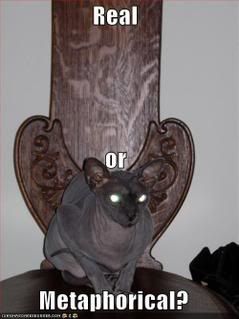
*copies, pastes*
BTW, I'm of the number 2 camp (without the rage), but I'll take Reverend's "the truth" under consideration.
*************
Disclaimer: The author of this message does not guarantee correct grammar, spelling or English usage. No responsibility can be accepted for the use of this message as a guide to written English.
**************
Discuss:
(This post was edited by Farawyn on Mar 2 2008, 8:47pm)
|
|
|
acheron
Mithlond

Mar 2 2008, 8:56pm
Post #25 of 61
(3643 views)
Shortcut
|
|
one other Gandalf the White magic
[In reply to]
|
Can't Post
|
|
In fact, the only outright magic worked by Gandalf the White is breaking Sauruman's staff to cast him out of the order.
How about the beam of light to shoo the Nazgul away from Faramir?
Of course, the 'power' of Gandalf the White is at work combatting the wills of Sauruman and Sauron, a fact ocassionally illustrated by his displays of incadescent White Rider wattage.
Unless that's what you mean there. :)
Great analysis though. Lots of things I hadn't thought of before.
For instance, on the planet Earth, man had always assumed that he was more intelligent than dolphins because he had achieved so much -- the wheel, New York, wars, and so on -- while all the dolphins had ever done was muck about in the water having a good time. But conversely, the dolphins had always believed that they were far more intelligent than man, for precisely the same reasons. -- Douglas Adams
|
|
|
|
|









 1
1


