|
|
 |


|
|
|
|
|
|
|
|
|
|
|
News From Bree
spymaster@theonering.net
Mar 6 2012, 9:51am
Post #1 of 6
(4404 views)
Shortcut
|
|
Michael Adams — From Elvish to Klingon: Exploring Invented Languages
|
Can't Post
|
|
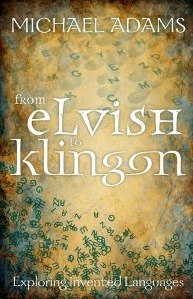 Back in 2001, I wrote Glossopoeia for Fun and Profit (also reprinted in The People's Guide to J.R.R. Tolkien), for our Green Books department, in which I discussed three examples of invented languages: Esperanto, Elvish, and Klingon. For those who found that necessarily brief article of interest, University of Indiana linguistics professor Michael Adams has now edited a new book, From Elvish to Klingon: Exploring Invented Languages (Oxford University Press, 2011), comprising eight essays (including his a general introductory essay by Adams) about linguistic invention, though not precisely the “invented languages” suggested by the book's title, as we will see. Each essay is accompanied by an appendix by Adams that extends or clarifies some aspect of the essay. Back in 2001, I wrote Glossopoeia for Fun and Profit (also reprinted in The People's Guide to J.R.R. Tolkien), for our Green Books department, in which I discussed three examples of invented languages: Esperanto, Elvish, and Klingon. For those who found that necessarily brief article of interest, University of Indiana linguistics professor Michael Adams has now edited a new book, From Elvish to Klingon: Exploring Invented Languages (Oxford University Press, 2011), comprising eight essays (including his a general introductory essay by Adams) about linguistic invention, though not precisely the “invented languages” suggested by the book's title, as we will see. Each essay is accompanied by an appendix by Adams that extends or clarifies some aspect of the essay.
Adams's introductory chapter deals with the spectrum of linguistic invention, and considers the motivations for such inventions. He considers whether invented languages are an attempt to re-create “the language of Adam”, i.e., a perfected language as spoken by Adam before the fall (it appears that Adams takes the Biblical texts quite literally here), and considers slang and poetry as examples of human linguistic creativity; Adams is the author of Slang: The People's Poetry(Oxford Press, 2009).
Arden Smith (who is a regular contributor to the Elvish journal Parma Eldalamberon here contributes a quite comprehensive survey on the history of International Auxiliary Languages, i.e., languages devised to “overturn the curse of Babel” and provide a means of communication between the world's diverse linguistic groups. Of these, the most famous is Esperanto, but Smith provides quite a comprehensive history of the various attempts that have been made over the centuries, including some detail on Volapük, the first such project to gain a real international following. There are, of course, several pages devoted to Esperanto itself, as well as some discussion of the later, and less successful schemes. IALs based on English (Basic English), German (Wede), and simplified Latin (Interlingua) all have their place here. Smith concludes by noting that Esperanto and other such schemes (such as Loglan) all have international communities who use the languages practically and regularly, although the actual likelihood of any of them succeeding in becoming a universal language is remote, and so may be considered to be successful in a limited sense.
Howard Jackson's essay considers two invented languages from literature, Newspeak (from 1984) and Nadsat (from A Clockwork Orange). We here begin to see the way in which the book's titular subject of invented languages is applied fairly loosely; for these are not true languages in which one can create productive new sentences, but are, as the essay itself points out, merely invented vocabularies that heighten reader involvement in their dystopian stories. That said, Jackson does an excellent job of surveying the vocabularies in the context of their respective novels and discussing how they relate to the novels' themes, as well as discussing the authors' relationships with language and their readers. Aspiring writers of fantasy often think they must imitate Tolkien and invent fully-developed languages; this chapter offers an alternative technique, carefully invented vocabulary, for enhancing a created world.
E.S.C Weiner and Jeremy Marshall's chapter on Tolkien's invented languages is, perhaps unsurprisingly, the longest of the essays in this volume, and will likely be of the most interest to readers here. They manage to cover quite a lot of ground, including the histories of the creation of the languages, their literary effectiveness, the phonetic aesthetics of Elvish, relationships to real-world languages — both intentional and unintentional — and a fair amount of detailed examples of Elvish grammar and vocabulary, although nothing that will be terribly new to those for whom Elvish linguistics is already a hobby. Indeed, it might be argued that there is rather too much detail for a general reader, and too little that is new for someone who specializes in the subject. The accompanying appendix is not written by Adams; instead, he has selected an anthology of reviews of Tolkien's linguistic inventiveness, mostly from the 1950s, although later quotes also appear.
The chapter on Klingon is written partly by Marc Okrand, who invented the language, and partly by Judith Hendriks-Hermans and Sjaak Kroon. Adams stitched their separate materials into a single chapter and added sufficient material of his own to warrant inclusion of his name as co-author. There is a good section on the history of the language and enough detail on the vocabulary and structure to give a good “taste” of Klingon. The essay concludes with several pages discussing Klingon in the real world: who speaks it, and why?
James Portnow contributes an essay on languages seen in electronic (video) gaming. He covers quite a wide variety of these, with a satisfying level of detail, ranging from the simple substitution cipher disguised-English Al-Bhed (Final Fantasy X) to the far more developed D'ni language of Myst, to the expensive failure of Logos in the game Tabula Rasa. A few pages are also devoted to“1337” or “LEET”, the jocular ASCII re-encoding of English words that serves as a kind of digital calligraphy in the electronic realm. A particularly interesting aspect of this chapter is the discussion of the goals of a gaming language, which are not quite the same as those of an IAL, a literary language like Sindarin, or a franchise product like Klingon.
Stephen Watt's chapter, far more academic and scholarly than the others in this volume, is devoted to the linguistic inventiveness of Irish writers James Joyce, Samuel Beckett, and Paul Muldoon. This is going to be fairly inaccessible to many Tolkien fans. It is something of a cliché that Tolkien fans and James Joyce enthusiasts are entirely separate (and I admit to not having read any of these writers except for Beckett's Waiting for Godot). Orson Scott Card once argued that the reason for this is that Tolkien is utterly uninterested in allegory or hidden messages, while Joyce (and other“serious” modernist literature) must be decoded to be appreciated. This chapter gives some credence to Card's comparison. Here, we are given a tour of Joyce's inventive, erudite, and playful, but semantically dense, word coinages and puns that help Joyce achieve his purposes, “one of which, according to Bishop, is the creation of a text of ‘stupefying obscurity’”. While shedding considerable light on Joyce's linguistic games (and relatively little space is devoted specifically to Beckett and Muldoon), this chapter (unlike the chapter on the literary languages of Newspeak and Nasdat) will probably only be of interest to those already quite familiar with these authors' works. It is somewhat out of place in a volume otherwise intended for popular audiences, and the neologism and puns are not really the same sort of linguistic invention as the other languages discussed (although it is notable that both Klingon and Elvish have punning elements in their vocabularies).
After the more “playful” creations of chapters 2–7, the final essay, by Suzanne Romaine, takes up the more serious subject of revitalized languages such as Hebrew, Irish, or Cornish. The essay considers the technical aspects of language re-creation such as the use (or rejection) of loan words, but these technical matters are always kept within the larger context of the relationships between language, culture, and ethnic identity. These are complex and vital issues, and would easily fill an entire book. Unsurprisingly, this chapter raises more questions than answers (what does“authenticity” mean? Who are the “real” speakers of a vanishing minority language? How much standardization is appropriate for these ethnic language, and from what source?), and perhaps skims too easily over the cultural and political differences between modernized Hebrew and neo-Breton (or, for that matter, Klingon). but it is a worthwhile and thought-provoking chapter to finish out the book.
All in all, From Elvish to Klingon is kind of a mixed bag. It is not just about the invented languages that are the subject of constructed-language web sites such as http://conlang.wikia.com/wiki/; its subject matter ranges from frivolous notations such as LEETspeak to the heavy academic examination of James Joyce's word coinages, to the ethnic politics of revitalized Cornish. Everyone will find some of these chapters, at least, informative and thought-provoking, but they hang together into a very uncertain single volume, however worthwhile.
- Ostadan
[Amazon.com]
|
|
|
Otaku-sempai
Elvenhome
Mar 6 2012, 4:20pm
Post #2 of 6
(1309 views)
Shortcut
|
Sean K. Reynolds wrote a very nice article in Dragon Magazine issue 279 (January 2001) about the Elven language used in Advanced Dungeons & Dragons. This lexicon included a brief glossary and basic grammatical rules. If the folks at WotC were smart they would re-hire Reynolds to produce a proper Elven to English dictionary for D&D. I've found a webpage that reproduces the article: http://www.fantasist.net/elven.shtml.
Reynolds also wrote a similar piece about the Dwarven language that appeared in Dragon #278.
All that is gold does not glitter,
Not all those who wander are lost.
(This post was edited by Otaku-sempai on Mar 6 2012, 4:29pm)
|
|
|
Modtheow
Menegroth

Mar 6 2012, 4:30pm
Post #3 of 6
(1313 views)
Shortcut
|
I had the book in my hands at the bookstore just last week and was wondering whether to buy it. Think I'll go back to take another look.
|
|
|
Ostadan
Ossiriand
Mar 6 2012, 7:53pm
Post #4 of 6
(1300 views)
Shortcut
|
In my paragraph on the chapter on re-created national languages, I described chapters 2—7 as 'playful'; I meant 3—7 because the languages of Chapter 2, international auxiliary languages, are not frivolous in their goals. Indeed, the goals of IALs and neo-Breton and the like are curiously reciprocal. An IAL seeks to provide a universal language as a bridge between communities, while the renewed ethnic languages are often a reaction to the 'universal' languages of their country (e.g., renewed Welsh within Britain as a reaction to the hegemony of English there) and seek to create a language for a specific community. But an IAL is intended as a second language, not to replace local languages, and you will find that Esperantists are generally very sympathetic to national language movements in their resistance to cultural hegemony.
Anyway, just wanted to correct that small typo.
|
|
|
Ostadan
Ossiriand
Mar 6 2012, 8:02pm
Post #5 of 6
(1305 views)
Shortcut
|
Looking at the referenced page, the Sean Reynolds stuff does not describe, even approximately, any of Tolkien's Elvish languages. Nor does it claim to. The world of D&D has its own elves that may or may not have anything to do with those of Middle-earth. See also 'Grelvish', which looks kinda sorta like Tolkien's work if you squint hard enough, but ain't. (http://tolkiengateway.net/wiki/Grelvish) And again, it doesn't claim to be.
|
|
|
Otaku-sempai
Elvenhome
Mar 6 2012, 9:35pm
Post #6 of 6
(3295 views)
Shortcut
|
|
Well, no. This is a different Elvish language entirely.
[In reply to]
|
Can't Post
|
|
I never indicated that D&D Elvish was at all related to Tolkien's Quenya or Sindarin (except, perhaps, in spirit). But, since the book being discussed in the subject is looking at a number of artificial languages, it seemed appropriate to bring up the Dragon articles as well. Reynold's professional experience is as a game designer, not a linquist, but he provided a nice base to start from which to develop a complete Tel-Quessir language.
All that is gold does not glitter,
Not all those who wander are lost.
(This post was edited by Otaku-sempai on Mar 6 2012, 9:44pm)
|
|
|
|
|