|
|
 |


|
|
|
|
|
|
|
|
|
|
|
sador
Gondolin
Nov 8 2009, 1:42pm
Post #1 of 18
(2848 views)
Shortcut
|
|
Tolkien's Poetry, 'The Sea-Bell' - II. Firiel and Joyce
|
Can't Post
|
|
Last week we discussed the poem ‘The Sea-Bell’ and pondered its meaning. As I promised, I would like to look at it in a wider context.
However, before doing that, I want to pause on a feature of it: it’s anonymity.
It’s not that the hero is anonymous – neither is the ‘merry passenger’ of Errantry or the several owners of The Hoard – but this is a powerfully personal poem: it is a soliloquy rather than an external description, the speaker feels himself called, crowns himself king, and then contrasts himself with others, “men that I meet”. But we know nothing about him! “Who are you, alone and nameless?” Tom Bombadil asked Frodo; and we might ask the same of our hero.
And the mystery gets worse, once we know that Tolkien did originally give him a name, or at least a nick: ‘Looney’. But in the later, more developed poem, he simply omitted that detail.
Do you think this omission strengthens the poem? How?
What is the point of the name ‘Looney’? It seems to be a familiar form of ‘lunatic’; does the form reassure you? Do you pity him more?
Is this connected with the Elvish affinity with the moon (as mentioned in The Sun and Moon and the Hiding of Valinor)? Does this raise second thoughts about the punishment of ‘for a year and a day’ – surely a solar year!?
Perhaps this is the right place to mention that today is 24 lunar months since I’ve joined these boards. It’s not a TORniversary by the Jewish calendar (as two years ago was a leap year), but it might be according to the Islamic one. Anyway, please consider this ‘a lunar mathom’.
Back to the plot – regarding the poem’s speaker: Who do you think it is? Is it still Looney, or someone else? Is it Tolkien himself (as Decision9 suggested)?
Do you identify with the speaker? Is it Everyman, or a special case?
An interesting counter-point to The Sea-Bell is the next (and last) poem in The Adventures of Tom Bombadil, The Last Ship.
The Last Ship has a heroine, who is named on the first word of the poem: Firiel. And unlike Looney (I will call the speaker of The Sea-bell by that name, for simplicity’s sake), she is described – waking at night, and following the dawn and sunrise, looking out at the world, and going down to the river. We get a sense of her as beautiful, and positively radiant – before she is ever called:
A sudden music to her came,
as she stood there gleaming
with free hair in the morning’s flame
on her shoulders streaming.
Flutes there were, and harps were rung,
and there was sound of singing,
like wind-voices keen and young
and far bells ringing. This time it is harps, and flutes, and singing – as opposed to the “pipes, horns and voices” Looney heard on the distant shore.
What do you make of the difference? Is this music more enticing? Less eerie?
I also note that the rhythm here is far more regular than in The Sea-bell; there are thirteen stanzas of eight lines each, with the simplest rhyming pattern.
Does this feel more serene? How does this connect with the image of Firiel as opposed to Looney?
But this is no empty boat she sees, and no invisible hunters she hears! A very ship glides up the water, with “Fair folk out of Elvenland... and three with crowns”! and they actually summon her:
‘To mortal fields say farewell,
Middle-earth forsaking!
In Elvenhome a clear bell
in the high tower is shaking.
Here grass fades and leaves fall,
and sun and moon wither,
and we have heard the far call
that bids us journey thither.’ Is this a temptation, a request, a command? Why would they want her to join? Note than when she hesitates they repeat their call.
Any comments on the ‘clear bell’ and the promise of fields with no decay? Please compare them to the symbols in The Sea-bell.
As I mentioned before, when Firiel hesitates they repeat the call. But:
Firiel looked from the river-bank,
one step daring;
then deep in clay her feet sank,
and she halted staring.
Slowly the elven-ship went by
whispering through the water:
‘I cannot come!’ they heard her cry.
‘I was born Earth’s daughter!’ Why do you think Firiel refused the call? Was it fear? Did she realise she would be out of place in Elvenhome? Was she right?
Note the line: “then deep in clay her feet sank”.
Is the clay the reason she stayed behind? Is this a love for Earth? A sign of mortality? Are Elves and Men made of different stuff?
So Firiel returns home, to a normal life:
She donned her smock of russet brown,
her long hair braided,
and to her work came stepping down.
Soon the sunlight faded. Has Firiel faded with the sunlight? What is the ‘work’ she returns to? Do you think she lives now in regret for the missed opportunity, or is she happy?
The last question is important. In Author of the Century,* Tom Shippey notes that like The Sea-Bell, The Last Ship is also a rewrite of an earlier poem; he sees the earlier one as brighter, noting that it ended with breakfast bustle and chatter, rather than with fading – as the two last stanzas of The Last Ship do. In the earlier poem (which I don’t know whether NZ Strider discussed; I decided to mention it too late for a PM to NEB  ), it is seen that life upon earth does offer its compensations for those who reject temptation. ), it is seen that life upon earth does offer its compensations for those who reject temptation.
An interesting parallel to this might be found in James Joyce’s A Portrait of the Artist as a Young Man:
He sat by the fire in the kitchen, not daring to speak for happiness. Till that moment he had not known how beautiful and peaceful life could be. The green square of paper pinned round the lamp cast down a tender shade. On the dresser was a plate of sausages and white pudding and on the shelf there were eggs. They would be for the breakfast in the morning after the communion in the college chapel. White pudding and eggs and sausages and cups of tea. How simple and beautiful was life after all! And life lay all before him.
The two are not entirely similar, as Joyce is describing deliverance from sin. But do you feel the beauty of simple life he descibes? Is it worth missing Elvenhome for?
There is another parallel between Firiel and a Joyce story, in Eveline (from the collection Dubliners). Another heroine who refuses the boat promising her a better life:
A bell clanged upon her heart. She felt him seize her hand: "Come!"
All the seas of the world tumbled about her heart. He was drawing her into them: he would drown her. She gripped with both hands at the iron railing.
"Come!"
No! No! No! It was impossible. Her hands clutched the iron in frenzy. Amid the seas she sent a cry of anguish.
"Eveline! Evvy!"
He rushed beyond the barrier and called to her to follow. He was shouted at to go on but he still called to her. She set her white face to him, passive, like a helpless animal. Her eyes gave him no sign of love or farewell or recognition.
Any comments on the differences between Eveline and Firiel?
Joyce seems to condemn Eveline’s choice. Does Tolkien condemn Firiel’s?
Comparing Joyce and Tolkien is a tangent which could take weeks. Shippey does this quite briefly, and he starts by commenting that he sees no evidence that Tolkien ever read Joyce. That might be true, although considering the fact that he mentions Joyce as the hero of some of the most virulent critics of Tolkien, I wonder about the Forword to the Lord of the Rings:
Some who have read this book, or at any rate have reviewed it, have found it boring, absurd, or contemptible; and I have no cause to complain, since I have similar opinions of their works, or of the kind of writing that they evidently prefer.
It would behhove us to return to Looney, wouldn’t it? But before, a last couple of questions about Firiel:
Does Tolkien identify with Firiel? Do you? Is Firiel an archetype, and if so, of what?
Who is Firiel? I would like to mention here dna’s UUT about her, and the other occurance of the name – king Ondoher of Gondor’s daughter, who was Arvedui’s wife.
How does Firiel compare with Looney? Why are their choices so different – because of their gender? The mode in which they were called? Something else?
Why is Firiel described in detail from the outside, while Looney is known only by his own words?
Would Firiel have destroyed Elfland like Looney did? If not, why not?
I think that’s enough for this thread. It is very long as it is; so I’ll post the rest later today.
*The only book of Tolkien-criticism I own; so I am about to milk it for all its worth.
"Now the world runs on swiftly to great tidings" - Melian.
|
|
|
Dreamdeer
Doriath

Nov 8 2009, 9:53pm
Post #2 of 18
(1934 views)
Shortcut
|
And the mystery gets worse, once we know that Tolkien did originally give him a name, or at least a nick: ‘Looney’. But in the later, more developed poem, he simply omitted that detail.
Do you think this omission strengthens the poem? How?
What is the point of the name ‘Looney’? It seems to be a familiar form of ‘lunatic’; does the form reassure you? Do you pity him more?
Is this connected with the Elvish affinity with the moon (as mentioned in The Sun and Moon and the Hiding of Valinor)? Does this raise second thoughts about the punishment of ‘for a year and a day’ – surely a solar year!?
I think it does strengthen the poem. Naming someone, even giving them a derogatory nickname, counts as an interaction. To have no name feels far lonelier. He might not even be sure if he's returned, or if the "men that I meet" might all be ghosts. He lives in a ghost-world, nameless.
"Looney" seems short for "Lunatic" to me, but in an almost affectionate way. I have more pity for the nameless man. I don't see this as having any connection with the Elvish idea of the moon, personally.
Back to the plot – regarding the poem’s speaker: Who do you think it is? Is it still Looney, or someone else? Is it Tolkien himself (as Decision9 suggested)?
Do you identify with the speaker? Is it Everyman, or a special case?
Anyman, perhaps--what any of us might stumble into if we make the same mistake of presuming too much in Faerie. And that could include Tolkien. It seems quite "applicable" to me.
This time it is harps, and flutes, and singing – as opposed to the “pipes, horns and voices” Looney heard on the distant shore.
What do you make of the difference? Is this music more enticing? Less eerie?
If anything, it seems more eerie to me. But it also seems gentler and mor feminine. Pipes, horns, and voices sounds martial, whereas harps, flutes and singing (even though the singing technically constitutes "voices") sounds more beguiling. Looney met with a challenge and was too dense to back down and act humbly, whereas Firiel's invitation came more overtly and with no apparent strings attached.
I also note that the rhythm here is far more regular than in The Sea-bell; there are thirteen stanzas of eight lines each, with the simplest rhyming pattern.
Does this feel more serene? How does this connect with the image of Firiel as opposed to Looney?
I think Firiel held onto her sanity by staying grounded, and those who retell her tale do so based on a measured, rational account. Looney lost his sanity and cannot speak in measured stanzas.
Is this a temptation, a request, a command? Why would they want her to join?
I think it's a mistake. Not all elves are wise. Maybe these are grey-elves who didn't get the memo about mortals not belonging in immortal lands.
Any comments on the ‘clear bell’ and the promise of fields with no decay? Please compare them to the symbols in The Sea-bell.
Now that opens up an interesting possibility--Was Looney deceived? Come to think of it, aren't there many islands of deception on the way to Valinor to sidetrack mortals who try to go there? And they evidently have magic in them, and so in a sense are also Faerie, yet of an unseelie nature.
Why do you think Firiel refused the call? Was it fear? Did she realise she would be out of place in Elvenhome? Was she right?
Note the line: “then deep in clay her feet sank”.
Is the clay the reason she stayed behind? Is this a love for Earth? A sign of mortality? Are Elves and Men made of different stuff?
So much meaning packed into that one line about clay! She has clay feet. She sinks deep whereas elves walk lightly. She feels her steps held back by earth. She belongs in earth--all wrapped into a single metaphor!
I think that line reminds her that she does not belong among elves. She has a different destiny. She's honest enough to face that the elves made a mistake in inviting her.
Has Firiel faded with the sunlight? What is the ‘work’ she returns to? Do you think she lives now in regret for the missed opportunity, or is she happy?
She has perhaps faded back to her natural state, which is not necessarily a bad idea. Certainly she avoided Looney's presumption and fall.
The work she returns to would be the mundane chores of an earthly woman. She washes dishes, changes diapers, milks the cow, what have you. Regret? Well, one can hardly avoid regrets, can one, no matter what one decides? You can't go into one door without choosing not to go into its opposite, and both have their blessings and travails. The poem does end on a wistful note, but she has chosen the more practical course, and she must--and can--make the best of it.
I wonder if Tolkien changed the poem, making it more wistful, less of a happy ending, after he saw his wife change, over the years, from a dancing girl with sparkling eyes to a weary and pragmatic matron, to the point where when he mentions her once-sparkling eyes to his children, he expects it to surprise them. She was indeed his Luthien, but apparently he watched her become something else in her mortality.
Life is beautiful and dangerous! Beware! Enjoy!
|
|
|
Dreamdeer
Doriath
Nov 8 2009, 10:06pm
Post #3 of 18
(1929 views)
Shortcut
|
Congratulations on your lunar anniversary!
The two are not entirely similar, as Joyce is describing deliverance from sin. But do you feel the beauty of simple life he descibes? Is it worth missing Elvenhome for?
I definitely feel that beauty. Is it worth missing Elvenhome for? Depends on your definition. I personally suspect that being able to tune into that brings you closer to Faerie.
Any comments on the differences between Eveline and Firiel?
Joyce seems to condemn Eveline’s choice. Does Tolkien condemn Firiel’s?
I don't think Tolkien condemns Firiel; I do think he pities her. Eveline seems to have let go of a possible future with a flesh and blood man; in a sense, she's Firiel's opposite. What Eveline calls impossible probably wasn't impossible at all. Firiel is wise enough to know the difference.
Does Tolkien identify with Firiel? Do you? Is Firiel an archetype, and if so, of what?
In a sense I'd call Firiel the opposite of an archetype, a woman who chooses not to become archetypal, but turns back and remains ordinary. Sometimes I'd identify with her, sometimes not. Maybe Tolkien felt the same.
Who is Firiel? I would like to mention here dna’s UUT about her, and the other occurance of the name – king Ondoher of Gondor’s daughter, who was Arvedui’s wife.
Interesting! Maybe they are the same!
How does Firiel compare with Looney? Why are their choices so different – because of their gender? The mode in which they were called? Something else?
They differ in humility.
Why is Firiel described in detail from the outside, while Looney is known only by his own words?
Firiel retained the ability to relate to others; therefore others can describe her. Looney seems too disconnected to have a biographer.
Would Firiel have destroyed Elfland like Looney did? If not, why not?
Well, his corner of it, anyway. When Firiel felt her feet sink in clay she knew herself not light enough for Faerie. Her heavy mortal hands would have bruised it. She wisely refrained from handling it.
Thank you for some interesting discussion!
Life is beautiful and dangerous! Beware! Enjoy!
|
|
|
FarFromHome
Doriath

Nov 9 2009, 10:43pm
Post #4 of 18
(1915 views)
Shortcut
|
... but I really wanted to tackle your interesting questions.
And the mystery gets worse, once we know that Tolkien did originally give him a name, or at least a nick: ‘Looney’. But in the later, more developed poem, he simply omitted that detail.
Do you think this omission strengthens the poem? How?
What is the point of the name ‘Looney’? It seems to be a familiar form of ‘lunatic’; does the form reassure you? Do you pity him more?
I guess I'd think of the name 'Looney' as being one that the subject gave himself - one that he imagines those men he can no longer communicate with might give to him. I think omitting the name makes the poem darker, somehow - since 'Looney' has a familiar sound to it, as you say, and even if it's no more than an imagined insult, it does suggest some contact still with other people.
You're probably right to see it as a familiar form of 'lunatic' - and both forms really mean 'moon-struck' which I think is meant to imply being drawn into the world of Faerie. Rather than a straight reference to the Elvish relationship to the moon, I'd see it as more generic, since the moon and stars - the night generally - are traditionally the realm of Faerie.
Back to the plot – regarding the poem’s speaker: Who do you think it is? Is it still Looney, or someone else? Is it Tolkien himself (as Decision9 suggested)?
Yes, I think it's still a version of Looney. And yes, I think it's Tolkien. And Frodo. And anyone else who's "torn in two" between Faerie and the real world.
Do you identify with the speaker? Is it Everyman, or a special case?
It could be anyone, at a particular moment in their life. I think Tolkien himself felt this tension strongly, to judge by the many things he wrote with this subtext.
This time it is harps, and flutes, and singing – as opposed to the “pipes, horns and voices” Looney heard on the distant shore.
What do you make of the difference? Is this music more enticing? Less eerie?
It sounds more tuneful, less wild and strange.
I also note that the rhythm here is far more regular than in The Sea-bell; there are thirteen stanzas of eight lines each, with the simplest rhyming pattern.
Does this feel more serene? How does this connect with the image of Firiel as opposed to Looney?
This poem is more balanced and melodious. Looney's poem is jumpy and nervous, somehow. Firiel is much more in control of her feelings, I think. She hears the call, is briefly tempted, but remains with her feet on the earth. Looney is swept away.
Is this a temptation, a request, a command? Why would they want her to join? Note than when she hesitates they repeat their call.
Any comments on the ‘clear bell’ and the promise of fields with no decay? Please compare them to the symbols in The Sea-bell.
I see it as a temptation. I sense that if she had gone with them, she would still have had to face decay. Decay is the lot of Men. Elves are after all no more than a fantasy of Men, and the promise they seem to hold cannot in the end be fulfilled. That, at least, is the pessimistic view that this poem (and even more so, The Sea-Bell) seems to portray.
Why do you think Firiel refused the call? Was it fear? Did she realise she would be out of place in Elvenhome? Was she right?
Note the line: “then deep in clay her feet sank”.
Is the clay the reason she stayed behind? Is this a love for Earth? A sign of mortality? Are Elves and Men made of different stuff?
It seems she was tempted, but the earth itself held her back from the call of the Sea. She is a creature of the earth, and in the end she accepts that the earth, and mortality, are her destiny. Yes, Elves are made of different stuff from Men - they are made of Faerie - of fantasy.
Has Firiel faded with the sunlight? What is the ‘work’ she returns to? Do you think she lives now in regret for the missed opportunity, or is she happy?
The light does seem to go out of her life. Since she puts on a smock and braids her hair, I assume she is going to do some manual work - household work, most likely. She reminds me of Sam, standing on the shore until night falls, then turning for home. I don't see an either/or between regret and happiness - it's more about acceptance, and the realization that all happiness is tinged with regret.
The two are not entirely similar, as Joyce is describing deliverance from sin. But do you feel the beauty of simple life he descibes? Is it worth missing Elvenhome for?
Interesting comparison. Perhaps the underlying motivation that Joyce and Tolkien have in common in these passages is the sense of Catholic guilt. Joyce (or at least, his alter-ego Stephen) is feeling the wonderful serenity of regained innocence after Confession. The simple life is bound up with that sense of innocence, I think. I get the impression that the protagonist of The Sea-Bell longs for that state of innocence that he can no longer regain. Firiel, by refusing the temptation to leave her own world, retains her innocence, it seems to me.
Any comments on the differences between Eveline and Firiel?
Joyce seems to condemn Eveline’s choice. Does Tolkien condemn Firiel’s?
Joyce seems to be writing from the point of view of the man. Eveline's refusal to go on the ship is (or seems to her companion) to be a failure of courage. Firiel's decision is ambiguous - we don't know whether it's for the best or not, but she herself seems to accept it, since she dutifully returns to her work.
Does Tolkien identify with Firiel? Do you? Is Firiel an archetype, and if so, of what?
Who is Firiel? I would like to mention here dna’s UUT about her, and the other occurance of the name – king Ondoher of Gondor’s daughter, who was Arvedui’s wife.
Firiel is a wise woman who feels the pull of Faerie - the desire to cross the Sea - but feels even more strongly her bond to the earth. Perhaps it was owing to my old memory of dna's UUT, but even before I followed your link I was trying to fit Firiel into Sam's family tree, since she reminds me so strongly of both him and his daughter Elanor (as we see her in the unpublished Epilogue).
How does Firiel compare with Looney? Why are their choices so different – because of their gender? The mode in which they were called? Something else?
Firiel is to Looney as Sam is to Frodo - she sees the beauty of the Elves and feels drawn to it, but she knows where she belongs. Looney, like Frodo, becomes lost in Faerie and can't find his way back to the innocence of the simple life that he craves so much.
Why is Firiel described in detail from the outside, while Looney is known only by his own words?
Perhaps Firiel is less self-aware than Looney - she acts on instinct in a way, and we can't really tell whether the earth chooses her or she chooses the earth. Looney is full of internalized fears and imaginings, so we need to see those imaginings from the inside.
Would Firiel have destroyed Elfland like Looney did? If not, why not?
It seems that Looney found that Elfland was an illusion. Firiel didn't have to destroy the illusion because she chose not to test it.
They went in, and Sam shut the door.
But even as he did so, he heard suddenly,
deep and unstilled,
the sigh and murmur of the Sea upon the shores of Middle-earth.
From the unpublished Epilogue to the Lord of the Rings
|
|
|
sador
Gondolin
Nov 10 2009, 11:39am
Post #5 of 18
(1906 views)
Shortcut
|
I think it does strengthen the poem. Naming someone, even giving them a derogatory nickname, counts as an interaction. To have no name feels far lonelier. He might not even be sure if he's returned, or if the "men that I meet" might all be ghosts. He lives in a ghost-world, nameless.
"Looney" seems short for "Lunatic" to me, but in an almost affectionate way. I have more pity for the nameless man.
I like that idea very much!
And I must ask about the Frodo connection - do you think that feeling was inspired by Bombadil's question I quoted?
And does it contradict or complement the later fame of Bilbo as 'Mad Baggins'?
Anyman, perhaps--what any of us might stumble into if we make the same mistake of presuming too much in Faerie. And that could include Tolkien. But will we - or will we be like Firiel?
But it also seems gentler and mor feminine. Pipes, horns, and voices sounds martial, whereas harps, flutes and singing (even though the singing technically constitutes "voices") sounds more beguiling. Looney met with a challenge and was too dense to back down and act humbly, whereas Firiel's invitation came more overtly and with no apparent strings attached.
Seduction rather than challange.
I've asked whether the different genders of Looney and Firiel influenced their courses, and you repeated about the type of charm each feels. Does it also make a difference in their reactions?
On a side note - do you sense a similar difference between the male and female TORnsibs?
Now that opens up an interesting possibility--Was Looney deceived? Come to think of it, aren't there many islands of deception on the way to Valinor to sidetrack mortals who try to go there?
I think I've answered that in the next thread; I'm sure the island was clearly supposed to be Tol Eressea, the Lonely Island (apparantly, in more than one meaning).
I think that line reminds her that she does not belong among elves. She has a different destiny. She's honest enough to face that the elves made a mistake in inviting her.
That she cannot rise above the common clay, and has no business a-gleaming of a morning? I guess that's not quite what you meant.
I wonder if Tolkien changed the poem, making it more wistful, less of a happy ending, after he saw his wife change, over the years, from a dancing girl with sparkling eyes to a weary and pragmatic matron, to the point where when he mentions her once-sparkling eyes to his children, he expects it to surprise them.
It was not quite happy to begin with; but clearly is less obsessed with fading.
An interesting thought about his wife. Is it based on something in Tolkien's letters?
But I must point out that from the little I know, Edith's marrying him seems more like a firiel answering that call. Was Tolkien wistful about that?
"The law is become less stern than aforetime" - Maeglin.
|
|
|
sador
Gondolin
Nov 10 2009, 11:51am
Post #6 of 18
(1903 views)
Shortcut
|
It actually raises the number of responses - thus superficially enhancing the thread's seeming popularity! 
Eveline seems to have let go of a possible future with a flesh and blood man; in a sense, she's Firiel's opposite. What Eveline calls impossible probably wasn't impossible at all. Firiel is wise enough to know the difference.
I don't Eveline lost her chance; she was benumbed.
But Firiel actively rejected temptation, or at least took responsibility for the rejection. That sure counts for something.
In a sense I'd call Firiel the opposite of an archetype, a woman who chooses not to become archetypal, but turns back and remains ordinary. Isn't that an archetype in itself?
At least in our times, the anti-hero, or the one who refuses to become heroic, seems to be a prominent archetype; don't you think so?
Interesting! Maybe they are the same!
Which one do you mean?
If it's Arvedui's wife - doesn't it change the picture? Don't you see the Council's choice to reject Arvedui's claim, prefering rather the well-known Earnil, as similar to Firiel's rejecting the elves?
(Aside - of course, they aren't the same. The Last Ship sailed long after.)
And another connection - a few years after Arvedui perished, an Elvenking did wait in his ship for his lover which never came - Amroth of Lorien waited for Nimrodel. Nimrodel is also described by Legolas as a very earthbound elf; is there any connection?
"The law is become less stern than aforetime" - Maeglin.
|
|
|
sador
Gondolin
Nov 10 2009, 2:46pm
Post #7 of 18
(1896 views)
Shortcut
|
I sense that if she had gone with them, she would still have had to face decay. Decay is the lot of Men. Elves are after all no more than a fantasy of Men, and the promise they seem to hold cannot in the end be fulfilled. That, at least, is the pessimistic view that this poem (and even more so, The Sea-Bell) seems to portray.
The Last Ship as well? Interesting - I never thought of it this way!
Yes, Elves are made of different stuff from Men - they are made of Faerie - of fantasy. Did Tolkien see it that way?
I get the impression that the protagonist of The Sea-Bell longs for that state of innocence that he can no longer regain.
Does Stephen, after he finally rebelled? From the first pages of Ulysses I did sense an undercurrent of such longing - although actually, I think I see it more in Bloom.
But I haven't read Ulysses in a long time, and I'm pretty sure I didn't understand it properly when I did.
I was trying to fit Firiel into Sam's family tree, since she reminds me so strongly of both him and his daughter Elanor. Do you think Sam would have resisted Gandalf in the old times?
The Gandalf who was responsible for so many quiet lads and lasses going off into the Blue for mad adventures. Anything from climbing trees to visiting Elves - or sailing in ships, sailing to other shores!
"The law is become less stern than aforetime" - Maeglin.
|
|
|
Dreamdeer
Doriath
Nov 10 2009, 3:47pm
Post #8 of 18
(1915 views)
Shortcut
|
|
My responses to your responses to my thoughts
[In reply to]
|
Can't Post
|
|
And I must ask about the Frodo connection - do you think that feeling was inspired by Bombadil's question I quoted?
And does it contradict or complement the later fame of Bilbo as 'Mad Baggins'?
Whether inspired or not I can't say, but perhaps connected. Tom Bombadil knows who he is, no matter who gives him what name. The character in the poem loses track of who he is and now apparently no one names him anything.
Regarding "Mad Baggins", I suspect that, over time, Frodo and Bilbo's tales might have conflated.
But will we [presume too much in Faerie] - or will we be like Firiel?
Actually, we have a third option, the Smith of Wooton Major option, of visiting respectfully and knowing our limits.
I've asked whether the different genders of Looney and Firiel influenced their courses, and you repeated about the type of charm each feels. Does it also make a difference in their reactions?
On a side note - do you sense a similar difference between the male and female TORnsibs?
Well, gender-behavior occupies overlapping bell-curves. The average female behaves in marked contrast to the average male, but plenty of females have masculine traits and vice versa (says the woman who absolutely loves to work in her shop with the sawdust flying!) On the whole, men have a competitive instinct that leads to improvement at best and conquest at worst, while women have a harmonizing instinct that leads to peacemaking and bonding at best, conformity and passivity at worst, but I've seen a bit of both on each side. In these poems they do manifest this difference in spirit: Looney tries to conquer, Firiel conforms to her own kind.
As for TORnsibs, honestly, half the time I don't know whether I correspond with a male or female anyway! Especially when they sport cross-gender avatars and ambiguous names.
An interesting thought about his wife. Is it based on something in Tolkien's letters?
But I must point out that from the little I know, Edith's marrying him seems more like a firiel answering that call. Was Tolkien wistful about that?
In his letter to his children explaining why he wanted to put "Luthien" on their mother's tombstone: #340. On rereading it, perhaps the dulling of her eyes he merely attributed to age. Yet biographical accounts do seem to portray a vibrant, elflike young woman becoming a stodgy, settled old matron, intimidated by her husband's social circle, and I can't help but wonder if Tolkien sometimes felt that he had domesticated a wild elf, and if he had regrets for her sake.
Life is beautiful and dangerous! Beware! Enjoy!
|
|
|
FarFromHome
Doriath
Nov 10 2009, 4:29pm
Post #9 of 18
(2054 views)
Shortcut
|
Yes, Elves are made of different stuff from Men - they are made of Faerie - of fantasy. Did Tolkien see it that way?
I believe he did. At least, that's how I understand this remark from that famous BBC interview:
Well of course as we all know ultimately we've only got humanity to work with, it's only clay we've got. We should all - or at least a large part of the human race - would like to have greater power of mind, greater power of art by which I mean that the gap between the conception and the power of execution should be shortened, and we should like a longer if not indefinite time in which to go on knowing more and making more. Therefore the Elves are immortal in a sense.
Perhaps we could say that the Elves are Men as they should have been (or at least, as they might wish to have been). And the Elves are very like the wise immortals of the Celtic myths (and other mythologies too, no doubt) - I suppose men have always wanted to imagine the possibility of freedom from death.
Quote
I get the impression that the protagonist of The Sea-Bell longs for that state of innocence that he can no longer regain.
Does Stephen, after he finally rebelled? From the first pages of Ulysses I did sense an undercurrent of such longing - although actually, I think I see it more in Bloom.
But I haven't read Ulysses in a long time, and I'm pretty sure I didn't understand it properly when I did.
Well, I'm no expert on Joyce. But I don't think Stephen does feel this great sense of innocent happiness ever again. In fact, perhaps the only reason that he can write about the feeling even in Portrait is because he is now distanced from it, seeing himself from the outside, as it were, after this simple faith has passed out of his life. It's rather like the reason Frodo couldn't have written The Sea-Bell - these are things you experience viscerally, and if you had the distance and objectivity needed to write about them, you wouldn't feel them.
Do you think Sam would have resisted Gandalf in the old times?
The Gandalf who was responsible for so many quiet lads and lasses going off into the Blue for mad adventures. Anything from climbing trees to visiting Elves - or sailing in ships, sailing to other shores!
Well, no. Not by the time we meet him. Bilbo has done the damage by then! If Bilbo hadn't told him stories, and Sam had grown up like his Gaffer before him, things might have been very different.
They went in, and Sam shut the door.
But even as he did so, he heard suddenly,
deep and unstilled,
the sigh and murmur of the Sea upon the shores of Middle-earth.
From the unpublished Epilogue to the Lord of the Rings
|
|
|
Darkstone
Elvenhome

Nov 19 2009, 6:46pm
Post #10 of 18
(1965 views)
Shortcut
|
|
"Think you're escaping and run into yourself. "
[In reply to]
|
Can't Post
|
|
Here I go, once again,
With my suitcase in my hand,
And I'm running away down River Road,
And I swear, once again, that I'm never coming home,
I'm chasing my dreams down River Road.
-Sylvia Tyson
And the mystery gets worse, once we know that Tolkien did originally give him a name, or at least a nick: ‘Looney’. But in the later, more developed poem, he simply omitted that detail.
Do you think this omission strengthens the poem?
Yes and no.
How?
It avoids the association with Loony Tunes and the phrase “I shoulda turned left at Albuquerque."
But knowing how significant the meaning of words are to Tolkien surely something very important is lost.by omitting it.
What is the point of the name ‘Looney’?
"Loon" seems to come from the Old Norse word lômr, which means "lame one". It seems to be associated with the bird. The loon’s legs are poorly situated for walking, and presents a comical image when walking on land, much like a goony bird.
There’s no doubt the speaker’s actions are “lame”, or clumsy.
And of course after Frodo returns he is "looney", lame, crippled in mind and body.
Or maybe the poem is about a Canadian. Or a Minnesotan. If it's the latter then that would mean that all those Elven songs were polkas. Which would definitely give Looney's Faerie a totally different feel.
It seems to be a familiar form of ‘lunatic’; does the form reassure you?
“Sub luna saltamus.”
-ABBA
Do you pity him more?
Sure.
Is this connected with the Elvish affinity with the moon (as mentioned in The Sun and Moon and the Hiding of Valinor)?
Legolas does act rather looney at times. At least in the book. In the movie it’s the opposite: Gimli acts looney and Legolas acts like a Vulcan on Xanax.
Does this raise second thoughts about the punishment of ‘for a year and a day’ – surely a solar year!?
It’s kind of like a baker’s dozen. You add a day to protect yourself, just in case of an unexpected leap year or some such nonsense.
Perhaps this is the right place to mention that today is 24 lunar months since I’ve joined these boards. It’s not a TORniversary by the Jewish calendar (as two years ago was a leap year), but it might be according to the Islamic one. Anyway, please consider this ‘a lunar mathom’.
L'shanah tovah!
Back to the plot – regarding the poem’s speaker: Who do you think it is? Is it still Looney, or someone else? Is it Tolkien himself (as Decision9 suggested)?
Personally I’m thinking it’s Tolkien as he wrestles with trying to write the Sil.
Of course it could be somebody else who in Tolkien’s eyes writes bad fantasy. Say, CS Lewis.
Do you identify with the speaker?
Not really.
Is it Everyman, or a special case?
It’s a bit too personal to be Everyman.
An interesting counter-point to The Sea-Bell is the next (and last) poem in The Adventures of Tom Bombadil, The Last Ship.
The Last Ship has a heroine, who is named on the first word of the poem: Firiel.
“Firiel” means “fading lady”. An interesting association with ”lame”.
(“Firiel can also mean “dying lady”, or “mortal lady”, or anything within reason.)
And unlike Looney (I will call the speaker of The Sea-bell by that name, for simplicity’s sake), she is described – waking at night, and following the dawn and sunrise, looking out at the world, and going down to the river. We get a sense of her as beautiful, and positively radiant –
As are all things young. But Elves are old.
….before she is ever called:
Quote
A sudden music to her came,
as she stood there gleaming
with free hair in the morning’s flame
on her shoulders streaming.
Flutes there were, and harps were rung,
and there was sound of singing,
like wind-voices keen and young
and far bells ringing.
This time it is harps, and flutes, and singing – as opposed to the “pipes, horns and voices” Looney heard on the distant shore.
What do you make of the difference?
A dance rather than a concert.
Is this music more enticing? Less eerie?
It’s more like what she stumbles across as she is experiencing life in the real world, rather than what Looney spends his life searching for in Faerie.
I also note that the rhythm here is far more regular than in The Sea-bell; there are thirteen stanzas of eight lines each, with the simplest rhyming pattern.
Does this feel more serene?
It gives the impression of the rhythm of a dance.
How does this connect with the image of Firiel as opposed to Looney?
If we take “Looney” as meaning “clumsy”, then it’s quite a nice contrast in rhythm.
But this is no empty boat she sees, and no invisible hunters she hears! A very ship glides up the water, with “Fair folk out of Elvenland... and three with crowns”! and they actually summon her:
Quote
‘To mortal fields say farewell,
Middle-earth forsaking!
In Elvenhome a clear bell
in the high tower is shaking.
Here grass fades and leaves fall,
and sun and moon wither,
and we have heard the far call
that bids us journey thither.’
Is this a temptation, a request, a command?
It’s the exhilaration of youth. Your life is full of potentialities. You can be anything, go anywhere. The world is your oyster, waiting to be opened up and savored.
Why would they want her to join?
Perhaps they wish her youth. The elderly often feel invigorated by visits from the young. At least at first.
Note than when she hesitates they repeat their call.
Any comments on the ‘clear bell’ and the promise of fields with no decay?
A choice between the cold immortality of death and the quick intense fire (Firiel?) of life.
“But at my back I always hear
Time's winged chariot hurrying near;
And yonder all before us lie
Deserts of vast eternity.
Thy beauty shall no more be found,
Nor, in thy marble vault, shall sound
My echoing song; then worms shall try
That long preserv'd virginity,
And your quaint honour turn to dust,
And into ashes all my lust.
The grave's a fine and private place,
But none I think do there embrace.
”Now therefore, while the youthful hue
Sits on thy skin like morning dew,
And while thy willing soul transpires
At every pore with instant fires,
Now let us sport us while we may;
And now, like am'rous birds of prey,
Rather at once our time devour,
Than languish in his slow-chapp'd power.
Let us roll all our strength, and all
Our sweetness, up into one ball;
And tear our pleasures with rough strife
Thorough the iron gates of life.
Thus, though we cannot make our sun
Stand still, yet we will make him run.”
-To His Coy Mistress, Andrew Marvell
Please compare them to the symbols in The Sea-bell.
Oops!
As I mentioned before, when Firiel hesitates they repeat the call. But:
Quote
Firiel looked from the river-bank,
one step daring;
then deep in clay her feet sank,
and she halted staring.
Slowly the elven-ship went by
whispering through the water:
‘I cannot come!’ they heard her cry.
‘I was born Earth’s daughter!’
Why do you think Firiel refused the call?
"I choose a mortal life."
-Liv Tyler as Arwen, The Lord of the Rings: The Fellowship of the Ring (2001)
Was it fear?
More dedication to duty, responsibility, family, the future.
Did she realise she would be out of place in Elvenhome?
Yep.
Was she right?
Any real, living, breathing woman would be out of place in such a lifeless world.
"Elvenhome's a fine and private place..."
Note the line: “then deep in clay her feet sank”.
Is the clay the reason she stayed behind? Is this a love for Earth? A sign of mortality?
Clay is life and generations:
“At last the children grew tired and sleepy and Joe asked Maria would she not sing some little song before she went, one of the old songs. Mrs. Donnelly said ‘Do, please, Maria!’ and so Maria had to get up and stand beside the piano. Mrs. Donnelly bade the children be quiet and listen to Maria's song. Then she played the prelude and said ‘Now, Maria!’ and Maria, blushing very much began to sing in a tiny quavering voice. She sang I Dreamt that I Dwelt, and when she came to the second verse she sang again:
”’I dreamt that I dwelt in marble halls
With vassals and serfs at my side,
And of all who assembled within those walls
That I was the hope and the pride.
”’I had riches too great to count; could boast
Of a high ancestral name,
But I also dreamt, which pleased me most,
That you loved me still the same. ‘”
-Clay, by James Joyce
Are Elves and Men made of different stuff?
One can either be an Arwen (“Noble Lady”) or a Firiel (”Mortal Lady”).
I think Firiels have more fun.
I think Arwen thought so too.
So Firiel returns home, to a normal life:
Quote
She donned her smock of russet brown,
her long hair braided,
and to her work came stepping down.
Soon the sunlight faded.
Has Firiel faded with the sunlight?
“Faded” is what her name means.
What is the ‘work’ she returns to?
The work of life. Feeding and raising a family of kids, grandkids, great-grandkids, and great-great-grandkids.
Do you think she lives now in regret for the missed opportunity, or is she happy?
Doc Tolkien: It was like having come this close to your dreams... and then watch them brush past you like a stranger in the crowd.
Ray Kinsella: Fifty years ago, for five minutes you came within... you came this close. It would KILL some men to get so close to their dream and not touch it. God, they'd consider it a tragedy.
Doc Tolkien: Son, if I'd only gotten to be a father for five minutes... now that would have been a tragedy.
-Field of Quenta Silmarillion Dreams
The last question is important. In Author of the Century,* Tom Shippey notes that like The Sea-Bell, The Last Ship is also a rewrite of an earlier poem; he sees the earlier one as brighter, noting that it ended with breakfast bustle and chatter, rather than with fading – as the two last stanzas of The Last Ship do. In the earlier poem (which I don’t know whether NZ Strider discussed; I decided to mention it too late for a PM to NEB ), it is seen that life upon earth does offer its compensations for those who reject temptation.
An interesting parallel to this might be found in James Joyce’s A Portrait of the Artist as a Young Man:
Quote
He sat by the fire in the kitchen, not daring to speak for happiness. Till that moment he had not known how beautiful and peaceful life could be. The green square of paper pinned round the lamp cast down a tender shade. On the dresser was a plate of sausages and white pudding and on the shelf there were eggs. They would be for the breakfast in the morning after the communion in the college chapel. White pudding and eggs and sausages and cups of tea. How simple and beautiful was life after all! And life lay all before him.
The two are not entirely similar, as Joyce is describing deliverance from sin. But do you feel the beauty of simple life he descibes?
Yes.
Is it worth missing Elvenhome for?
Arwen thought so.
There is another parallel between Firiel and a Joyce story, in Eveline (from the collection Dubliners). Another heroine who refuses the boat promising her a better life:
Quote
A bell clanged upon her heart. She felt him seize her hand: "Come!"
All the seas of the world tumbled about her heart. He was drawing her into them: he would drown her. She gripped with both hands at the iron railing.
"Come!"
No! No! No! It was impossible. Her hands clutched the iron in frenzy. Amid the seas she sent a cry of anguish.
"Eveline! Evvy!"
He rushed beyond the barrier and called to her to follow. He was shouted at to go on but he still called to her. She set her white face to him, passive, like a helpless animal. Her eyes gave him no sign of love or farewell or recognition.
Any comments on the differences between Eveline and Firiel?
Earlier in “Eveline”:
“She had consented to go away, to leave her home. Was that wise? She tried to weigh each side of the question. In her home anyway she had shelter and food; she had those whom she had known all her life about her. Of course she had to work hard, both in the house and at business.”
Joyce seems to condemn Eveline’s choice.
Condemnation more for the reason for her choice:
“She stood up in a sudden impulse of terror. Escape! She must escape! Frank would save her. He would give her life, perhaps love, too. But she wanted to live. Why should she be unhappy? She had a right to happiness. Frank would take her in his arms, fold her in his arms. He would save her. “
-Eveline, James Joyce
Does Tolkien condemn Firiel’s?
I think he looks at it as Firiel’s acceptance of the Gift of Men, the noble choice of a true Numenorean. If she sailed she’d be rejecting it, which would be a bad thing.
Does Tolkien identify with Firiel?
Probably. It does seem to be a similar theme of choices with Luthien and Arwen.
Do you?
Sure. Except in that I’m a guy.
Is Firiel an archetype, and if so, of what?
Woman the Weaver, source of life:
“'The weaver said: "How is this, friend? Why should you dance with only one hand raised? Dance with me raising both hands. Look at me. See how I dance with both hands raised." But the guest still pressed one arm to her side. She danced with the other hand raised and said with a smile, 'This is all I know of dancing."'
"The Sri Ramakrishna continued: ‘I don't press my arm to my side. Both my hands are free. I am not afraid of anything. I accept both the Nitya and the Lila, both the Absolute and the Relative.’”
-The Parable of the Weaver Woman, The Gospel of Sri Ramakrishna.
Who is Firiel?
Fading Lady, Mortal Woman. Luthien, Arwen.
How does Firiel compare with Looney?
They both are crippled in some manner (“fading” versus “lame”), yet one accepts their limitation while the other just gives up.
Why are their choices so different – because of their gender?
Firiel knows she is a daughter of the earth. That self-knowledge allows her to take control.
"Dreams come from the past, not from the future. Dreams shouldn't control you--you should control them."
-Haruki Murakami, "Blind Willow, Sleeping Woman"
The mode in which they were called?
Firiels’s call is more clear and consistent.
Something else?
Like I said earlier, boys are 60% seawater, girls are 55%. Sometimes that 5% makes a huge difference.
Why is Firiel described in detail from the outside, while Looney is known only by his own words?
Looney is a guy, Firiel is a girl, Tolkien is a guy, but Tolkien the guy did do right by Eowyn the girl, but then again look at the cipher that is Arwen the girl.
Would Firiel have destroyed Elfland like Looney did?
Just the opposite. She would have given it life.
If not, why not?
Neurotics build castles in the air, psychotics live in them, and women get stuck with the housework.
******************************************
That hobbit has a pleasant face,
His private life is a disgrace.
I really couldn't tell to you,
The awful things that hobbits do.
|
|
|
Elizabeth
Gondolin

Nov 19 2009, 7:56pm
Post #11 of 18
(1919 views)
Shortcut
|
What a treat it is to have you back, Darkstone! I hope you can stick around for a while, and that all is well with you.
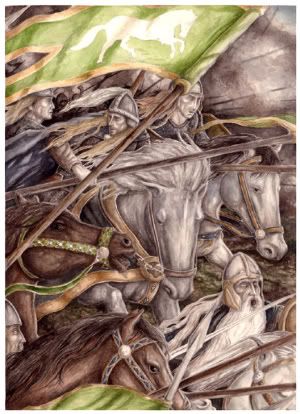
The Rohirrim, by Peter Xavier Price
Elizabeth is the TORnsib formerly known as 'erather'
|
|
|
FarFromHome
Doriath
Nov 19 2009, 8:58pm
Post #12 of 18
(1914 views)
Shortcut
|
"Loon" seems to come from the Old Norse word lômr, which means "lame one".
I really like the sound of that - it seems very Tolkien, somehow, to have a complex meaning like this, hidden inside an apparently obvious, almost childish usage such as "looney" = "lunatic" - even though that meaning has resonance too.
The French poem I linked to in response to sador's first post on this topic uses the imagery of lameness and clumsiness too, and there's also this poem with a very similar theme - Baudelaire's The Albatross:
Often our sailors, for an hour of fun,
Catch albatrosses on the after breeze
Through which these trail the ship from sun to sun
As it skims down the deep and briny seas.
Scarce have these birds been set upon the poop,
Than, awkward now, they, the sky's emperors,
Piteous and shamed, let their great white wings droop
Beside them like a pair of idle oars.
These wingèd voyagers, how gauche their gait!
Once noble, now how ludicrous to view!
One sailor bums them with his pipe, his mate
Limps, mimicking these cripples who once flew.
Poets are like these lords of sky and cloud,
Who ride the storm and mock the bow's taut strings,
Exiled on earth amid a jeering crowd,
Prisoned and palsied by their giant wings.
(Original and other translations here)
So your mention of that other clumsy bird, the loon, really hit the spot for me!
They went in, and Sam shut the door.
But even as he did so, he heard suddenly,
deep and unstilled,
the sigh and murmur of the Sea upon the shores of Middle-earth.
From the unpublished Epilogue to the Lord of the Rings
|
|
|
sador
Gondolin

Nov 20 2009, 10:08am
Post #13 of 18
(1914 views)
Shortcut
|
|
'To his Coy Mistress'? Darkstone, you're A. Marvell!
[In reply to]
|
Can't Post
|
|
And I Marvell at you, to keep it hidden and not use it... (rephrasing Faramir)
"Loon" seems to come from the Old Norse word lômr, which means "lame one". It seems to be associated with the bird. The loon’s legs are poorly situated for walking, and presents a comical image when walking on land, much like a goony bird.
There’s no doubt the speaker’s actions are “lame”, or clumsy.
And of course after Frodo returns he is "looney", lame, crippled in mind and body.
Interesting. I thought only of the lunar connection; and of course it might have a double meaning.
By the way, do you think there is any connection to the Gulf of Lhun?
Personally I’m thinking it’s Tolkien as he wrestles with trying to write the Sil. That's an insight to remember when I read your response to no. III.
“Firiel” means “fading lady”. An interesting association with ”lame”.
That's simply fascinating - in the context of king Arvedui's wife (which you skipped).
Was the name Firiel given her as a symbol of her husband's failure?
How is she connected to the choice which will come to the Dunedain (in Malbeth's prophecy)? Does this choice of hers reflect it in any way?
It’s the exhilaration of youth. Your life is full of potentialities. You can be anything, go anywhere. The world is your oyster, waiting to be opened up and savored.
Well, it will stay waiting for me...
But this raises a question I suppressed before: how does this compare to the final temptation, to which Stephen succumbs, and the end of ch. 4 of A Portrait of the Artist as a Young Man?
Why did Stephen jump (fall?), while Firiel remains firmly entrenched in the clay?
Does this reflect Joyce's and Tolkien's different attitudes towards their Church? How far were they from exchanging places?
The elderly often feel invigorated by visits from the young. At least at first.
Legolas felt the other way round - he felt young again by Fangorn.
On the other hand, Treebeard himself seems invigorated by Pippin and Merry.
I think he looks at it as Firiel’s acceptance of the Gift of Men, the noble choice of a true Numenorean. If she sailed she’d be rejecting it, which would be a bad thing.
Did Bilbo and Frodo finally reject it?
Would they have done better to die peacefully and normally?
Why are their choices so different – because of... The mode in which they were called?
Firiels’s call is more clear and consistent.
Did that make it easier to reject?
Neurotics build castles in the air, psychotics live in them, and women get stuck with the housework. Some women egg men on to building castles in the air, even if it causes them to fall. Like Hilda Wangel.
Is that another case of the old being invigorated by youth - to its loss? Rosmersholm is.
"I hear now that thou wouldst barter with me. What is thy price?" - Sauron.
|
|
|
Darkstone
Elvenhome
Nov 20 2009, 6:31pm
Post #14 of 18
(2043 views)
Shortcut
|
|
“God grant me chastity and continence. But not yet!"
[In reply to]
|
Can't Post
|
|
Da mihi castitatem et continentiam, Sed noli modo!
-Saint Augustine
In Reply To
"Loon" seems to come from the Old Norse word lômr, which means "lame one". It seems to be associated with the bird. The loon’s legs are poorly situated for walking, and presents a comical image when walking on land, much like a goony bird.
There’s no doubt the speaker’s actions are “lame”, or clumsy.
And of course after Frodo returns he is "looney", lame, crippled in mind and body.
Interesting. I thought only of the lunar connection; and of course it might have a double meaning.
By the way, do you think there is any connection to the Gulf of Lhun?
The problem is there is no “lh” in Sindarin. So “Lhun” seems to be of Khuzdul origin. It would mean “fall” or “descend swiftly”. So we have "lame", "fading", and "fall", all three words tantalizingly connected.
In Reply To
“Firiel” means “fading lady”. An interesting association with ”lame”.
That's simply fascinating - in the context of king Arvedui's wife (which you skipped).
Was the name Firiel given her as a symbol of her husband's failure?
I think it’s symbolic of Arnor’s fading into Arthedain which itself faded into the nomadic tribe of the Rangers of the North. Yet she also reunited the Sun (the blood of Anaorion) with the Moon (the blood of Isildur). When there is a conjuntion of the Sun and the Moon there is always a fading. Yet after the eclipse, the Sun returns just a bright as ever. And one is forcefully reminded that the Moon is always there, even during the day when you cannot see her.
How is she connected to the choice which will come to the Dunedain (in Malbeth's prophecy)? Does this choice of hers reflect it in any way?
Her choice is indeed “the one that seems less hopeful”.
In Reply To
It’s the exhilaration of youth. Your life is full of potentialities. You can be anything, go anywhere. The world is your oyster, waiting to be opened up and savored.
Well, it will stay waiting for me...
Whoops! Sorry. How about “Life is like a box of chocolates”? (Just avoid the Crunchy Frog.)
But this raises a question I suppressed before: how does this compare to the final temptation, to which Stephen succumbs, and the end of ch. 4 of A Portrait of the Artist as a Young Man?
Why did Stephen jump (fall?), while Firiel remains firmly entrenched in the clay?
Again, the difference between male and female.
“A girl stood before him in midstream, alone and still, gazing out to sea. She seemed like one whom magic had changed into the likeness of a strange and beautiful seabird. Her long slender bare legs were delicate as a crane's and pure save where an emerald trail of seaweed had fashioned itself as a sign upon the flesh.”
Was her name Firiel?
Does this reflect Joyce's and Tolkien's different attitudes towards their Church?
Lessee. In Ulysses Gerty MacDowell supposedly represents the Irish Catholic Church. After her interlude of passion with Bloom she is revealed to be lame.
Despite his break with the Church, Joyce’s body of work remains fundamentally Catholic in nature. (Now just where have I heard that phrase before…?)
How far were they from exchanging places?
One simply cannot possibly imagine Tolkien even conceiving of indulging in Joyce’s Augustinian hedonism. One surmises that Joyce’s questioning of religion was inspired by the pleasures of sex, while Tolkien’s religious doubts were produced by the horrors of war. I’d say that accounts for the difference of themes in their writings.
In Reply To
I think he looks at it as Firiel’s acceptance of the Gift of Men, the noble choice of a true Numenorean. If she sailed she’d be rejecting it, which would be a bad thing.
Did Bilbo and Frodo finally reject it?
Gollum did.
Would they have done better to die peacefully and normally?
Could Gollum have died peacefully and normally?
In Reply To
Why are their choices so different – because of... The mode in which they were called?
Firiels’s call is more clear and consistent.
Did that make it easier to reject?
It’s much easier to answer a question when it is put succinctly and unambiguously. That’s why such language is the bane of lawyers.
In Reply To
Neurotics build castles in the air, psychotics live in them, and women get stuck with the housework.
Some women egg men on to building castles in the air, even if it causes them to fall. Like Hilda Wangel.
Yet Lobelia was ultimately redeemed.
Is that another case of the old being invigorated by youth - to its loss? Rosmersholm is.
Both Rosmer and Rebecca cannot go on living with the knowledge of their past crimes. Is their jumping onto the mill-run the same as Bilbo and Frodo jumping onto the Grey Ship?
BTW, I’ve been reading a lot of novels from the 1920s and 1930s (such as Agatha Christie), and indeed “gone west” was a euphemism for “died”.
******************************************
That hobbit has a pleasant face,
His private life is a disgrace.
I really couldn't tell to you,
The awful things that hobbits do.
|
|
|
sador
Gondolin
Nov 22 2009, 9:47am
Post #15 of 18
(1896 views)
Shortcut
|
The problem is there is no “lh” in Sindarin. So “Lhun” seems to be of Khuzdul origin. What of the Lhammas?
And one is forcefully reminded that the Moon is always there, even during the day when you cannot see her. Unless it is Durin's Day.
Whoops! Sorry. How about “Life is like a box of chocolates”? (Just avoid the Crunchy Frog.) 
You don't know how great it is to post such an innuendo, and people actually understand you!
"But wait a bit," the Oysters cried,
"Before we have our chat;
For some of us are out of breath,
And all of us are fat!"
"No hurry!" said the Carpenter.
They thanked him much for that.
In Ulysses Gerty MacDowell supposedly represents the Irish Catholic Church. After her interlude of passion with Bloom she is revealed to be lame.
What of Rosie' O'Grady?
They went on together, Cranly repeating in strongly
stressed rhythm the end of the refrain:
And when we are married,
O, how happy we'll be
For I love sweet Rosie O'Grady
And Rosie O'Grady loves me.
"There's real poetry for you", he said. "There's real love".
He glanced sideways at Stephen with a strange smile and said:
"Do you consider that poetry? Or do you know what the words mean?"
"I want to see Rosie first", said Stephen.
"She's easy to find", Cranly said.
One simply cannot possibly imagine Tolkien even conceiving of indulging in Joyce’s Augustinian hedonism. One surmises that Joyce’s questioning of religion was inspired by the pleasures of sex, while Tolkien’s religious doubts were produced by the horrors of war. I’d say that accounts for the difference of themes in their writings. I'm with you on that.
Both Rosmer and Rebecca cannot go on living with the knowledge of their past crimes. Is their jumping onto the mill-run the same as Bilbo and Frodo jumping onto the Grey Ship?
So did Bilbo need Frodo to embark?
"I hear now that thou wouldst barter with me. What is thy price?" - Sauron.
|
|
|
Darkstone
Elvenhome
Nov 23 2009, 3:41pm
Post #16 of 18
(1902 views)
Shortcut
|
Assisted By
EARL J. LLAMA
MIKE Q. LLAMA III
SY LLAMA
MERLE Z. LLAMA IX
Directed By
40 SPECIALLY TRAINED
ECUADORIAN MOUNTAIN LLAMAS
6 VENEZUELAN RED LLAMAS
142 MEXICAN WHOOPING LLAMAS
14 NORTH CHILEAN GUANACOS
(CLOSELY RELATED TO THE LLAMA)
REG LLAMA OF BRIXTON
76000 BATTERY LLAMAS
FROM "LLAMA-FRESH" FARMS LTD. NEAR PARAGUAY
-Monty Python and the Holy Grail (1975)
In Reply To
The problem is there is no “lh” in Sindarin. So “Lhun” seems to be of Khuzdul origin.
What of the Lhammas?
“Lhammas” is Noldorin, or Gnomish (I won’t even mention Ilkorin.) Unfortunately all three languages went the way of Trotter and his shoes.
In Reply To
And one is forcefully reminded that the Moon is always there, even during the day when you cannot see her.
Unless it is Durin's Day.
The Dwarves are of course more in tune with the planets. Elves just concern themselves with the slight fuzz on the surface.
In Reply To
In Ulysses Gerty MacDowell supposedly represents the Irish Catholic Church. After her interlude of passion with Bloom she is revealed to be lame.
What of Rosie' O'Grady?
A free united Ireland. Also represented by "Wild Irish Rose", "Dark Rosaleen", or any other rosy name within reason..
In Reply To
Both Rosmer and Rebecca cannot go on living with the knowledge of their past crimes. Is their jumping onto the mill-run the same as Bilbo and Frodo jumping onto the Grey Ship?
So did Bilbo need Frodo to embark?
Absolutely. It is through Frodo that the Wise realize how truly corrupting the ring is. They dismiss Isildur as tragically ignorant, Smeagol as morally predisposed, and Bilbo as simply eccentric. But they can’t ignore the effects of the ring’s corrupting influence on Frodo. In the end the Wise rethink their assessment of Bilbo and send him off with Frodo to be healed. The same with Sam. Whether the ring corrupted him or not , the Wise send Sam off after Frodo just to be sure.
It is interesting to contemplate the possible fate of Bilbo if Frodo had perished at Mount Doom. Would Bilbo had lingered at Rivendell, fading into a hobbit banshee? Frodo saved so many people in so very many ways.
******************************************
That hobbit has a pleasant face,
His private life is a disgrace.
I really could not tell to you,
The awful things that hobbits do.
|
|
|
sador
Gondolin
Nov 23 2009, 4:29pm
Post #17 of 18
(1882 views)
Shortcut
|
|
But wouldn't Gil-galad prefer a Gnomish name to a Khuzdul one?
[In reply to]
|
Can't Post
|
|
“Lhammas” is Noldorin, or Gnomish (I won’t even mention Ilkorin.) Unfortunately all three languages went the way of Trotter and his shoes.
"forget for a while the dreadful doom of life - Luthien.
|
|
|
Darkstone
Elvenhome

Nov 25 2009, 2:08pm
Post #18 of 18
(1930 views)
Shortcut
|
|
"Gil-galad was a Gnomish king..."
[In reply to]
|
Can't Post
|
|
Doesn't quite work, does it?
******************************************
That hobbit has a pleasant face,
His private life is a disgrace.
I really could not tell to you,
The awful things that hobbits do.
|
|
|
|
|