|
|
 |


|
|
|
|
|
|
|
|
|
|
|
Elizabeth
Gondolin

Nov 6 2009, 8:45am
Post #1 of 9
(705 views)
Shortcut
|
|
** The Coming of Men … ** 5 - Relationships between Men
|
Can't Post
|
|
There are two kinds of relationships that we can look at here: relationships between Men, and relationships between Men and Elves. The latter is clearly much more complex, so we'll start by looking at the relationships between individual Men and the different Houses.
Initially, it seems that the Men of Bëor's house were pretty much in agreement: they wanted to go westward. However, their way was blocked by various things: the barriers around Doriath and the fens along the River Sirion. But the Noldor invited them to come into their lands, and so many did move into the western parts of Beleriand. Not all Men thought this was a good thing, and dissension broke out:
The leaders of discontent were Bereg of the house of Bëor, and Amlach, one of the grandsons of Marach; and they said openly: ‘We took long roads, desiring to escape the perils of Middle-earth and the dark things that dwell there; for we heard that there was Light in the West. But now we learn that the Light is beyond the Sea. Thither we cannot come where the Gods dwell in bliss. Save one; for the Lord of the Dark is here before us, and the Eldar, wise but fell, who make endless war upon him. In the North he dwells, they say; and there is the pain and death from which we fled. We will not go that way.’
1. Note that the dissension isn't between tribes or Houses, but some discontents in both of these Houses. What, then, does membership in one of these Houses mean in terms of loyalties?
To deal with this issue, a large council is called. The real disagreement is between the "Elf friends" who wish to accept the invitation of the Noldor to live in their lands, and those who argue that Men should go their own way and find their own place. In other words, it has become a racial issue. It begins to get ugly; Amlach spoke up:
‘All this is but Elvish lore, tales to beguile newcomers that are unwary. The Sea has no shore. There is no Light in the West. You have followed a foolfire of the Elves to the end of the world! Which of you has seen the least of the Gods? Who has beheld the Dark King in the North? Those who seek the dominion of Middle-earth are the Eldar. Greedy for wealth they have delved in the earth for its secrets and have stirred to wrath the things that dwell beneath it, as they have ever done and ever shall. Let the Orcs have the realm that is theirs, and we will have ours. There is room in the world, if the Eldar will let us be!’
However, shortly thereafter, Amlach stoutly denies that he was even present when this inflammatory speech was given. The assumption is that somehow the Dark Lord was responsible. The breech is not resolved, and about a thousand Men depart southward, out of our story.
2. The Men don't seem to have much in the way of government, or even any kind of structured leadership. It appears that there may have been thousands of people in this Council. How have they managed to get this far without a more structured society? Other thoughts on their government or lack thereof?
3. Was that outrageous speech really delivered by a spy of Morgoth, or is Amlach embarrassed and backpedalling?
Now the scene shifts to the Haladin, who are even less organized than the people of Bëor and Malach: they live independently, in scattered homesteads. All is well until Morgoth sends some orcs to attack them. Their lack of social order makes it hard to resist, until a leader named Haldad emerges and organizes a minimal defense. This failed, and Haldad and his son were slain. Haldad's daughter, Haleth, took charge, and assembled the survivors. Caranthir offered to take them under his protection, but Haleth would have none of it, and went their own way. In due course, we see this interesting event:
Soon however Haleth desired to move westward again; and though most of her people were against this counsel, she led them forth once more; and they went without help or guidance of the Eldar, and passing over Celon and Aros they journeyed in the perilous land between the Mountains of Terror and the Girdle of Melian. That land was even then not yet so evil as it after became, but it was no road for mortal Men to take without aid, and Haleth only brought her people through it with hardship and loss, constraining them to go forward by the strength of her will. At last they crossed over the Brithiach, and many bitterly repented of their journey; but there was now no returning. Therefore in new lands they went back to their old life as best they could; and they dwelt in free homesteads in the woods of Talath Dirnen beyond Teiglin, and some wandered far into the realm of Nargothrond. But there were many who loved the Lady Haleth and wished to go whither she would, and dwell under her rule; and these she led into the Forest of Brethil, between Teiglin and Sirion. Thither in the evil days that followed many of her scattered folk returned.
What a contrast! This folk who were so fiercely independent responded to the strong leadership of Haleth and followed her, even though they disagreed with her, for a long time. And even after many reverted to their scattered lifestyle, a contingent stuck with Haleth.
4. How was Haleth able to lead this fiercely independent people? What was her secret?
5. For those looking for a really strong woman in Tolkien's writing, we have one here. But the cost to her was personal: she never married. Your thoughts?
Next: Relationships between Men and Elves.
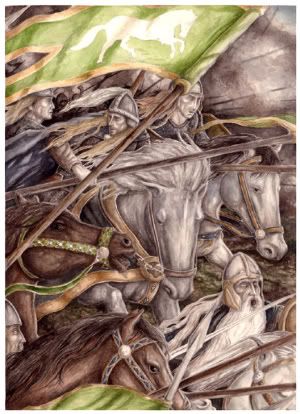
The Rohirrim, by Peter Xavier Price
Elizabeth is the TORnsib formerly known as 'erather'
|
|
|
Dreamdeer
Doriath

Nov 6 2009, 9:28pm
Post #2 of 9
(436 views)
Shortcut
|
1. Note that the dissension isn't between tribes or Houses, but some discontents in both of these Houses. What, then, does membership in one of these Houses mean in terms of loyalties?
Probably nothing more than distant kinship. Ideally everybody gets along like one big happy family because they are one big happy family. But nothing obliges everyone in a clan to agree, and sooner or later clans fission or else they get too big and unwieldy.
2. The Men don't seem to have much in the way of government, or even any kind of structured leadership. It appears that there may have been thousands of people in this Council. How have they managed to get this far without a more structured society? Other thoughts on their government or lack thereof?
Tribal groups don't really need much in the way of structure until a war breaks out. Wherever you find structured societies, you can trace backwards to one group that developed military structure first, for the sole purpose of preying on their neighbors, until they responded by developing structure so as to fight back. In the Middle East it started with the Assyrians and spread from there into Europe. In Africa it came very late with Tchaka and the Swaihilis, but some might debate that even this might have come about in response to European expansion into Africa. In Asia it took Ghengis Khan organizing scattered clans under his own Mongol clan banner. I forget the name of the central American city-state that started the ball rolling in the Americas (I think it might have begun with a "C") but their influence hadn't extended very far north, nor completely in the south. In Middle Earth it all starts with Morgoth.
This clanlike minimal organization leads me to speculate that whatever the men fled from the East, it wasn't war. This fits well with the speculation that it might have been the Fall, of Genesis.
3. Was that outrageous speech really delivered by a spy of Morgoth, or is Amlach embarrassed and backpedalling?
I think it had to have been a spy. Otherwise Amlach would have left with the other naysayers. He would not have developed a grudge against Morgoth and decided to abandon his branch of the clan in order to avenge himself. Besides, backpedaling would have made it hard to make his surprise entrance.
4. How was Haleth able to lead this fiercely independent people? What was her secret?
Charisma. If you can ever figure out how to bottle it, you'll become a billionaire. Ask Alexander the Great how he repeatedly persuaded people to do things that they thought impossible until they achieved them.
For the record, we do know a number of Alexander's advantages. 1) He really did know his stuff, and so men could rely on him to lead a battle well. He could justly boast that nobody under his leadership had ever had to suffer a wound in the back. Without this foundation, none of the tricks would have worked. 2) He had medical training, and instead of resting after battle he'd put on a medic's apron and help take care of his men, which strengthened the bonds between them. 3) He managed to memorize the name of every soldier in his enormous army, plus at least one anecdote about each, however trivial, which created an illusion of intimacy. 4) Strange as this may sound, psychologists now know that his peculiar habit of tipping his head to one side while speaking sends an "I'm cute!" signal on an instinctive level. Although it's usually women who unconsciously use this to their advantage, this might have been how he turned his shortness into an asset, especially since he grew up as the pet of his father's army.
Conclusion: In a bisexual-norm society, Alexander the Great complemented genuine knowhow with a kind of flirtation, a Platonic seduction of his army that inspired them to follow him anywhere. Therefore it isn't such a great stretch to imagine Haleth, in a hetrosexual-norm society, as using a similar complex of psychological intimacies to complement her prowess in strategy.
5. For those looking for a really strong woman in Tolkien's writing, we have one here. But the cost to her was personal: she never married. Your thoughts?
Considering that an Englishman wrote this, the chief historical model he had for a strong woman leader was Queen Elizabeth, who could not marry without losing power.
Life is beautiful and dangerous! Beware! Enjoy!
|
|
|
Dreamdeer
Doriath
Nov 6 2009, 9:37pm
Post #3 of 9
(430 views)
Shortcut
|
Regarding the historical forces that organized tribes into nations, I did have to oversimplify a lot. Some organization in China had already taken place in Asia, in response to a variety of warlords, which might have in turn inspired Ghengis Khan to do it better. Egypt actually organized in response to a famine before foreign invasion led them to organize even more. The Greeks organized in response to the Cretan/Minoan civilization as much as to the Assyrians, and then spread the influence by invading Italy and inspiring Romans to organize, who then spread this throughout Europe and Northren Africa.
But always there's the same pattern.
1) Either you stay disorganized until an outside bully forces you to pull together, or
2) Your own tribe gets the bright idea that if you organize you can prey on your neighbors.
Life is beautiful and dangerous! Beware! Enjoy!
|
|
|
Elizabeth
Gondolin
Nov 7 2009, 12:25am
Post #4 of 9
(423 views)
Shortcut
|
So, several thousand people are pulling up stakes and heading West. I would have thought that would require some sort of organization, no? As I recall, Moses had several levels of management among the Israelites.
Good point, though, about the lack of organization implying it wasn't violence (at least, attacks) they were fleeing from. Still, Bëor's words about the "darkness" behind them sounds pretty ominous. I like your theory that they fled after the Fall in Genesis, but I don't know if they were so populous until later. My pet theory is that this is part of the diaspora after the Tower of Babel fiasco.
And thanks for all the cool info about Alexander!
The Rohirrim, by Peter Xavier Price
Elizabeth is the TORnsib formerly known as 'erather'
|
|
|
Hamfast Gamgee
Dor-Lomin
Nov 7 2009, 9:21am
Post #5 of 9
(448 views)
Shortcut
|
Thanks for leading the discussion so far Elizabeth! I've often thought that Haleth is similair to Eowyn in Lotr. Both warrior women leaders after all! As far as the discussion between the Men is concerned this is a point in the Silm that often gets overlooked. While those that wanted to depart Westward where probably wrong, one can in a way understand their point of view. After all, they have never seen the Valar, as far as they are concerned the most powerful person in the world, and those of them that are Wise might realize he is getting more powerful is Morgoth so if many want to live they might well have to respect him!
And the Valar have made no effort whatsoever, not even in dreams! to recruit Men in contrast to the attitidue of Morgoth who actually seems a bit wisier in this case. This attitude to the race that will eventually dominate the world has bad far-reaching consequences for Thousands of years to come.
|
|
|
Dreamdeer
Doriath
Nov 7 2009, 3:28pm
Post #6 of 9
(420 views)
Shortcut
|
Mass migrations are notoriously chaotic. Notable exceptions are the migrations of the Huns and Mongols, organized to military precision--at which point they ceased to be migrations and became invasions.
Consider American history. Who organized the Gold Rush? Who organized the settlement of the Midwest? Sometimes individual leaders cropped up, like Daniel Boone or Davy Crockett (I always get those two mixed up!) but more often than not they had no leader, or a very informal one. As a matter of fact, mass migrations usually include a sizeable component of anarchic personalities, eager to get away from the restrictions of a more ordered life left behind.
I don't imagine these groups in thousands all marching behind one leader each. Rather, I see them as extended families, each managed by a head-of-household who in turn has individually decided to follow the overall leader--but who may change his mind at any time. No oaths of fealty or anything like that, just "Hey, they seem to know what they're doing--let's travel with them for awhile!"
Life is beautiful and dangerous! Beware! Enjoy!
|
|
|
sador
Gondolin
Nov 8 2009, 1:59pm
Post #7 of 9
(437 views)
Shortcut
|
1. Note that the dissension isn't between tribes or Houses, but some discontents in both of these Houses. What, then, does membership in one of these Houses mean in terms of loyalties?
They hearken back to previous loyalties. Or to different groups of Avari they had learned for.
I note that the Haladdin are sundered from the two other houses in their language, and that (according to the Athrabeth) the people of Beor and of Marach had different traditions regarding the Fall of Man.
2. The Men don't seem to have much in the way of government, or even any kind of structured leadership. It appears that there may have been thousands of people in this Council. How have they managed to get this far without a more structured society? Other thoughts on their government or lack thereof?
I don't see the migration as specially disorganised, and even had it been, it could be just the banding together of fugitives from violence to different clans (unlike Dreamdeer's theory). And how far did they actually get? When were the Three Houses formed? If they were recent conglomerats made of the splinters of earlier clans, they could not have had yet enough time to create a structured government, and the folkmoot would be a reasonable form of government for them.
3. Was that outrageous speech really delivered by a spy of Morgoth, or is Amlach embarrassed and backpedalling?
I tend to agree it was a spy.
Now the scene shifts to the Haladin, who are even less organized than the people of Bëor and Malach: they live independently, in scattered homesteads
4. How was Haleth able to lead this fiercely independent people? What was her secret?
Well, I am sorry The Wanderings of Hurin could not have been included in the published Sil! But I think that charisma, with the semblance of freedom and choice for any dissenters to stay behind, was enough.
5. For those looking for a really strong woman in Tolkien's writing, we have one here. But the cost to her was personal: she never married. Your thoughts?
Neither would Eowyn without her trauma. And Luthien's marriage was a freak.
"Now the world runs on swiftly to great tidings" - Melian.
|
|
|
Beren IV
Mithlond

Nov 9 2009, 3:02am
Post #8 of 9
(428 views)
Shortcut
|
1. Note that the dissension isn't between tribes or Houses, but some discontents in both of these Houses. What, then, does membership in one of these Houses mean in terms of loyalties?
Well, they're tribes - you're loyal to your family. Really, I don't think the Elves are that different - they just call their chieftains kings because it makes them sound more noble.
2. The Men don't seem to have much in the way of government, or even any kind of structured leadership. It appears that there may have been thousands of people in this Council. How have they managed to get this far without a more structured society? Other thoughts on their government or lack thereof?
Tolkien wasn't thinking of them as more than a few dozen when he wrote this, I think, on account of the more rustic, adventurous Norse eddas. If you had asked him, I am sure he would have said that the sub-chiefs held the council. Tribes have sub-chiefs.
3. Was that outrageous speech really delivered by a spy of Morgoth, or is Amlach embarrassed and backpedalling?
Considering his subsequent behavior, he had to have been an agent - if all he had done was to give the speech, he might have been only disgruntled. I wonder what Morgoth bribed him (or threatened him) with.
4. How was Haleth able to lead this fiercely independent people? What was her secret?
Any combination of talent, resolve, and, yes, charisma. You need all three.
5. For those looking for a really strong woman in Tolkien's writing, we have one here. But the cost to her was personal: she never married. Your thoughts?
Queen Elizabeth I
The paleobotanist is back!
|
|
|
Elizabeth
Gondolin
Nov 9 2009, 6:27pm
Post #9 of 9
(460 views)
Shortcut
|
2. The Men don't seem to have much in the way of government, or even any kind of structured leadership. It appears that there may have been thousands of people in this Council. How have they managed to get this far without a more structured society? Other thoughts on their government or lack thereof?
Tolkien wasn't thinking of them as more than a few dozen when he wrote this, I think, on account of the more rustic, adventurous Norse eddas. If you had asked him, I am sure he would have said that the sub-chiefs held the council. Tribes have sub-chiefs.
The text says, In this way the migration of the Edain began: at first little by little, but later in families and kindreds, they arose and left Estolad, until after some fifty years many thousands had entered the lands of the Kings.
Now, this was describing the secondary migration from Estolad into Dorthonian and other regions, but it does convey that there were significant numbers of Men in the West by the time this council occurred, and Tolkien writes, Then a council and assembly of Men was called, and great numbers came together. So I think we're meant to view this council as quite large, indeed.
The Rohirrim, by Peter Xavier Price
Elizabeth is the TORnsib formerly known as 'erather'
|
|
|
|
|