|
|
 |


|
|
|
|
|
|
|
|
|
|
|
Voronwë_the_Faithful
Doriath
Feb 6 2009, 9:08pm
Post #1 of 19
(2469 views)
Shortcut
|
|
The Tale of Aragorn and Arwen: History
|
Can't Post
|
|
[My apologies for this being so late. Our power got knocked out in a storm.]
Today I am going to take a brief look at the history of the writing of this important tale. I know that many people have not read HoME, and do not own it, so I will try to present this in a way that is easy to follow without having to consult the Peoples of Middle-earth, which traces the history of the appendices. I also know that some people think that there is no value in looking at the history of the texts, but I think there are some interesting observations to be made. So bear with me. Or not, if that is your choice.
It is particularly interesting to note that, in its earliest conception, "It was not 'a part of the tale', as it came to be called in Appendix A, and was indeed quite differently conceived." Christopher is unable to determine when it was written, but he notes "its peculiar subsequent history may indicate that it had been in existence for some time when my father was working on the narrative of the Realms in Exile described in the preceding section." More on this later.
Christopher prints the beginning part of the original manuscript, up to (but not including) Aragorn's first meeting with Arwen, to show how it differs from the final version. He says "this is sufficient to show the nature of its relation to the published text: the latter being marked by a general reduction, compression of what was retained and omission
of allusive passages, notably the story of Celebrian. But as will be seen, the reason for this was not, or was not primarily, the result of a critical view taken by my father of the telling of the tale, but of the use to which he later thought of putting it." The only missing element from the final version is the element of Aragorn being given the name Estel (originally Amin), though his ancestry was hidden from him. Interestingly, it begins with the statement "Ere the Elder Days were ended," implying that at that point Tolkien considered the Elder Days to include the Third Age.
From that point until the plighting of their troth the text is not much different from the final form. But their important words about the Shadow and the Twilight when they plight their troth were missing form the original version, and Elrond's reaction is much shorter (though basically the same). There is a then "a long passage (more than 500 words, with a part of it rejected and replaced by a new version) in which the history of the war is given in summary: telling of Mithrandir and the Halflings, the doubts of the Wise, the Ringwraiths, the Company of the Ring, and the quest of the Ringbearer; and then more expressly of Aragorn, of the Paths of the Dead, the Pelennor Fields, the battle before the Morannon, and his crowning at the gates of Minas Tirith. At the end of this the tale moves quickly to its conclusion." The original ending of the tale has very little of the power and beauty of the final version.
Tolkien then went back and expanded the portion of the Tale dealing with the War of the Rings to more then twice its length. He then expanded it even further. "It was now much less of a resume than it was at first, and its purpose in the work as a whole is clearly seen. 'It was the part of Aragorn,' my father wrote, 'as Elrond foresaw, to be the chief Captain of the West, and by his wisdom yet more than his valour to redress the past and the folly of his forefather Isildur.'"
Then comes what I consider to be perhaps the most interesting and important part of the history of this text:
At the end of this account of Aragorn's commanding significance in the War of the Ring, the revised ending of the story in the typescript B concludes with his farewell to Arwen at his death almost exactly as it stands in Appendix A. The original manuscript pages in which my father first set down this inspired passage are preserved. He wrote them so fast that without the later text scarcely a word would be interpretable.
Inspired, indeed!
The text at this point ended with the words "'Here endeth the Tale, and with the passing of the Evenstar all is said of the Elder Days.'" Christopher notes that it was unclear what his father intended to do with this Tale at this point. It contained all of the elements of the final form, except for Aragorn and Gilraen's parting, and much more, including Celebrian's story, and the much, much longer story of Aragorn's part in the War of the Ring. Christopher notes that his father had taken great pains with that part of the story (Aragorn's part in the War) and that at this point it appeared to be a completed text. Christopher speculates "Can it have been his intention that it should stand as the final element of The Lord of the Rings?"
I wish that it had been so!
Things get tricky after this. Christopher notes that when his father was drafting the history of the Northern Kingdom that was discussed last week, his father experimented with inserting this text there, following the account of the hobbits visiting King Elessar when he came to the north. As Christopher says, it enters on the typescript page with extraordinary abruptness (even allowing for the device of supposed extracts from written sources to account for such transitions). The words "Arador was the grandfather of the King.... " literally come right after the statement that Samwise the Mayor and Thain Peregrine had been there (meaning Fornost) many times, with no transition at all.
It seems clear (as Christopher acknowledges) that Tolkien was not sure what to do with this text. But it was here "that the abbreviation and compression and stylistic 'reduction' that distinguishes the final form of Aragorn and Arwen from the original version first entered." It was here that the portion describing Aragorn's role in the War of the Rings was reduced to just a few lines, presumably because it would not have been appropriate to have the long (but very interesting) description in that context. It appears that it remained in that place until close to the very final form. In fact, Christopher notes that on the final typescript of the Tale, "the page on which it begins still carries at the top the words 'Master Samwise the Mayor and Thain Peregrin have been there many times', struck out and replaced by 'Here follows a part of the Tale of Aragorn and Arwen'. 'A part', presumably, because so much had gone."
So there is the answer to my original question of why it is called "part" of the Tale. It is because it really is "part" of the Tale as Tolkien originally wrote it.
The only major final change that was made to this last typescript (besides changing "Amin" to "Estel" at all points), was the insertion of the story of Gilraen's departure death, and the linnod that we have already discussed. Isn't interesting that this was the last element to enter the story?
Finally, the idea that this was taken from a longer tale written by Barahir, grandson of Faramir, did not enter into the equation until the second edition, when the "Note on the Shire Records" was added to the Prologue. It seems clear to me now that the statement that it was an abbreviated version of those parts of the Tale that lie outside the account of the War of the Ring is a direct reference to the history of Tolkien's own work on the Tale!
'But very bright were the stars upon the margin of the world, when at times the clouds about the West were drawn aside.'
|
|
|
N.E. Brigand
Gondolin

Feb 6 2009, 10:32pm
Post #2 of 19
(2125 views)
Shortcut
|
|
"Elder Days" can refer to the Third Age even in LOTR.
[In reply to]
|
Can't Post
|
|
Interestingly, it begins with the statement "Ere the Elder Days were ended," implying that at that point Tolkien considered the Elder Days to include the Third Age.
The introduction to Appendix B includes this line: "In the Fourth Age the earlier ages were often called the Elder Days; but that name was properly given only to the days before the casting out of Morgoth." I guess Barahir, or his prototype in Tolkien's mind, was using lax Fourth Age terminology.
Thanks for that fascinating history of the tale. I've never done more than skimmed the drafts of the LotR appendices in The Peoples of Middle-earth.
<><><><><><><><><><><><><><><><><><><><>
We're discussing The Lord of the Rings in the Reading Room, Oct. 15, 2007 - Mar. 22, 2009!
Join us Feb. 2-8 for The Tale of Aragorn and Arwen.
+=+=+=+=+=+=+=+=+=+=+=+=+=+=+=+=+=+=+=+=
How to find old Reading Room discussions.
|
|
|
Voronwë_the_Faithful
Doriath
Feb 6 2009, 10:36pm
Post #3 of 19
(2092 views)
Shortcut
|
|
I knew without a shadow of a doubt that you were going to call me on that :-) //
[In reply to]
|
Can't Post
|
|
'But very bright were the stars upon the margin of the world, when at times the clouds about the West were drawn aside.'
|
|
|
squire
Gondolin

Feb 6 2009, 10:56pm
Post #4 of 19
(2107 views)
Shortcut
|
As you observed, Tolkien very very often took his own internal history of mythologizing, and adapted it to story terms. Thus the philological or alphabetical qualities of the "ancestral" Elvish languages to Quenya or Sindarin turn out to be a record of Tolkien's actual early experiments in Elvish language-making. The earlier attempts are, after all, the "ancestors" of the later, developed languages!
Likewise, The Hobbit (1938) is ostensibly Bilbo's memoir of his adventure with the dwarves, while LotR (1954, with its different take on the meaning of Bilbo's adventure) is said to be a later emendation of Bilbo's book, by his descendants.
The Silmarillion as a whole, although not published until 1977, was largely written long before The Hobbit or LotR. It records the legends of the Elder Days in a less accessible Elvish "high style", which does in fact reflect Tolkien's earlier and stylistically more formal essays in legend-creation. By the 1950s, those dusty notebooks from the 1910s or 1930s must indeed have seemed to Tolkien like "ancient" records: confused, much written-over, and difficult to reconcile with later histories.

squire online:
RR Discussions: The Valaquenta, A Shortcut to Mushrooms, and Of Herbs and Stewed Rabbit
Lights! Action! Discuss on the Movie board!: 'A Journey in the Dark'. and 'Designing The Two Towers'.
Footeramas: The 3rd TORn Reading Room LotR Discussion; and "Tolkien would have LOVED it!"
squiretalk introduces the J.R.R. Tolkien Encyclopedia: A Reader's Diary
|
|
|
Elizabeth
Gondolin

Feb 7 2009, 3:14am
Post #5 of 19
(2111 views)
Shortcut
|
|
Where is this wonderful stuff?
[In reply to]
|
Can't Post
|
|
Is any of this fascinating deleted material published anywhere (e.g. Peoples of ME)? Have you seen it? Have any of you who attend the scholarly gatherings hears papers on it?
There must be millions of fans who would pay well to see this extra history. And what do you suppose Jackson and del Toro would give to get rights to it?
Despite Tolkien's urgent wish to keep LotR hobbit-centric, Aragorn does emerge as such a classical romantic hero that more on him would sail instantly to the top of whatever charts apply.
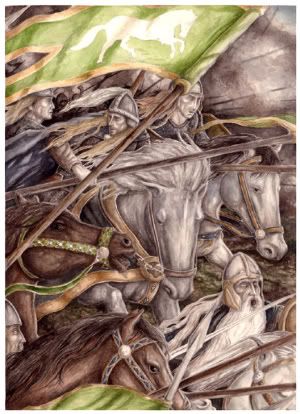
The Rohirrim, by Peter Xavier Price
Elizabeth is the TORnsib formerly known as 'erather'
|
|
|
simplyaven
Hithlum

Feb 7 2009, 3:35am
Post #6 of 19
(2100 views)
Shortcut
|
This is great! I haven't read HoME nor do I own it, so thank you for posting all this. Is it part of HoME?
It was bery interesting to read all this. I do regret that Tolkien didn't leave the longer tale and also that this tale didn't become part of the books although I think it stands out now, doesn't it? Or may be a "final element" doesn't mean part of the books but finishing strike of the brush and still an Appendix? Is it said what the final element would be?
It's indeed very interesting that Gilraen's part was added later and was not part of the first draft. I've always thought the linnod very significant and foreshadowing...
Culinary journey through Middle Earth continues! Join us on January 30 on the Main board for a visit at the "Prancing pony"!
I believe
|
|
|
Dreamdeer
Doriath

Feb 7 2009, 3:38am
Post #7 of 19
(2104 views)
Shortcut
|
What additional material do these notes offer about Celebrian?
Life is beautiful and dangerous! Beware! Enjoy!
|
|
|
N.E. Brigand
Gondolin
Feb 7 2009, 4:57am
Post #8 of 19
(2103 views)
Shortcut
|
|
Yes, "The Peoples of Middle-earth", pp. 262-270.
[In reply to]
|
Can't Post
|
|
To his credit, Voronwë has made the most of this section, which I found less compelling, on reading it this evening, than I expected to based on his description -- although V has quoted relatively little text, what's in the book is almost entirely matched in interest by his paraphrasing. There's no new story to speak of, just restatement of familiar events. It reminds me of "Of the Rings of Power" from The Silmarillion, but in rougher form.
<><><><><><><><><><><><><><><><><><><><>
We're discussing The Lord of the Rings in the Reading Room, Oct. 15, 2007 - Mar. 22, 2009!
Join us Feb. 2-8 for The Tale of Aragorn and Arwen.
+=+=+=+=+=+=+=+=+=+=+=+=+=+=+=+=+=+=+=+=
How to find old Reading Room discussions.
|
|
|
ElanorTX
Dor-Lomin

Feb 7 2009, 6:27am
Post #9 of 19
(2111 views)
Shortcut
|
Elrond Half-Elven waited a long time to marry, until early in the Third Age (originally in 2300 TA, final text 109 TA) Celebrian was of the line of Finarfin and through her maternal grandmother Earwen from Olwe. Their twin sons and daughter are thus three-fourths elven blood. In 2509 TA, Celebrian was going east over the mountains to visit Galadriel. In an earlier draft she was killed by Orcs. In later drafts she was waylaid in Caradras and received a poisoned wound. Her husband and sons rescued her, and she was brought home to Rivendell and healed in body, but "she lay under a great cloud of fear and loved Middle-earth no longer; so at the last Elrond granted her prayer". She departed from the Grey Havens.into the West never to return.
No wonder Arwen could empathasize with Frodo's situation.
"I shall not wholly fail if anything can still grow fair in days to come."
|
|
|
Dreamdeer
Doriath
Feb 7 2009, 7:42am
Post #10 of 19
(2090 views)
Shortcut
|
The part about fear was new to me. So it wasn't just poison, it was also PTSD.
Tolkien wrote with courage. Most writers of his day did not deal so frankly with mental illness, except as a consequence or manifestation of immoral conduct or depravity, or as a sign of weakness or inferiority. But Tolkien was not afraid to show heroes and heroines going mad. I think it was a consequence of watching a son of his own wrestle with PTSD, as a form of war-wound, a consequence of going out and doing his duty.
Life is beautiful and dangerous! Beware! Enjoy!
|
|
|
Voronwë_the_Faithful
Doriath
Feb 7 2009, 7:46am
Post #11 of 19
(2112 views)
Shortcut
|
Christopher didn't elect to publish the full manuscripts, just a few samples from the drafts.
I would really like to see the full text of the version CT says his father considered finished, before reducing it to try to fit it in the Northern Kingdom narrative.
'But very bright were the stars upon the margin of the world, when at times the clouds about the West were drawn aside.'
|
|
|
squire
Gondolin
Feb 7 2009, 3:16pm
Post #12 of 19
(2108 views)
Shortcut
|
|
Also, it wasn't called PTSD back then
[In reply to]
|
Can't Post
|
|
Tolkien knew it as shell shock, its name from the Great War era, where he must have witnessed many cases in the Army and perhaps among his civilian acquaintances - it wasn't rare. (It didn't originate with WW I either: Oliver Wendell Holmes, among others, documents the mental breakdowns suffered in the Union Army during the Wilderness campaign.) Tolkien was hardly the only writer or artist to refuse to attribute shell shock to moral failure or weakness in the years during or following the War. The people who did that were more likely those who could not or would not experience or sympathize with the realities of the Western Front: generals, businessmen, gentle folk or workingmen still trapped in a Victorian fantasy land of martial glory.
In fact, it was the Great War, with its millions of casualties and its endless combat, that really began to open most people's eyes to the limits of moral fibre. Armies were forced to understand that over time combat itself destroys the mind whether the body survives or not, once they had to deal with mass manifestations of dysfunction over time that far transcended any concepts of individual weakness, inferiority, or "depravity".
I wouldn't assert that Tolkien was showing much courage as a writer here. It seems to me that he is merely up to date, incorporating the most modern 20th century concepts of pyschological distress and despair into his mythology. Celebrian's "poisoned" wound is clearly linked to the wound Frodo receives at Weathertop - it is not primarily physical but mental. The state of fear and disorientation that Frodo undergoes as he is drawn into the wraith world until Elrond heals him is repeated many times in LotR, and is also referred to as the Black Breath.
It is characteristic of Tolkien that he takes the eternal human struggle between life and death, hope and despair, good and evil, and writes fairy tales about it that include examples in action and feeling from his own generation's experience of modern war, totalitarianism, and industrial regimentation. Other writers and artists responded to the Great War, and its almost characteristic cases of shell shock, with satire, cynicism, radicalism, or similar forms of unconventionality.
squire online:
RR Discussions: The Valaquenta, A Shortcut to Mushrooms, and Of Herbs and Stewed Rabbit
Lights! Action! Discuss on the Movie board!: 'A Journey in the Dark'. and 'Designing The Two Towers'.
Footeramas: The 3rd TORn Reading Room LotR Discussion; and "Tolkien would have LOVED it!"
squiretalk introduces the J.R.R. Tolkien Encyclopedia: A Reader's Diary
|
|
|
Dreamdeer
Doriath
Feb 7 2009, 6:18pm
Post #13 of 19
(2104 views)
Shortcut
|
To this day people still have a hard time grasping that mental illness doesn't mean you're bad. Almost all depictions of mental illness on TV show evil, dangerous people, mostly in cop shows. (Kudos to "Lost" for bucking the general trend, by depicting a much-beloved character as mentally ill, wrestling with hallucinations and compulsions but still a genuinely nice guy. Yet even Hurley suffers from being mistaken for a homicidal maniac, just because he has the misfortune to be seen standing over a dead body with a large ketchup stain on his shirt.) And the condition is still sufficiently stigmatized that when a friend of mine recently had to go into a mental hospital, she had to ask me to tell no one where she was, and her doctors helped her to concoct lies about her absence, so as not to hurt her relationships, her tenant-status, or her ability to earn a living. People will talk freely about gall-bladder operations, arthritis, cancer, you name it, but not mental illness. No one thinks twice about a TORnsib reporting, "I'm going through a bowel-prep for some intestinal tests," but what would be the reaction be if someone wrote, "I'm going in for a psychiatric evaluation."? And what would happen to that person's job prospects if an interviewer happened to Google her name and discovered something like that?
Life is beautiful and dangerous! Beware! Enjoy!
|
|
|
Elizabeth
Gondolin
Feb 7 2009, 9:35pm
Post #14 of 19
(2077 views)
Shortcut
|
Christopher was so thorough about many things, including (for example) the whole ~30pp draft of The Return of the Shadow. Even in the early-1990's when he was working on this he must surely have known how much interest there would have been in more Aragorn material.
The Rohirrim, by Peter Xavier Price
Elizabeth is the TORnsib formerly known as 'erather'
|
|
|
Voronwë_the_Faithful
Doriath
Feb 7 2009, 10:31pm
Post #15 of 19
(2099 views)
Shortcut
|
PoMe is fairly long book, and he had a lot of different things to cover it it, so I guess Christopher felt he needed to pick and choose what to print in full. There is a LOT of drafts of appendical material that he could have printed, and I guess he felt that it was better to give a few samples of different material. Personally, I think it would have been better to have covered this section in more depth, given its importance. But as I have often said regarding Christopher's work, hindsight is 20/20, and I still believe that no one else could have accomplished close to what he has in presenting the scope of his father's work.
(If it seems like I feel more and more of the need to emphasize that point the close it comes to the release of Arda Reconstructed, I won't deny it.)
'But very bright were the stars upon the margin of the world, when at times the clouds about the West were drawn aside.'
|
|
|
N.E. Brigand
Gondolin
Feb 8 2009, 1:35am
Post #16 of 19
(2069 views)
Shortcut
|
I think you mean "The New Shadow", the eight-page scrap of a sequel to The Lord of the Rings that Christopher Tolkien published in The Peoples of Middle-earth, and not The Return of the Shadow, which is the first of the "History of Middle-earth" volumes to examine the drafts of LotR itself. I can understand why CT would choose to print a previously unseen story in entirety but only publish samples of the drafts that led to a known work like LotR. CT's treatment of the appendices is in keeping with his work on the main text, where he regularly skips lots of fine details. For instance, as I've noted before, he never shows when his father changed "boom" to "doom" as the sounds of the drums in Moria.
<><><><><><><><><><><><><><><><><><><><>
We're discussing The Lord of the Rings in the Reading Room, Oct. 15, 2007 - Mar. 22, 2009!
Join us Feb. 2-8 for The Tale of Aragorn and Arwen.
+=+=+=+=+=+=+=+=+=+=+=+=+=+=+=+=+=+=+=+=
How to find old Reading Room discussions.
|
|
|
Elizabeth
Gondolin
Feb 8 2009, 3:44am
Post #17 of 19
(2091 views)
Shortcut
|
Yes, I meant "The New Shadow".
I wouldn't classify 500 words on Aragorn's adventures to be a "fine detail", though. A lot of unseen stuff there.
The Rohirrim, by Peter Xavier Price
Elizabeth is the TORnsib formerly known as 'erather'
|
|
|
Voronwë_the_Faithful
Doriath
Feb 8 2009, 5:10am
Post #18 of 19
(2096 views)
Shortcut
|
|
It's actually a lot more than 500 words!
[In reply to]
|
Can't Post
|
|
Christopher says that the first draft had 500 words on Aragorn's role in the War of the Ring. He says that his father then struck that out and extended it to nearly twice its original length. And then he rewrote it again and even greater length, and attached a rider to it. In fact, the portion of the final long text about Aragorn's role in the War of the Ring that he does print itself is 609 words, and that is probably less than half of that part of the manuscript.
As for "The New Shadow," I make mistakes like that all the time. 
'But very bright were the stars upon the margin of the world, when at times the clouds about the West were drawn aside.'
|
|
|
Gollum2008
Lindon
Feb 10 2009, 3:10am
Post #19 of 19
(2092 views)
Shortcut
|
|
Arador, the Grandfather of the King
[In reply to]
|
Can't Post
|
|
The king at the time was Elssar or Elro.
|
|
|
|
|